writing


I just heard from Beacon Hill, and they did not accept my book proposal, Spiritual Direction 101. Bonnie said they liked how I started in a conversational tone with personal experience, but then I would go into teacher/academic mode, and it wasn’t consistent. I need to be able to have a consistent voice throughout that engages the reader. I’m having this same problem with the Career Women of the Bible book proposal. Right now it has conversational/academic schizophrenia. I haven’t figured out how to have good scholarship in a conversational tone, and I really want to learn how. She offered to send me specifics of what the committee said, and I said yes! Hopefully, I’ll get some ideas on how to tone down the academia while retaining the scholarship in a conversational, reader friendly tone. I didn’t think it would be so hard! But I will keep trying. I think what I have to say is very important and needs to get out there, so I will continue to learn and write and rewrite and rewrite and rewrite…. I may need to re-read Anne Lamott’s Bird by Bird.

Sphere: Related Content

I have been thinking a lot about nurturing recently. Part of it has to due with the clinical depression, but not all of it. Earlier this year I went through The Artist’s Way: A Spiritual Path to Higher Creativity. Every week it was stressed how important it was, not only to take care of ourselves, but to nurture ourselves–especially our inner artist. The child in us who loves to draw, color, paint, write and not be told what to do. It is also because of the command to love our neighbors as ourselves. We cannot love anyone else if we do not love ourselves. Sally’s Friday Five, Extravagant Unbusyness also brought this up. How do we take care ourselves? How do we treat ourselves?

Several of you wanted me to write poetry and post it this week. I’m sorry to say that I didn’t write any poetry (but it’s still a goal). But I did do two things on my list:: I took a long hot bath, and I started reading The Golden Compass. In fact, I got a good ways into The Golden Compass last night. The characters are great. I also like Pullman’s writing. He’s a wonderful storyteller. I think Wicked was the last novel I read, and that has to be at least three months ago. I need to take the time to read fiction. I love it. I get so caught up in the books I’m reading for my writing projects and launching the church, that I’m not reading something just to read it and have fun. I enjoy what I read for work, but it’s that: work. All reading cannot be for work. The same with writing poetry. Not all writing can be for work. Some of it has to be fun and just because. So yes, I intend to keep that one way of nurturing myself: writing a poem, just because.

My wonderings (and wanderings) about nurturing myself have clicked with the observance of the Sabbath. This idea that we need a day off to rest, to worship, and to recoup. A day where it’s okay to stop and take care of ourselves. I wonder if we kept a Sabbath, if taking care of ourselves and nurturing ourselves would be so hard. Because it would be ingrained in us to stop, to worship, to rest, to relax, and to have fun one day a week instead of being on a merry-go-round of always having to do something. And I’m not talking about a strict do nothing observance of days past where one did nothing except go to church and then sit for the rest of the day.

In her book, Keeping the Sabbath Wholly, Marva Dawn says that not all activity has to cease. Just work: what we do to feel productive, make money, pretend to give meaning to our lives. The work we cease from doing is the work we do to live. The Sabbath is a day to trust God: to trust God to take care of our needs without us doing anything. The activities we can do on the Sabbath are those we enjoy doing and may be don’t do because we see them as frivolous: taking a walk through the park, playing in the park, gardening, sewing, crocheting, taking a nap and getting some well-deserved rest, or may be writing poems and reading a novel. It’s doing things that free us from the mentality that we are what we do and how much we produce.

It’s also a time to leave behind the world’s way of relating to each other in using people for what we can get or for what they can do for us. It’s a time to receive God’s unconditional love, knowing there is nothing we can do to earn it. It is a time of learning to give and receive that unconditional love from each other. It is a time of love and give as God loves and gives. It’s a day of feasting and celebration. It’s a day of worshiping God together and being the people of God without worrying about anything apart from communion with God and communion with one another.

The Sabbath makes it okay to stop. To stop and take care of ourselves. To stop and love and rejoice with other people. To stop and focus on God and his love. I think if we took the Sabbath seriously, we would not have such a hard time taking care of ourselves and nurturing ourselves. I think if we practiced the Sabbath we would not feel guilty of nurturing ourselves because God himself rested after creation on the Sabbath. Right after he created human beings in his image, he rested. We are made in God’s image, and we are made to rest on the Sabbath. Part of being made in the image of God is a day of rest, worship, nurture, and feasting and fun.

I’m beginning to think about this as I will begin to pastor and “work” on Sunday again. Marva published a book last year that I need to read: The Sense of the Call: A Sabbath Way of Life for Those Who Serve God, the Church, and the World. I need to get it because it is so hard to observe a Sabbath when you’re a pastor. I remember that. It’s doubly hard when you’re bivocational. I remember the burnout from that. I’m hoping I get a sense of how to keep the Sabbath while pastoring from Marva’s new book.

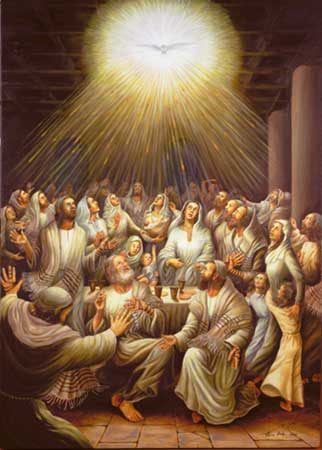
The picture is “The Risen Lord” by He Qi.

Sphere: Related Content

On beginning a ministry in the Loop area, I met with a college student who goes to our church. T and I sat down and brainstormed ideas for the college ministry we would like to start. I am going to be contacting Roosevelt University about reserving a room and how we put up flyers to advertise the group. Our tentative start date is October 20. We have decided to focus on homelessness since that is a big issue here and the prophets and Jesus has plenty to say about taking care of the poor and oppressed. I will also be contacting ministries like Pacific Mission Garden to found out about volunteer opportunities for the group.I am also going to start going to different services in this area and setting up times to talk with pastors. I want to see how they are ministering to the people here. I also want to know what they think the felt needs of the area are. I’m also hoping to learn some of the history of the area as well. I will be going to an Eucharist Service at Grace Episcopal Church tomorrow at noon. Sunday I will be attending Willow Creek’s satellite church that meets at Roosevelt’s Auditorium Theater.

The next step I plan on taking is starting a Bible Study that will meet at one of the coffee houses in the area. I will put up flyers at the coffee shops, in my building, and any other community bulletin board I can find. I want to gear the Bible study to what would interest people who live here, which is why I want to know what pastors think people need and are looking for in this area.

On the writing front, I am writing an article for Credo, the Nazarene magazine for teens. If it goes well, I might writing regularly for them. First I have to see if I can actually write the age group. And they gave me a whopper of a topic: A Christian Response to Global Violence. Work on the Career Women of the Bible book proposal has kind of come to a stop with everything going on. I am hoping to get back on track with that later this week.

Sphere: Related Content

Because my in-laws were here, I missed that Madeline L’Engle had passed away. Oh my. I first heard A Wrinkle in Time read aloud by my teacher in the third grade. As she read the classroom disappeared, and the world of Meg, Charles Wallace, and Calvin became more real than the desk I sat at. When I found out there were more books, I went to the school library, checked out, and promptly read A Wind in the Door and A Swiflty Tilting Planet (Many Waters would not appear until my sophmore or junior year of high school).

After 4 1/2 years of college and 4 years of seminary with nearly no fiction reading through that time, I went back to Madeline to recapture the wonder, whimsy, and sheer imagination that has always been inside me, but was buried for far too long. Madeline, C. S Lewis, J. R. R. Tolkein, and J. K. Rowling helped me remember that imagination and wonder were vital to the soul. No wonder my soul had dried up in my years of academia where everything was explored, explained, and parsed. No wonder, my mystery, no imagination. Theological education needs an overhaul. Not that I didn’t receive a good education–I did. But inspirational and imaginative, it was not. I remember that before all my education, I learned most of my theology in novels. I have returned to that practice. In fact, Madeline said it best: “Faith is best expressed in story.” Amen Madeline. May your faith, imagination, and introspection light up heaven as it has lit up earth. Rest in peace.

Here is Madeline’s obituary from the AP with a very big and grateful hat tip to Kathleen Falsani for posting this on her blog (I also swiped the picture from her).

HARTFORD, Conn. — Author Madeleine L’Engle, whose novel ”A Wrinkle in Time” has captivated generations of schoolchildren and adults since the 1960s, has died, her publicist said Friday. She was 88.

L’Engle died Thursday at a nursing home in Litchfield, said Jennifer Doerr, publicity manager for publisher Farrar, Straus and Giroux.

The Newbery Medal winner wrote more than 60 books, including fantasies, poetry and memoirs, often highlighting spiritual themes and her Christian faith.

For many years, she was the writer in residence and librarian at the Episcopal Cathedral Church of St. John the Divine in New York City.

Although L’Engle was often labeled a children’s author, she disliked that classification. In a 1993 Associated Press interview, she said she did not write down to children.

”In my dreams, I never have an age,” she said. ”I never write for any age group in mind. … When you underestimate your audience, you’re cutting yourself off from your best work.”

”A Wrinkle in Time” — which L’Engle said was rejected repeatedly before it found a publisher in 1962 — won the American Library Association’s 1963 Newbery Medal for best American children’s book. Her ”A Ring of Endless Light” was a Newbery Honor Book, or medal runner-up, in 1981.

In 2004, President Bush awarded her a National Humanities Medal.

Keith Call, special collections assistant at Wheaton College in Illinois, which has a collection of L’Engle’s papers, said he considers her the female counterpart of science fiction author Ray Bradbury because people loved her personally as much as they loved her books.

”She was tremendously important initially as a children’s book author, and then as she wrote meditative Christian essays, that sort of expanded her audience,” he said. ”She spoke exactly the way she wrote, very elegant, no nonsense, crisp, and deeply spiritual.”

”Wrinkle” tells the story of adolescent Meg Murry, her genius little brother Charles Wallace, and their battle against evil as they search across the universe for their missing father, a scientist.

The brother and sister, helped by a young neighbor, Calvin, and some supernatural spirits, must pass through a time travel corridor (the ”wrinkle in time”) and overcome the ruling powers on a planet with a totalitarian government reminiscent of George Orwell’s ”1984.”

”A Wrinkle in Time” exposes readers to the words of great thinkers, as its characters quote Shakespeare, the Bible, Euripides, Dante and others.

L’Engle followed it up with further adventures of the Murry children, including ”A Wind in the Door,” 1973; ”A Swiftly Tilting Planet,” 1978, which won an American Book Award; and ”Many Waters,” 1986.

”A Ring of Endless Light,” 1980, is part of another L’Engle series, the Austin family books. In all, there were nine Austin books from 1960 to 1999, and eight Murry books from 1962 to 1989, many featuring a grown-up, married Meg and Calvin and their children.

Among L’Engle’s memoirs are ”The Summer of the Great-Grandmother” in 1974, about life at the family home in Connecticut. The great-grandmother is L’Engle’s own mother; the story deals with L’Engle’s memories and emotions as her mother dies at age 90.

After Harry Potter mania swept the world of children’s literature, ”A Wrinkle in Time” was often cited as a precursor or, for frantic Potter fans, something to read while waiting for their hero’s next installment.

L’Engle told Newsweek in 2006 that she had read one Potter book and, ”It’s a nice story but there’s nothing underneath it. I don’t want to be bothered with stuff where there’s nothing underneath.”

Born Madeleine L’Engle Camp in 1918, L’Engle graduated from Smith College in 1941 and worked as an actress in New York City. There, she met her future husband, Hugh Franklin, an accomplished stage actor who became known later for his portrayal of Dr. Charles Tyler on the soap opera ”All My Children.”

In 1945, her first book, ”The Small Rain,” was published; she and Franklin married the following year. They moved to Connecticut in 1951 and for several years, the couple ran a general store to make ends meet.

They had a son, Bion, and two daughters, Josephine and Maria. The couple had adopted Maria after her parents, who were friends of theirs, died.

The family later moved back to New York; Franklin died of cancer in 1986. Her son died in 1999 at age 47.

Sphere: Related Content

I was awake at two in the morning writing. Ideas and thoughts kept twirling through my head, so I finally got up and wrote, and wrote, and wrote. It was great. Here is some journaling I did on writing. I started writing at 2:55 a.m.

I have just written something that I know is good. It is good and it is right on. It feels so good. Especially after being sick for three days. It feels good to have it flow and just come. It kept twirling around and around in my head, so I finally got up and wrote it: the rough draft of my introduction to Career Women of the Bible! And it work–it just works! Yes, there will be editing, and I’m sure I’ll be adding to it, but it works. Writers don’t get these inspired highs much, or at least I don’t. May be I need to write more at 2:00 in the morning. It really is amazing. When ideas are swirling in my head after I go to bed, I can always get up, work on it, then sleep until 10:00 or 11:00 and get up and work in the afternoon. I remember writing my thesis: a lot of that happened between 10:00 p.m.–2:00 a.m. Then I had to be at work 7:30 a.m. Yes, I was a zombie during the day. My creative juices do flow in the wee hours, so may be I just need to go with it. Put in four to five hours in the afternoon and another two to three in the wee hours and see what happens.

Of course that’s going to royally screw me up on Sunday when I need to get up early for Sunday School and church. To be to Sunday School by 9:30, I have to leave home at 8:30. Why you ask? Because that’s the closest Church of the Nazarene. That’s one of the many reasons I want to plant a church in the area. Oh well, I’ll deal. There’s always Tylenol PM until I have a ministry going closer to home.

I really do like writing at this time. It’s quiet. There’s a misty, mysterious fog over the lake and the lamps have that otherworldly glow to them. Yes, this is my time. May be it’s time to accept that and go with it.

Not to mention it’s very cool to be working in bed next to my sleeping husband who is so cool with his quirky wife and my quirky hours. He woke up a few minutes ago: “You’re working?” “Oh yeah, babe the creative juices are flowing,” and I then proceeding to tell the poor man I had the introduction to my next book. Then he went back to sleep. I like glancing over and watching him sleep and feeling his foot up against mine, his hand reaching out to touch me. How’d I get so lucky? I married a man who supports me in both of my callings: writing and pastoring, and he’s fine with the weird hours I tend to keep due to insomnia. May be it’s not insomnia after all. May be I’m awake at this time because I’m supposed to be up writing and creating. For so long I’ve thought I need to keep “business” hours. But why? I am self-employed. And I should work when I am at my best. If that happens to be at two in the morning, so be it! I normally don’t get much done in the morning anyway: I might as well sleep late. I get much more done in the afternoon and late at night.

This gets me thinking about planting a ministry later on Sunday or Saturday night for people who can’t do the traditional Sunday church thing. There’s an idea. I may have to think and pray on that for awhile and see what happens. Even moving Sunday School after the service with the service starting at 11:00 a.m. would be better than Sunday School at 9:30 or 10:00 a.m. The other option would be having “Sunday” School/small groups and a worship service on Saturday. I’m definitely going to need to keep those options in mind.

I’m right where I’m supposed to be, doing what I’m supposed to do, and it’s a good feeling. Even if it is 3:11 in the morning! Now that this done and my creativity is starting to wind down, I will be able to sleep. And I did some good work tonight. That’s something to sleep too.

Related Links:
Career Women of the Bible: Introduction

Updated: Potential “Career Women of the Bible” Outline

Sphere: Related Content

Here is the very beginning of my potential outline for the Career Women of the Bible book proposal.

1. Introduction

2. In the Beginning
Does It Really Mean “Helpmate”?

The Fall and Women

2. Ministers
The 12th Century, B.C.E. Woman: Deborah

Standing Between Life and Death: Miriam

Standing Between Life and Death: Zipporah and Huldah

The Apostle to the Apostles: Mary Magdalene

Apostles and Prophets

Teachers, Elders, and Coworkers

3. Mothers and More
Sarah
Hagar
Rebekah
Rachel and Leah
Hannah

4. Just a Housewife?
Standing Between God and the People: Jael

Abigail
The Proverbs 31 Woman
Sisters in Service: Mary and Martha

The Samaritan Woman

5. Off to Work
Rahab
Ruth
Esther
Priscilla and Lydia

The women who don’t have links, I have not written on yet. I also realize the articles I have written need a lot of rewriting. For those who just found the site, Career Women of the Bible started out as my thesis in seminary. I’ve started to rewrite it, but it still is very scholary and has some ways to go before it has the narrative and story-like quality that I want the finished book to have.

This is just a start, but I think it is a good one. Any advice or opinions? Who did I leave out? Why do you think they should be included? Please let me know. Thanks.

Sphere: Related Content

After my 30-page week, I wrote 18 pages last week on my novel. Not as many, but I introduced a new character and had to develop her. I also had to remember something I read in Julia Cameron’s The Artist’s Way:

Growth is an erratic movement: two steps forward, one step back. . . . You are capable of great things on Tuesday, but on Wednesday you may slide back. This is normal. Growth occurs in spurts. You will lie dormant sometimes. . . . Very often, a week of insights will be followed by a week of sluggishness.

At times like this Cameron says that we need to be kind to ourselves. She says one of the biggest mistakes artists of any stripe make is that we are too hard on ourselves. We are never going to get anywhere if all we are going to do is beat ourselves up. Our inner artist does not like that and hides. Well wouldn’t you, if someone beat up on you all the time? I am on week nine now and something she said really struck me:

Enthusisam (from the Greek “filled with God”) is an ongoing energy supply tapped nto the flow of life itself. Enthusiasm is grounded in play, not work. Far from being a brain-numbed soldier, our artist is actually our child within, our inner playmate. As with all play mates, it is joy, not duty, that makes for a lasting bond.

True our artist may rise at dawn to greet the typewriter or easel in the morning stillness but this event has more to do with a child’s love of secret adventure than with ironclad discipline. What other people may view as discipline is actually a play date that we make with our artist child: “I’ll meet you at 6:00 a.m. and we’ll goof around with a script, painting, sculpture . . .”

Our artist child can best be enticed to work by treating work as play. Paint is great gooey stuff. Sixty sharp pencils are fun. Many writers eschew a computer for the comforting, companionable clatter for a solid typewriter that trots along like a pony. In order to work well, many artists find that their work spaces are best dealt with a play spaces.

It hit me why this last year had been so hard for me: I was so hard on myself. I was treating my artist like a soldier. We have to do this! We have to do that! Good night, no wonder I had no creativity and had absolutely no idea what to write. It’s now totally changing as I look at my writing as something I can play with and have fun with. I can say to my inner artist: Hey you want to see what Kathryn is up to today? You want to see what kind of trouble she gets into? And my inner artist perks up. She’s interested in that, instead of me saying, “We have to do this and that”, and “This what it means to be a professional writer” like some self-destructive drill sergeant.

It is so foreign from what the world the tells us: we have to be tough on ourselves to get ahead and get what we want. We have to have our nose to the grindstone and go, go, go. There must be production; there must be results. But creativity does not work that way. Creativity needs to be nurtured and given space. The inner artist needs a play area not a 10 mile hike. I’ve noticed as I have started being nicer to myself (and my inner artist) that more ideas are coming. That writing is easier. That it’s okay if I’m not that productive one day because there’s tomorrow, and who knows what me and my inner artist will find to get into and play with tomorrow?

Sphere: Related Content

« Previous PageNext Page »