Sermon: Sinful Women and Pharisees

Sinful Women and Pharisees
Luke 7:36-8:3

We all know that you just can’t make some people happy. In the previous story Jesus commented on the fact that you just can’t make some people happy–notably the Pharisees. Luke 7:33-34 tells us that John didn’t drink wine and fasted all the time, and he was accused of being demon possessed. Jesus came eating and drinking, and the Pharisees said he was a glutton, drunkard, and a friend to the worst kinds of sinners. In this story we see how Jesus is a friend to the worst kind of sinners.

Simon, a Pharisee is throwing a big, fancy dinner party, and he invites Jesus. I’m not sure that was a good move on his part, but he did it anyway. Normally when a big party like this was thrown the house was left open, and those who hadn’t been invited to the dinner itself could wander in through the courtyard and listen to the discussion going on. After the party the left-over food was given to those in the courtyard, so the poor were fed, the host didn’t have a lot of food spoiling, and everyone was happy. This is why the woman–this sinful woman–could get in. All of this lively dinnertime discussion is going on when, this woman comes in, (I imagine a dead silence coming over the room at this point) this sinful woman walks up to Jesus and kneels at his feet. Crying, she anoints his feet and wipes them with her hair. We’re never told what sins this woman committed that brand her as a sinful woman. I like that. It leaves it open-ended for us, and any kind of sin that we need to ask forgiveness for. May be that’s why Luke didn’t elaborate–that way his readers could fill in the blank with their sin and know that Jesus forgave them just as he forgave this woman.

Simon is not happy that his party has been crashed by this sinful woman. He’s even more appalled that Jesus is not rebuking her. Now we find out why he invited Jesus in the first place: he thought Jesus might be a prophet. Now he thinks differently: if Jesus were a prophet, he would know this woman is sinner, and that by touching her, Jesus has made himself ritually unclean. Of course, Jesus proves him wrong by reading his mind. He tells Simon a little parable about two debtors: one owed a creditor 2 years worth of wages, and the second owed 2 months worth of wages. The creditor forgives both debts–neither has to pay what they owe. Then Jesus asks “Which of the two will love this creditor more?” At this time I imagine that Simon has that sinking feeling in the pit of his stomach because he knows Jesus is about to nail him. But to give the guy credit–he did give the right answer: The one who had been forgiven the bigger debt.

(more…)

Book Review: As Is by Krista Finch

As Is: Unearthing Commonplace Glory is Krista Finch’s first book published through the publishing press she owns with her husband, Swerve Press. As Is is a memoir of finding places of glory in the everyday messiness of life. Finch sets out to see heaven on earth:

Life is noisy, dirty, dangerous–and that is with its best foot forward. But there is more than only chaos, commotion, and calamity. We catch glimpses of the glory when we look in the impossible and preposterous places.

I really wanted to like this book, but the alliteration and lists that have a nice lilt to them in the beginning get old quick. There are several chapters, or sketches (the Table of Contents is called Sketches in this book), that get overwhelmed with her lists. It’s almost like Finch wants to write poetry throughout the book, but then changes to prose. Each section of the book begins with a poem then is followed by short vignettes on different topics. Most of the sketches are just over a page long and skim the surface of the topic she’s talking about. The book is loosely structured, which makes it hard to follow as it’s not in chronological order and doesn’t have a strong narrative structure. Finch jumps around her life without giving a lot of surrounding detail or connecting narrative to help us transition from one sketch to the other. Although we see glimpses into Finch’s life, the reader doesn’t feel like you get to know her. For example in “This Lounge Chair Thing” she mentions three miscarriages and a cancer scare in another long list, and that’s it. She never elaborates on either the rest of the book. We don’t know what happened. It’s mentioned and then she goes on.

There are nice sections in the book where Finch gets away from lists and adjectives and gives a little more narrative and detail that make that story shine like this paragraph where she describes why we are “hesitant hopers”:

Because hope is an odd cat. That’s probably why we don’t entertain her very often. Everything around us tells us not to invite her in. Hospitals can’t heal, wars don’t end, bonds won’t mend. We’ve asked hope to come, and she has left us high and dry. Why would we summon that kind of company…? …Hope just doesn’t look like we think she will look. She changes her hair color and gets a new wardrobe just when we start to recognize her (p. 116).

I look forward to seeing how her writing develops, but I don’t recommend this book. It would be best for those who like to read in short spells. It might be an easier book to read slowly, taking your time. It’s not a good book to read straight through. If you’re interested in short blog-style chapters that are easy to read in five minutes here and there, you  might enjoy this book. If you expect a memoir to have more narrative where you feel like you get to know the author, then this book isn’t for you.

I received a copy of this book from The Ooze Viral Bloggers agreeing to post a copy of the review on my website.

Pentecost Post up on Examiner.com

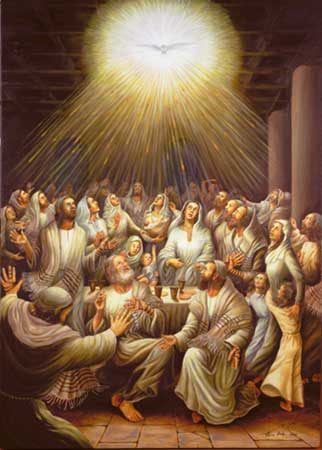
Pentecost by Nora Kelly

I have new post up on Examiner.com for Pentecost: Expanding our view of Pentecost. I talk about the painting to the right.

As always let me know what you think. I hope everyone has a happy, lively, vibrant and Spirit-filled Pentecost. May the Spirit surprise you in new and wonderful ways.

Company Girl Coffee: it's busy but in a good way edition

It’s been busy here, which is why I haven’t had a chance for coffee the last few weeks. My biggest news is that I’m now the Chicago Protestant Examiner for Examiner.com. So I’m getting the hang of reporting and actually covering things that are happening now and talking to living people instead of researching things that happened over 2,000 years ago and interviewing people in my head. It’s a change. 🙂

I am feeling really good. Joining the gym has really helped. Swimming and practicing yoga just sets me right. I love how both are a melding of meditation and movement. My time with my personal trainer is good as well, but I don’t get the spiritual practice on the machines the way I do in the water and yoga poses.

My biggest thing right now is time management: figuring out when and how long to work on various writing projects: The Book, Examiner, other freelance work, and being an editor on The Christian Godde Project (really need to get back to translating Luke), not to mention all the research that goes with each. Plus all the daily life stuff: running errands, cleaning, laundry, showering, eating, sleeping, etc. etc. Not to mention The Hubby appreciates it when I talk to him on occasion. 😉

My in-laws and a nephew are coming to see us in June, so that means we have a lot of cleaning out, organizing and cleaning up to do in the next few weeks. They’ll be here during the Printer’s Row Book Fair (every bookaholic’s best dream and worst nightmare), and I will be preaching at church that Sunday. My father-in-law wants to hear me preach. I’m a little psyched about it, but I’m sure it will all be fine. The Old Testament passage for that Sunday is Jezebel. And I love Jezebel. Wondering how much fun I can have with her even in a liberal Episcopal Church. We’ll see.

This weekend is pretty quiet. Tomorrow is cleaning and writing. I also need to make a trip to the grocery store for odds and ends. Then Sunday is Pentecost. I’m looking forward to that. Ooh, that reminds me: I need to start reading Acts 2:1-21 in the Greek, since I will be doing that Sunday morning. We will have the Acts passage read in several different languages in the service: English, Spanish, German, French, and Greek, and who knows what else. Last year each person started reading a few verses full voice, then read quietly while they walked through the sanctuary, then the next person picked up and read then walked. By the end of the reading, they were people reading the passage in different languages all over the congregation. It was so powerful. I’m not sure that’s they way we’ll do it this year, but I’m sure it will still be powerful.

I hope everyone has a good weekend and a blessed Pentecost!

Who supported Jesus out of their own means?

Soon afterwards [Jesus] went on through cities and villages, proclaiming and bringing the good news of the kingdom of God. The twelve were with him, as well as some women who had been cured of evil spirits and infirmities: Mary, called Magdalene, from whom seven demons had gone out, and Joanna, the wife of Herod’s steward Chuza, and Susanna, and many others, who provided for them out of their resources (Luke 8:1-3, NRSV).

One of the arguments that complementarians make for women staying at home is that it is God’s plan for men to work and financially support the family. As long as I’ve been on the other side of the argument, pointing out that women have always worked and supported their families monetarily, it was only last week when it hit me what these verses were saying. I’ve used these verses to show that women were disciples and followed Jesus in his travels just as the 12 did. But last week it hit me between the eyes: Mary Magdalene, Joanna, and Susanna plus other women “provided for them out of their resources.” The Greek word translated as resources can mean property, possessions, resources, or means. These women financially supported Jesus and his ministry from their own finances.

I’m sure some would say that what they gave Jesus was really the money their husbands made. This could be true for Joanna, but she is the only one with a husband in this passage. Mary Magdalene had no husband, and Susanna is not paired with a husband in these verses. This means their money was theirs. We don’t know how they had these resources. Maybe they were business women like Lydia and Priscilla. Maybe they were widows. But neither woman, nor her resources, is tied to a husband.

It’s a little thing. A little thing that can be easily overlooked. But I think that we should pay attention to this little thing. Women who weren’t tied to a husband, and a married woman who isn’t tied to her home, are following Jesus all over the countryside and supporting him. These little things start adding up to show that roles women played in the Bible are much broader than mother and wife. It also shows the freedom Jesus allowed women to have in his own ministry. He didn’t tell these women to go back home and take care of their husbands and children (and he didn’t tell them to go home, get married, and start having kids). He welcomed them and accepted their support.

These three verses in Luke give us a glimpse of the broader role of women in Jesus’ ministry beyond the home.

Originally posted at The Scroll, April 22, 2010.

Does It Really Mean "Helpmate"?

I had just started working on my thesis in seminary. Tired of being asked if I was going to seminary to be a pastor’s wife, I decided to write a biblical theology of single women in ministry, showing that Godde’s calling for a woman was not dependent on her marital state. My thesis advisor, Dr. Joseph Coleson (professor of Old Testament Studies at Nazarene Theological Seminary), looked at my outline and thesis proposal and told me that I needed to add a chapter addressing the Creation Story in Genesis 1:1–2:25. He thought that I needed to deal with the second creation account found in Gen. 2:5-25, where woman is created to be an ezer cenegdo to the man. If the Hebrew phrase simply meant, “helper” then could a woman hold a leadership position in the church, let alone a single woman? But if that isn’t what ezer cenegdo meant, then that would open up the vistas I needed to write and successfully defend my thesis. Defend, not in front of the professors at seminary, but to defend against those who say woman was created to be a wife and mother, and only a helpmate for her husband. Dr. Coleson said the translators who translated our Bibles into English know that “helpmate” is a gross mistranslation of the Hebrew phrase, and he did not see how they could look themselves in the mirror day-to-day keeping that misintepretation in the Bible. It is the only time I saw him angry. So what does this little Hebrew phrase mean?

(more…)

Company Girl Coffee: It's My Birthday Edition!

Yes, Company Girls, you heard right! Today is my birthday!  As of 10:06 a.m., I’m 40. My Mom called and made my day. My Hubby woke me up with kisses and wishing me a Happy Birthday. The Cat just wanted to be fed. I’ve had a nice lazy morning, and I have decided I will do what I want today. What is the point of being self-employed if you can’t enjoy your birthday? Which means, instead of working on all the non-fiction stuff I’ve been working on lately–I’m going to work on fiction today! Because it’s been forever since I wrote any fiction, and I want to!

Tonight The Hubby and I are getting together with Lainie at Juicy Wine Company and celebrating with wine and all sorts of wonderful cheeses, cured meats, sauteed mushrooms, and incredible applewood smoked bacon.

My review of N. T. Wright’s After You Believe: Why Christian Character Matters is up for The Ooze Viral Bloggers (thanks for the free book!). Yay!

It is a beautiful sunny day here in Chicago, and I am loving all of the sunshine pouring through my windows. The maid service came earlier this week: I have a clean house, so no housework today! (That is a birthday gift in and of itself.)

The Matisse exhibit is open at The Art Institute. I am thinking of going and looking at all the wonderful Matisse paintings and write poems or stories about them!

I hope everyone has a great weekend!