RevGal Friday Five: Life is a Verb

Over at the RevGalBlogPals Jan has been reading and says: Jennifer recommended this book, which I got because I always value Jennifer’s reading suggestions. The author of Life is a Verb, Patti Digh worked her book around these topics concerning life as a verb:

  • Say yes.
  • Be generous.
  • Speak up.
  • Love more.
  • Trust yourself.
  • Slow down.

As I read and pondered about living more intentionally, I also have wondered what this Friday Five should be. This book has been the jumping off point for this Friday.

1. What awakens you to the present moment?

  • Writing
  • Taking a walk
  • Slowing down and breathing
  • A great musical like Fiddler on the Roof, which we saw last night!
  • Live music

2. What are 5 things you see out your window right now?

  • Lake Michigan
  • Sailboats on the lake
  • Grant Park
  • The Ebony Jet Building
  • The Essex Hotel

3. Which verbs describe your experience of God?

  • Complicated
  • Calming
  • Frustrating
  • Focus
  • Messy
  • Love

4. From the book on p. 197:
Who were you when you were 13? Where did that kid go?

I was a shy nerd who had just been moved again. This time from Columbia, MO to Sayre, OK, which became my hometown. We wound up staying there, and I graduated high school and from the local community college (We finally settled down).  I was really excited when we bought our house there because I finally had a room of my own! My own space! No little sister always there. That kid is still around in some ways. I’m still a nerd, and I still like showing everyone up. I still like having my own space. I was the reverse of 13 when I bought my first house: 31. I was so excited to have a whole house to myself! Then I had to get a cat because I needed someone other than myself and the TV to talk to. 🙂 I’m still shy, but I can have a conversation. Along the way I did develop social skills. Which is a good thing. That kid grew up but parts of her are still around.

5. From the book on p. 88:
If your work were the answer to a question, what would the question be?

In the Bible are women really made in the image of God and can women be leaders, prophets, priests, pastors, and secular leaders? The resounding answer is YES!

Bonus idea for you here or on your own–from the book on p. 149:
“Go outside. Walk slowly forward. Open your hand and let something fall into it from the sky. It might be an idea, it might be an object. Name it. Set it aside. Walk forward. Open your hand and let something fall into it from the sky. Name it. Set it aside. Repeat. . . .”

Hopefully I’ll be doing this later, totally dependent on the weather. Big dark clouds are rolling in and it looks like one heck of a storm is on the way.

Pentecost Sermon Meanderings

I’m preaching this Sunday. It’s the first time in a year I’ve preached and will be the first time at Grace Episcopal. Plus this will be the first time I’ve preached twice in one day: the 8:00 a.m. and 10:00 a.m. services. Me getting out of bed at 6:00 a.m. Sunday morning is going to be a sight to see. 🙂

I’ve been thinking about wind. Both the Greek and Hebrew words for spirit also mean wind and breath. I’ve been playing with the wind being a metaphor for the Spirit. I’m from Oklahoma, and I have lived in some part of the Midwest for 26 years. In other words wind is a part of my life. I really like the wind as a metaphor for the Spirit.

Wind is unpredictable. You don’t know what it’s going to do. It can give you a wonderful cool breeze on a hot summer day. It can also destroy large swaths of land and city. As Jesus told Nicodemus you can’t see either the wind or the Spirit but you can feel them. You don’t where either comes from or where they are going. Wind is not something anyone can control. It decides when it blows and how. It can choose to be still and silent or roaring hundreds of miles per hour. No one tells the wind where to blow, but it will blow you a few blocks up the street on certain days. It’s wonderful when it acts like we think it should, and it’s disasterous  when it does what it want to do with no regard to humanity.

I think this is why we don’t here to much about the Holy Spirit. We can’t control her. Godde the Father-Mother gets put in a nice, neat little box with all of her attributes. Godde the Son gets put in his own little box with his works and attributes. But what do we do with Godde the Holy Spirit? What do we do with this wonky member of the Trinity who doesn’t fit into all of our nice, net little boxes with the nice neat little attributes afixed to her box? The Spirit does what she wants and blows where she wants. When she gives a nice breeze of inspiration during private prayer, we love her. When she blows us out of our comfort zones to serve the poor and oppressed, we not to sure about her and her methods.

Just like the wind, fire cannot be controlled either. We love the illusion we control fire in the pits and fireplaces of life, but then a bush fire starts and devastates thousands of square miles, burning everything it comes across, blown by the unpredictable wind. We like to think the Spirit enriches our lives. We don’t like to think about the devastation that same Spirit can cause. Like the wind and the fire we cannot control Godde’s Spirit. She blows where she wills, convicts where she wills, redeems where she wills, and blows us kicking and screaming into obeying the Beatitudes instead of just giving them lip service.

She is the part of Godde that theologians, preachers, and writers have never been able to pin down, examine, and define. So we ignore her.

How do you think of the Spirit? What metaphors do you like for the Spirit? (C’mon! help a preacher gal out here.)

Happy Anniversary! Or I'm so happy The Hubby decided to spend the rest of his life with me!

The Hubby and I were married three years ago today. Is he sexy in that tux or what? (And yes, I probably said that last year as well. The Man cleans up gooooood. ;))

Here’s our song: “Lifelong Fling” by Over the Rhine.

The moon blind-sided the sky again
As we grabbed loose ends of the tide and then
The slippery slide
You know I can’t say when
I ever took a ride that could slap me this silly
With roiling joy
Lazy as sin
Lyin’ up in heaven with my special friend
And the space he’s in
It can make a girl grin
In the beginning of a lifelong fling

I wrote down a dream
Folded the note
Slipped it in the pocket of my tattered coat

I wrote down a dream
In invisible ink
It never was mine I’m beginning to think

I wrote down a dream
What more could I do
I drew myself a picture and the picture was you

I wrote myself a riddle
I said, What I wouldn’t do
To give something good
To a love like you

The moon blind-sided the sky again
As we grabbed loose ends of the tide and then
The slippery slide
You know I can’t say when
I ever took a ride that could slap me this silly
With roiling joy
Lazy as sin
Lyin’ up in heaven with my special friend
And the space he’s in
It can make a girl grin
In the beginning of a lifelong fling

I wrote down a dream
Folded the note
Passed it to you we stepped in our boat

Sailed ‘round the world
We were hoping to find
More than the sum of all we left behind

I wrote down a dream
But what was it now
And why does it feel so distant somehow

Did I take too long
Did I get it wrong
You’re still the missing line in my favorite song

The moon blind-sided the sky again
As we grabbed loose ends of the tide and then
The slippery slide
You know I can’t say when
I ever took a ride that could slap me this silly
With roiling joy
Lazy as sin
Lyin’ up in heaven with my special friend
And the space he’s in
It can make a girl grin
In the beginning of a lifelong fling

My First Girlhood Heroine: Florence Nightingale

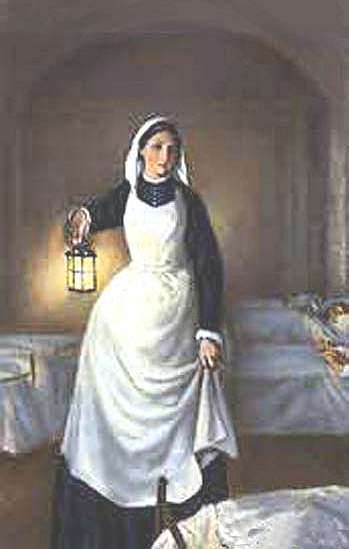
Today in The Episcopal Church and Anglican Communion, we remember Florence Nightingale. Florence was my first heroine in grade school. I discovered her in the second grade and wanted to be just like her. She has greatly influenced my life and how I think about serving God. Here is a brief biography of her life from James Kiefer:

The commemoration of Florence Nightingale is controversial. On the one hand, she doubted or denied many of the central articles of the Creed. On the other hand, she believed in God and devoted her life to His service as she understood it.

She was born in Florence on 12 May 1820 of upper-class English parents travelling through Italy, and named for her native city. (“Florence” was not an accepted first name at the time. Her sister was born in Naples and named “Parthenope,” the Greek name for that city.) Florence was reared in the Unitarian Church, but later joined the Church of England.

In her diary, an entry shortly before her seventeenth birthday reads: “On February 7th, 1837, God spoke to me and called me to his service.” She did not know what the service would be, and therefore decided that she must remain single, so as to have no encumbrances and be ready for anything. With this in mind, she rejected a proposal of marriage from a young man whom she dearly loved. She suffered from “trances” or “dreaming” spells, in which she would lose consciousness for several minutes or longer, and be unaware when she recovered that time had passed. (Could this be a form of petit mal epilepsy? No biographer of hers that I have read uses the word.) She found the knowledge that she was subject to such spells terrifying, and feared that they meant that she was unworthy of her calling, particularly since she did not hear the voice of God again for many years. In the spring of 1844 she came to believe that her calling was to nurse the sick. In 1850 her family sent her on a tour of Egypt for her health. Some extracts from her diary follow:

March 7. God called me in the morning and asked me would I do good for Him, for Him alone without the reputation.

March 9. During half an hour I had by myself in my cabin, settled the question with God.

April 1. Not able to go out but wished God to have it all His own way. I like Him to do exactly as He likes without even telling me the reason.

May 12. Today I am thirty–the age Christ began his mission. Now no more childish things. No more love. No more marriage. Now Lord let me think only of Thy Will, what Thou willest me to do. Oh Lord Thy Will, Thy Will.

June 10. The Lord spoke to me; he said, Give five minutes every hour to the thought of Me. Coudst thou but love Me as Lizzie loves her husband, how happy wouldst thou be.” But Lizzie does not give five minutes every hour to the thought of her husband, she thinks of him every minute, spontaneously.

Florence decided that she must train to be a nurse. Her family was horrified. In her day, nursing was done mostly by disabled army veterans or by women with no other means of support. It was common for nurses of either sex to be drunk on the job most of the time, and they had no training at all. It was common practice never to wash or change the sheets on a bed, not even when a patient died and his bed was given to a new patient. Florence was told to go to Kaiserswerth, Germany, to learn and train with the Lutheran order of Deaconesses who were running a hospital there. Back in England again, she used the influence of Sidney Herbert, a family friend and Member of Parliament, to be appointed supervisor of a sanatorium in London. Under her able guidance, it turned from a chamber of horrors into a model hospital. The innovations introduced by Miss Nightingale were, for their day, little short of revolutionary. She demanded, and got, a system of dumb-waiters that enabled food to be sent directly to every floor, so that nurses did not exhaust themselves carrying trays up numerous flights of stairs. She also invented and had installed a system of call bells by which a patient could ring from his bed and the bell would sound in the corridor, with a valve attached to the bell which opened when the bell rang, and remained open so that the nurse could see who had rung. “Without a system of this kind,” she wrote, “a nurse is converted to a pair of legs.”

While working in the poorer districts of London, Miss Nightingale encountered a Roman Catholic priest, Henry Edward Manning (later Cardinal Manning), who was working among the poor of London. She was impressed by the assistance he gave to many who had nowhere else to turn, and they became friends for life. She was greatly attracted by Roman Catholicism, but rejected much of its theology, and so reluctantly decided against joining it.

Then war broke out in the Crimea (in Russia, on the north edge of the Black Sea), and Sir Sidney Herbert, now Secretary of War, obtained permission for Florence to lead a group of 38 nurses there. Of these, 10 were Roman Catholic nuns, 14 were Anglican nuns, and the remaining 14 were “of no particular religion, unless one counts the worship of Bacchus.” They found conditions appalling. Blankets were rotting in warehouses while the men did without, because no one had issued the proper forms for their distribution. The lavatories in the hospitals had no running water, and the latrines were tubs to be emptied by hand. But no one emptied them, since official regulations did not specify which department was responsible for doing so. The result was that the hospital had a foul stench that could be smelled for some distance outside its walls. Far more men were dying in hospitals of infection than of wounds. The chief concern of many of the Army doctors was that the nurses might usurp some of their authority. Florence gradually managed to win the doctors and other authorities over, and to reform hospital procedures, with spectacular results. Once the medical situation had ceased to be an acute problem, she turned her attention to other aspects of the soldiers’ welfare. For example, most of them squandered all their pay on drink. She noted that there was no trustworthy way for them to send money home to their families, and she set up facilities for them to do so. First, she undertook to send money home herself for any soldier in the hospital that wanted it sent, and the soldiers brought in about 1000 pounds a month. She asked the authorities to set up an official service to do this, and they refused. By appealing to Queen Victoria herself, she overcame opposition to the idea, and the men sent home 71,000 pounds sterling in less than six months. She established with her own money a reading-room with tables for writing letters, and the men used it enthusiastically. She imported four schoolmasters to give lectures, and the halls were filled to overflowing. All this was done despite opposition from officers who said, “The men are hopeless brutes. You cannot expect anything from them.”

At night, she would often patrol the wards, carrying a dim lamp, to make sure that all was well and no one was in need of help. She became famous as “the Lady with the Lamp.”

In April 1856 the war was over, and by mid-July the hospital was emptied and her work in Crimea over. She returned to England a national hero, with a great welcome prepared for her; but she slipped into the country unnoticed and went to a convent that had supplied some of her nurses. There, she spent the day in prayer before coming out to face the public and beginning to lobby Parliament for suitable legislation. She wrote pamphlet after pamphlet, pointing out by pie charts, for example, that the major cause of deaths in the Army was not wounds caused by enemy action but disease caused by lack of proper sanitation. She is perhaps the first person to use pie charts and similar graphic devices to convey statistical information. She obtained the formation of an Army Medical Staff Corps and a Sanitary Commission to oversee military health conditions.

Throughout these efforts, she relied on the help of Sidney Herbert, insisting that he must work hard and long to get the legislation she needed through Parliament. When he protested that she was asking too much, she would not listen. His health broke, and he died in August 1861. Florence prayed God to raise him from the dead, explaining that she needed him for the job. When God failed to comply, her faith was badly shaken. She wrote a book called, Suggestions for Thought: An Address to the Artisans of England, in which she explained that God was less of a Person and more of a Cosmic Force than is generally supposed by Christians. (But note that she was working on this book before Sir Sidney died, and one cannot call it simply a response to his death.) Advance copies were given to a few friends, such as John Stuart Mill, who praised it highly. However, it was never published (I have not seen it, and neither the Library of Congress nor the National library of Medicine has a copy, nor any other library in the United States that I have been able to learn of), since Florence kept revising it — arguably, because her beliefs on the nature of God were simply not internally consistent. Eventually, it seems, God spoke to her again and said, “You are here to carry out my program. I am not here to carry out yours.” She wrote in her diary, “I must remember that God is not my private secretary.”

Before his death, Sir Sidney had gotten her involved in Indian affairs. She served on the Indian Sanitary Commission. In May 1859, she decided that there were insufficient data available in England on conditions in the Indian Army, and she wrote to 200 military stations there, asking for copies of all regulations and all documents relating to the health and sanitary administration of the army. The reports that came back filled two vans. She read them all and summarized them for the Report of the Commission. Her conclusion was that the death toll from disease in the Indian Army was appallingly high (69 out of 1000 annually), and that this was largely due, not to the climate, but to lack of sanitation, and that preventive measures included sanitation not just for army posts but for neighboring villages and, in the long run, for all of India.

She was a friend of General Charles George Gordon, who captured the British imagination when he and his troops were beseiged at Khartoum in the Sudan, and finally captured and killed. After his death, Florence wrote to a friend that suffering, disappointment, and lack of success are the tribute which it is the soul’s greatest privilege to present to God. In Gordon’s death, she wrote, we see “the triumph of failure, the triumph of the Cross. With him, all is well.”

She met the scholar Benjamin Jowett, who was translating Plato into English. They became fast friends, and she contributed to the translation. She also began an anthology of mystical writings, called “Notes from Devotional Authors of the Middle Ages, Collected, Chosen, and Freely Translated by Florence Nightingale.” It was her contention that mystical prayer is not just for monks and nuns, but should form a part of the every-day life of ordinary persons.

Under the strain of ceaseless overwork, her own health broke, and she was an invalid for the latter half of her life. On Christmas Day when she was sixty-five, she wrote: “Today, O Lord, let me dedicate this crumbling old woman to thee. Behold the handmaid of the Lord. I was thy handmaid as a girl. Since then, I have backslid.” She wrote a manual called Notes for Nurses, and a set of instructions for the matron in charge of training nurses, emphasizing the importance for a nurse of a schedule of daily prayer. A few years before her death, she was the first woman to receive the Order of Merit from the British government. She died at ninety, and, by her directions, her tombstone read simply, “F.N. 1820-1910”.

Florence Nightingale died on 13 August 1910, and is commemorated on this day on the Lutheran Calendar. The Episcopal calendar commemorates Jeremy Taylor on 13 August, and accordingly has shifted the commemoration of Nightingale to 18 May. I am not sure of the significance of this date, but it is the date (or nearly) of the opening of the Nightingale Training School for Nurses in 1860.
Here is today’s prayer:

Life-giving God, who alone have power over life and death, over health and sickness: Give power, wisdom, and gentleness to those who follow the example of your servant Florence Nightingale, that they, bearing with them your Presence, may not only heal but pain and fear; through Jesus Christ, the healer of body andf soul, who lives and reigns with you and the Holy Spirit, one God, for ever and ever. Amen.

Biblical Women Who Didn't Submit: Sarah

Bedouin Meets Europe by Piotr Pastusiak.

It was in this way long ago that the holy women who hoped in God used to adorn themselves by accepting the authority of their husbands. Thus Sarah obeyed Abraham and called him lord. You have become her daughters as long as you do what is good and never let fears alarm you (1 Peter 3:4-5).

I have one question about these verses: Who is this Sarah Peter is speaking of? Because this is not the Sarah I have encountered in the Old Testament. Here are some viginettes of the Sarah we find in Genesis:

Now Sarai, Abram’s wife, bore him no children. She had an Egyptian slave-girl whose name was Hagar, and Sarai said to Abram, “You see that the LORD has prevented me from bearing children; go in to my slave-girl; it may be that I shall obtain children by her.” And Abram listened to the voice of Sarai. So, after Abram had lived ten years in the land of Canaan, Sarai, Abram’s wife, took Hagar the Egyptian, her slave-girl, and gave her to her husband Abram as a wife.

He went in to Hagar, and she conceived; and when she saw that she had conceived, she looked with contempt on her mistress. Then Sarai said to Abram, “May the wrong done to me be on you! I gave my slave-girl to your embrace, and when she saw that she had conceived, she looked on me with contempt. May the LORD judge between you and me!” But Abram said to Sarai, “Your slave-girl is in your power; do to her as you please.” Then Sarai dealt harshly with her, and she ran away from her (Genesis 16:1-6).

But Sarah saw the son of Hagar the Egyptian, whom she had borne to Abraham, playing with her son Isaac. So she said to Abraham, “Cast out this slave woman with her son; for the son of this slave woman shall not inherit along with my son Isaac.” The matter was very distressing to Abraham on account of his son. But God said to Abraham, “Do not be distressed because of the boy and because of your slave woman; whatever Sarah says to you, do as she tells you, for it is through Isaac that offspring shall be named for you. As for the son of the slave woman, I will make a nation of him also, because he is your offspring” (Genesis 21:9-13).

Now Sarah also did obey Abraham when he wanted her to say she was his sister, so Abraham would not be killed by Pharaoh or Abimelech. Sarah obeyed and in both cases was taken into both rulers’ harems. But we don’t see Sarah submitting in all ways to Abraham as complementarians would have wives to submit blindly to their husbands today. It was her idea to give Hagar to Abraham as his concubine, so they could have children.  When Hagar started looking at Sarah with contempt, it was Sarah who blamed Abraham, who returned Hagar to being Sarah’s slave instead of his concubine.

It was Sarah who told Abraham that Ishmael would not inherit with her son, Isaac, and to send Hagar and Ishmael away. Godde sides with Sarah on this and tells Abraham to send Hagar and Ishmael away. Godde will honor the covenant to both women: their sons shall become nations, but Sophia-Yahweh’s covenant would go through Isaac.

1 Peter would have us believe that Sarah was always submissive. But she wasn’t. Genesis gives a very different picture of this brave, strong woman who left all she knew to follow Sophia-Yahweh and find the land Godde had promised to her and Abraham’s descendants. She told Abraham what she thought, and she made decisions that affected God’s covenant for millenia to come. Sarah was not always a nice person, and she was definitely wrong in the ways she dealt with familial problems, but she was not a submissive wallflower who blindly followed her husband.

Related Posts

Biblical Women Who Didn’t Submit: Abigail
Woman of the Week: Sarah

The Christian Godde Project: Exploring the Divine Feminine within The Christian Godde

I have joined a new project: The Christian Godde Project as an associate editor. It is a project to translate the New Testament using Divine Feminine language for Godde. I have mentioned before on this blog that I like using both masculine and feminine language for God. Instead of Lord, I use Sophia-Yahweh, and in the place of Father, Father-Mother. Normally I use “God” with the understanding that God carries no gender. Godde is the combination of God and Goddess to grammatically represent both the masculine and feminine characteristics of Godde. Many Christians who do not want to be tied to just male imagery of God are now using “Godde.” I will start using Godde now on this blog to refer to Godde (how redundant is that sentence?).

I am really excited about being on this project. There are two different Bibles which have used gender neutral language for Godde, but none that has taken the step of using feminine language for the Divine. I am looking forward to knowing Godde better as I work on this project and seeing Godde in new ways. Please feel free to join us at the blog (the above link) and our website: The Divine Feminine New Testament. Come see Godde in new ways!

Hymn: Walk on ahead, Good Shepherd

We sang this hymn after communion yesterday. I loved it.

Walk on ahead, Good Shepherd, I know your sweet voice true,
and even through the valley of death I’ll follow you!
Walk on ahead, Good Shepherd, I know you’ll lead me through,
for though I oft’ go straying, I know you’re ever true.

So draw me back, Good Shepherd, I need your rod and staff;
my stubborn selfish trends, Lord, they lead me off the path.
So draw me back, Good Shepherd, to paths of righteousness;
Bring me back to my Shepherd and Guardian of my soul.

Good Shepherd I have heard you – by name you call me out.
Guard me from thieves and robbers, and shield my heart from doubt
The way, the truth and life, yes! My Lord you are the gate
for those who enter in there salvation’s pastures wait.

Walk on ahead, Good Shepherd, lead me to pastures green.
For myriad other voices are not quite what they seem –
I will not trust the stranger whose voice I do not know.
That leads to death; destruction – no there I will not go!

So lead me now, Good Shepherd, and I will follow you.
I’ll live my life in fullness just as you call me to.
May your life and your light shine through me in such a way
that others too may know this: My Shepherd is the Way.
(Brenton Prigge © 2005 New Hymn CCLI # 4494858)

Them and Us: Mental Illness

Sophia at Sophia’s call has an incredible post up on mental illness and the very fine lines there are in our society and receiving the benefit of doubt and getting treatment or being tossed aside and falling through the cracks. There is also an incredible call for the church to stop acting like the mentally ill are not part of us, the Body of Christ.

I reject the oh-so-tempting divide, and if it is made by others I will stand humbly and proudly with my sisters and brothers who also live with serious mental illness, many with far fewer resources and far greater courage and holiness than I have. I am indeed one of them, who depends on her medication for survival but can pass for one of us because of the grace of God, good luck, and a heap of social privilege. I am white, upper middle class, temporarily able-bodied, highly educated and professionally experienced, and bisexual but in a straight marriage. So I can obtain appropriate medication and therapy, arrange a peaceful and relatively non-stressful life, and when I had my one serious episode I was given some benefit of the doubt and escaped from serious consequences. The police were abusive, but I wasn’t tased or shot as people of color so often are, and I was treated with relative dignity in both hospitals. But with a few changes in circumstance I, and anyone else, could slip past the great divide and become clearly and embarrassingly and powerlessly one of them.

Disabilism with regard to both physical and mental differences is as rampant in the church as it is in the rest of society, as I became aware recently when I did an internet search for prayers and worship resources about disability. Every one I found focused on the need for “us,” the church, the “normal” folks, to have compassion and help “them”, the disabled, the needy, the damaged–who are apparently not fully a part of the church. None gave thanks for the gifts and insight disabled people bring to the Christian community, of which they are in fact full members–the Body of Christ which was, as Nancy Eiseland points out in The Disabled God, a holy and lifegiving and disabled body with wounds remaining even after his resurrection.

St. Mary Magdalene, cherished by Christian feminists as a beloved disciple of Jesus and first witness to his resurrection, is a perfect example of this disabilism–rarely honored in her own fullness as someone who lived with the burdens and blessings of a serious mental illness. Progressive theologians rightly reclaim her place as an apostle and decry her misidentification as a repentant prostitute (though this sometimes carries unwelcome overtones of demonizing sex workers, who brilliantly defied medieval scorn by claiming her special patronage–given with compassion and enthusiasm, I’m sure). But the crucial scriptural fact of her healing by Jesus–that he cast seven devils out of her–is ignored or glossed over.

Go read the rest of Mary Magdalene, My Sister.

RevGals Friday Five: Celebrating the Seasons of Life

Sally writes: It is the first of May, or as I have been concentrating on dialogue with folk interested in the new spirituality movement this last week, it is Beltane, a time to celebrate the beginning of summer. The BBC web-site tells us that:

Beltane is a Celtic word which means ‘fires of Bel’ (Bel was a Celtic deity). It is a fire festival that celebrates of the coming of summer and the fertility of the coming year.
Celtic festivals often tied in with the needs of the community. In spring time, at the beginning of the farming calendar, everybody would be hoping for a fruitful year for their families and fields.
Beltane rituals would often include courting: for example, young men and women collecting blossoms in the woods and lighting fires in the evening. These rituals would often lead to matches and marriages, either immediately in the coming summer or autumn.

Another advert for a TV programme that has caught my eye on the UK’s Channel 4 this weekend is called Love, Life and leaving; and is a look at the importance of celebrating the seasons of life through ritual and in the public eye, hence marriages, baptisms and funerals.

I believe that we live in a ritually impoverished culture, where we have few reasons for real celebration, and marking the passages of life;

So

1. Are ritual markings of birth, marriage, and death important to you?

Yes, they are.

2. Share a favourite liturgy/ practice.

The Renewal of the Baptismal Covenant.

3. If you could invent (or have invented) a ritual what is it for?

I have invented rituals. I have my own Samhain/All Saints ritual, and a couple of years ago I created a ritual for casting out fear.

4. What do you think of making connections with neo-pagan / ancient festivals? Have you done this and how?

I like making those connections, especially with the ancient feasts. I love the Celtic calendar and like how they cycle through the year.

5. Celebrating is important, what and where would your ideal celebration be?

I love all the outdoor music Chicago has in the summer. There are free concerts and free dancing at Millennium Park. I love listening to music and dancing in the park as the sun goes down and the lake is right there.

Me, Working at Home, and the Bible

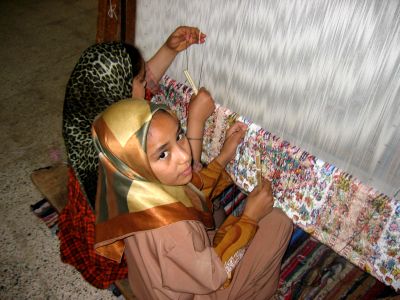
Girls in Cairo weaving

Girls in Cairo weaving

Since I struck out for the freelance life almost three years ago, I’ve wondered if I’m actually working. I work from home, I stay in my PJs to all hours of the afternoon, and I don’t make a lot of money. When people ask me what I do, and I say, “I’m a writer,” I wonder if that’s a “real job.” After all you actually have to take showers and work a specific amount of hours to have a “real job” right? Not to mention you get a regular pay check at a “real job.”

I’ve also been at odds with myself over housework. Because I’m the one who’s home a lot, I do most of the housework. It’s nice to break up sitting around on the computer with doing a load of laundry or picking stuff up. And who hasn’t put off writing a blog post to clean out the fridge? (OK, My Hubby wishes I did this.) I used to find all sorts of house stuff to do when I was in school too. It’s amazing what needs to be cleaned right now when you need to parse Greek verbs or write a soul-bearing blog post.

Then something happened last year. Something devastating: I actually wanted to to do housework, and figure out how to be a decent homekeeper. This feminist-who-did-not-want-to-be-an-absolute-clean-freak-like-her-mother freaked out. You can reading about my freaking out here.

And through all of this it never hit me what a total hypocrite I was. You see I’m writing this book called Career Women of the Bible. In the Bible most of the work was done at home, and women did a substantial amount of the work for the family to survive including house repairs, all the food preparation, making sure the children didn’t wander off into wadis or be trampled by sheep or goats, and they spun thread and wove all the textiles the family and the household needed. In fact women’s work–textiles–drove the ancient economy. Women wove and their men traveled and sold the textiles. They sent back the money from the textiles to their wives, and the wives spent it how they saw fit.*

So here I am being this big advocate that yes women worked and had actual careers in the Bible, and most of that work was done at home. In fact, most men worked from home because work and home hadn’t been divided by the Industrial Revolution yet. Even if you lived in a town or city, your shop or business was run out of your home. Home, work, and family were interwoven.

I realized what a disconnect I was having a couple of weeks ago when I read What Does “Workers at Home” Really Mean? I was cheering what Sandra was saying when it hit me. I was not practicing what I preach. All the women in the Bible I applaud, preach about, teach about, and storytell about worked from their homes. Their weaving drove ancient economy, and they were in charge of the family’s largest resource: food. The women apportioned the food and made it last from one harvest to the next.

The matriarchs were in charge of small moving businesses, and their weaving probably helped the family buy the thing they needed while roaming around Canaan and Egypt. Not to mention their weaving literally sheltered the family: they wove the goat’s hair in thread and wove the panels for the tent. (Women’s work was also setting up the tents and tearing them down.) Rahab was a prostitute yes, but she also ran an inn (most likely in her own home), and there is flax on her roof for weaving. The Proverbs 31 woman has girls who weave for her, and she sells the textiles. She also buys and sells property. Priscilla and Aquila made tents, and Lydia did travel for her business: she was a merchant of the purple cloth that only royalty could buy.

In addition, the early church met in people’s homes. We know Priscilla and Aquila had churches meet in at least in three of their homes spread over Asia and in Rome. The first church in Europe met in Lydia’s home. Homes were the hubs of hospitality and grace. Homes are where the first Christians heard of God’s love and grace, ate together, and celebrated the Eucharist together.

And I didn’t think “real work” could happen in my home. I was wondering if I was really working and could honestly say I work just because I don’t go to an office and keep certain hours. I am a working woman in my home just like all the women of the Bible. Like them I am also a homekeeper. I am in charge of one of the things that cost us the most money: food. I shop and provide our meals. I love it. I love to cook, and I love to feed people. Nothing shows love like cooking. I also want my home to be a place to live in, be comfortable in, have people over, and not look like a couple of tornadoes go through it a week. So I pick up, do laundry, sweep, and mop, so that I don’t have to do a manic clean-out just to have somone over for dinner. For some reason I think Sarah, Deborah, Martha, and Priscilla would approve.

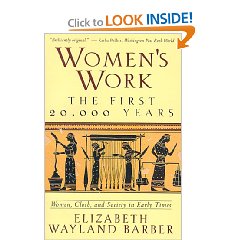
*For an extensive record of women and the textile industry read Elizabeth Wayland Barber’s Women’s Work: The First 20,000 Years Women, Cloth, and Society in Early Times. In fact, this is must read to really understand how intertwined the home and business were in the ancient world. “Cloth for the Caravans” is the chapter that deals with women weavers sending their wares out on caravans for trading. The letters between the husbands and wives they recovered are great!

(There are affliate links in this post.)