I now have a newsletter on Substack: Creative Midlife Mayhem. In Creative Midlife Mayhem, I am exploring the intersection of faith and creativity in my day-to-day chaotic life. I’m also posting my baking and gardening adventures in the Notes section. To be made in the image of God, the Creator, means that all of us are born creators! Here are the first two newsletters:
When You Find Chaos: Create: Out of chaos God created the heavens and the earth, and we are called to do the same.
Multi-ethnic multi-generation group of people from young children to 95 years old.
Photo credit: Diverse Generations by adispo.ch
In 2006 when I started this blog, I had just married and I was still part of the Evangelical Movement. I was an ordained minister, theologian, and writer. I was convinced I could show the world that women were made in the image of God and God called us to the same lives she called men: pastors, teachers, theologians, etc. There are only eight verses in the Bible that limit women’s roles in the life of their specific churches. These eight verses stand in contrast to all of the stories of women leaders we have in the Bible: Miriam, Deborah, Huldah, Isaiah’s wife, Anna, Mary Magdalene, Phoebe, Junia, and many other women. I even wrote a book about how these eight verses should not be used to strip women of the callings God placed on their lives: What You Didn’t Learn in Sunday School: Women Who Didn’t Shut Up and Sit Down. Just two years later, I realized I was going to be fighting the same the battle my entire life if I stayed in the Evangelical Movement. My previous denomination also viewed my LGBTQIA+ friends to be committing sin, and I could no longer tow that party line. In 2008 I resigned my credentials and started attending an Episcopal Church. I was confirmed later that year.
In the Episcopal Church I did not pursue ordination. My call is to preach and to teach, and the church had lay preacher certifications. Since then I have been a happy and content Episcopalian who preaches and teaches in her home church. I also discovered other Christian women who decided that motherhood was not for them. I went from being the only woman in a church who didn’t want children to one of the many. After the shock wore off, I was so happy to be part of a church where women were not defined by our wombs. It didn’t matter we weren’t mothers: we were still treated like adults, and no one questioned our decisions. That was between us, our spouses, and God.
Just Sit Down and Be a Good Little Girl
I have spent my entire life fighting against what society and church tells me a woman should be. “Boys don’t like smart girls.” “No man is going to marry you if you’re smarter than him.” “Stop being so aggressive: it’s not ladylike” (I grew up in the South). “You’re a girl/woman: you’re not suppose to be talking. Paul said so.” “Stop being so ambitious: no man wants an ambitious wife.” “God doesn’t call women to preach.” “God talked through an ass, so I guess he could use a woman too.” “A woman’s highest calling is to be a wife and mother.” “No one is going to marry a women that doesn’t want children.” Ad nasuem. For the record I did find a man who was fine with all of this and all of me. I never fit the cookie cutter mold society and the church thought I should be in. And more importantly: I did not want to. (Everything in quotes are things people said to me or was preached from the pulpit of the church I grew up in.)
Now I’m a little more jaded and cynical than I was 18 years ago because I keep seeing the same cycles go around in society. Once again women are being told we shouldn’t want to pursue education or careers because we’re just going to get married and stay home with our children. We’re told women who are child-free or childless are the enemy, and that we’re all sad, angry women who want to take out our anger on society as a whole. No one bothers to ask us why we chose not to have children. Worst of all, there doesn’t seem to be any empathy for women who tried for years to have children, but could not. Having no children is not always a choice.
Biblical Family?
Once again I also see the definition of family being made smaller and smaller. Once upon a time step-children and adopted children were included in family, but now one vice presidential candidate has made it clear he does not consider those kinds of family to “real” families, just as my husband and I are not considered a “real” family because we did not have children. The American nuclear family is touted as “biblical marriage” and “biblical family,” when the Bible does not even recognize such a small definition of family. Biblical families were multi-generational clans. The reason Jacob had to sneak off with his two wives, two concubines and 12+ kids is because he was not the head of his family. His nuclear family was part of Laban’s clan, and Laban was the head (see Genesis 31).
When we get to the New Testament, we discover that Jesus doesn’t seem to think much of biological family: nuclear, clan, or otherwise:
[Jesus’] mother and brothers arrived. Standing outside, they sent someone in to call him. A crowd was sitting around him. They said, “Look, your mother and brothers and sisters are outside looking for you.”
He answered, “Who are my mother, sisters, and brothers?” Looking at those who sat around him, he said, “Look, my mother and sisters and brothers! Whoever does the will of God is my sister, brother and mother.” (Mark 4: 31-35, New Testament: The Divine Feminine Version [DFV]
Biblical literalists conveniently ignore these verses just as they do The Beatitudes and Jesus’ command to love our enemies. Jesus didn’t mean all of this, literally, right?
My response always is: What if he did? It has been close to three decades since I lived close to my own nuclear family. These verses have always given me great comfort because I know that wherever I move to, I will find family there in the church God leads me to. I have never been alone: even when I was single and lived alone. God has always led me to family in every city I’ve lived, and Lincoln has been no exception. Yes, my husband’s family lives here, but I have my church family too. One of my favorite psalms says that God places the solitary in families. She has placed me in families over and over again, and they are families I am not biologically related to.
Family is so much richer and more expansive than the anemic mom, dad, and 2.5 kids of the the so-called American dream. Family is biological, married into, adopted, and found. There is always room for more family, more mothers (and fathers), more sisters, more brothers, more aunts and uncles, more nieces and nephews and more love and acceptance.
The God of All Families
In the end that’s what bothers me the most about these limiting views of both women and family. It’s all about bringing the fences in, making homes smaller, and limiting our view of how God works in the world and WHO God works through. The older I get the less I limit God. I’m on the other side of 50, and I know how very little I actually control. I know how very little I know. I only see a very tiny slice of what is going on in this world and universe. And I am not going to reduce the God who made the heavens and the earth, the God of the universe to a small, sectarian vision.
God works through women and men and all of the genders between those two poles. God works through all sorts of people and families. God works through the multi-generational households, the tribal clans, the nuclear families, and those families (like mine) that aren’t “traditional” according the the middle class American definition. I want a bigger God than that. I believe in a bigger God than that. I obey a bigger God than that.
This blog has been on life support for quite a few years, but as we come into another cycle of circling wagons and once again decrying everything we don’t agree with as un-American and not “real” Christianity, it seems like a good time to start writing again. After all, I’ve done this once before almost 20 years ago when I started insisting that women were also made in the image of God and my family WAS a family, even without children. It might even be fun to revisit what I’ve written across the years. I’m sure there will a whole lot of updating. There will new writing too because there will new research, new stories, new ways of looking at the Bible and society, and most important of all: I am not the same person I was 18 years ago. The way I look at the world, read the Bible, and see and interpret society have all changed. What are the words and vision we need to hear now? What are the words and vision I need to write about now? I’m looking forward to finding out.
A month and a half ago we began a journey through the book of Ephesians in our New Testament readings. Unfortunately, Ephesians has been overshadowed by our study of David flowing into Jesus’ discourse on the bread of life. And this is not OK with me because Ephesians is one of my favorite books in the Bible. Has been ever since I can remember.
The book of Ephesians is Paul’s last love letter to the church. Paul is in prison in Rome. Soon, he will be presenting his case to the Roman Emperor, Nero. Nero was the Caesar who dowsed early believers in wax and oil and set them on fire to light his garden parties at night. Nero was the Caesar who laughed and cheered as early believers were driven into the Colosseum to be torn apart by lions. Paul knew his fate. Paul knew what Nero’s verdict would be. One of his last acts was to write this letter of his vision and dream of what the church of Christ is and could be.
Over the last month and a half we have heard portions of Paul’s last love letter to the churches he worked so hard for. These also happen to be some of my favorite passages in the Bible.
I pray that the God of our Lord Jesus Christ, the Father of glory, may give you [all] a spirit of wisdom and revelation as you [all] come to know him, so that, with the eyes of your hearts enlightened, you [all] may know what is the hope to which he has called you (Ephesians 1:17-18).
[Jesus] came and proclaimed peace to you [all] who were far off [Gentiles] and peace to those who were near [Jews], for through him both of us have access in one Spirit to the Father. So then, you [all] are no longer strangers and aliens, but you [all] are fellow citizens with the saints and also members of the household of God, built upon the foundation of the apostles and prophets, with Christ Jesus himself as the cornerstone (2:17-20).
I pray that, according to the riches of his glory, he may grant that you [all] may be strengthened in your inner being with power through his Spirit and that Christ may dwell in your hearts through faith, as you [all] are being rooted and grounded in love. I pray that you [all] may have the power to comprehend, with all the saints, what is the breadth and length and height and depth and to know the love of Christ that surpasses knowledge, so that you [all] may be filled with all the fullness of God (3:16-19).
[Jesus] himself granted that some are apostles, prophets, evangelists, pastors and teachers to equip the saints for the work of ministry, for building up the body of Christ, until all of us come to the unity of the faith and of the knowledge of the Son of God, to maturity, to the measure of the full stature of Christ. We must no longer be children, tossed to and fro and blown about by every wind of doctrine by people’s trickery, by their craftiness in deceitful scheming; but speaking the truth in love, we must grow up in every way into him who is the head, into Christ (4:11-15).
Be careful, then, how you live, not as unwise people but as wise, making the most of the time, because the days are evil. So do not be foolish, but understand what the will of the Lord is (5:15-17).
Paul’s Dream
This is Paul’s dream for the church, for the Body of Christ, everywhere! This is what Paul wants to see happen! He wants the church to know the deep and expansive love of God. If the love of Christ can reconcile even Jews and Gentiles, and make enemies into family in the household of God, what more can happen in the world when that love and reconciliation are the rule and not the exception? Learning to love our enemies and be reconciled to them by the love of Christ is supposed to be normal—not the exception. In Paul’s eyes, THIS is what it means to be part of the body of Christ.
So we’ve done the hard work of loving our enemies and being reconciled with them. You think that would be good enough, wouldn’t you? Not for Paul. Oh no, his dream for the church is just starting. Now we head into my favorite part of Ephesians: the part where Paul tells the church to stop being whiny teenagers and grow up already. One of the reasons I left the Evangelical Movement 16 years ago is that I was never allowed to grow up. I was 38 years old and an ordained minister, and that still wasn’t good enough. One day, I was done with being seen as a perpetual child, and I left.
The reason I was so frustrated is because I knew what Paul told the church in Ephesians 4: Jesus granted different gifts to build “up the body of Christ, until all of us come to the unity of the faith and of the knowledge of the Son of God, to maturity, to the measure of the full stature of Christ.” These gifts are given to the church for one reason and one reason only: to build up the body of Christ and help us grow up, so we can be the hands and feet of Christ in our world. We also have to grow up, so we can be wise and discern the will of God.
Now we come to this morning’s passage in Ephesians:
Finally, be strong in the Lord and in the strength of his power. Put on the whole armor of God, so that you [all] may be able to stand against the wiles of the devil. For our struggle is not against enemies of blood and flesh, but against the rulers, against the authorities, against the cosmic powers of this present darkness, against the spiritual forces of evil in the heavenly places. Therefore take up the whole armor of God, so that you [all] may be able to withstand on that evil day, and having done everything, to stand firm. Stand therefore, and fasten the belt of truth around your waist, and put on the breastplate of righteousness. As shoes for your feet put on whatever will make you [all] ready to proclaim the gospel of peace. With all of these, take the shield of faith, with which you [all] will be able to quench all the flaming arrows of the evil one. Take the helmet of salvation, and the sword of the Spirit, which is the word of God.
Pray in the Spirit at all times in every prayer and supplication. To that end keep alert and always persevere in supplication for all the saints. Pray also for me, so that when I speak, a message may be given to me to make known with boldness the mystery of the gospel, for which I am an ambassador in chains. Pray that I may declare it boldly, as I must speak (6:10-20).
Standing Firm
Now that we, as the body of Christ, know the expansive love of God, now that we’ve done the hard work of loving our enemies and being reconciled with them. Now that we have used our gifts to grow up into the full maturity of Christ, and we are wise people who can discern the will of God, now we can put on the full armor of God to stand against all the forces in this world that tell us we are wrong.
Back in chapter 5, Paul told the church to be wise because the days are evil, and here in chapter 6 he describes the forces arrayed against the church. Forces that didn’t want to hear about God’s love, forces that did not want to love their enemies and be reconciled to them. Forces that wanted to be right and win more than they wanted to hear the truth of God’s love, mercy, and forgiveness. Sound familiar? “This present darkness” and “the spiritual forces of evil” haven’t changed over the millenia. The idols of greed, power, and war have been with us since the early chapters of Genesis. We saw those same idols continue through the reigns of Saul and David. Those forces condemned Jesus to death, and were actively working against the early church at the close of Paul’s life. Those same forces will kill Paul as well.
Paul never minced words. As a Pharisee, he was well-versed in both Jewish history and scripture. He also never forgot how he had persecuted the first Jewish followers of Jesus before God set him straight. He knew the power of these evil forces through history that were alive and well then and now, and he tells his beloved family what they have to do to stand firm and hold their ground.
His words come down to us today, so we too can stand firm and hold our ground against the forces of greed, power, war, and all of the ways we find to diminish and demean each other. The first thing is to remember the truth: every human being on this planet is made in the image of God, God loves every, single person, and God is actively working throughout the whole world to reconcile every, single one of us to God’s self. God has no favorites. So when the powers of “this present darkness” try to divide us up and set us at each other’s throats, we stand firm proclaiming the truth: God has no favorites, and we will not vilify people who don’t look like us, who don’t speak like us, or who don’t believe the same things we do. They are God’s beloved children too, and that is how we are going to treat them.
Then we are told to put on the breastplate of righteousness. The Greek word dikalosynē, can also be translated as justice. If everyone is equally loved by God, then we need to work to make that a reality for all of the people in our lives. This is why the early church in Acts held all things in common, so no one did without. In God’s kingdom, everyone has a place to lay their head at night, everyone eats, and no one is looked down. Everyone has an equal opportunity to find work and to be paid fairly for that work. Jesus’ brother James had some serious words for bosses who didn’t pay a fair wage in the letter he wrote to the early church. Righteousness and justice means we believe that God’s creation provides more than enough for everyone. There is no hoarding. There is no greed. God has provided for all of us, and it’s up to us to make sure God’s bounty is distributed to everyone who needs it.
Next we have to start pushing back against all of the lies we hear day in and day out on our TVs, on our radios, on social media. Paul tells us to put on for shoes “whatever will make you [all] ready to proclaim the gospel of peace.” Peace—everyone says they want it, but very few people, politicians, and countries are willing to do the work and give up the power necessary to make it happen.
I’m sure all of us are thinking about the war in Ukraine and Israel’s bombardment of Gaza. I have no answers on how we proclaim the gospel of peace in the face of these wars. But that is why every you in this letter is plural in the Greek. That’s why when I spoke those passages, I added all to you: you all. We, as part of the body of Christ, are going to have to discern how we can proclaim the gospel of peace to our war-torn and strife-ridden world. This is why Paul told us we had to love and reconcile with our enemies and grow up into the full maturity of Christ. This is why we have to be wise before we can put on the armor of God because this is not a calling for the immature and unwise who will do more damage than good.
According to Paul it is up to the church to preach the gospel of peace to the world, which means there must be a way for the church to proclaim peace and build sturctures of peace for Ukraine and Gaza. I believe there is a role the church must play to proclaim and bring peace to our world because of these verses. Paul believed the church could stand and hold our ground against these evil forces in the world and make our world a better to place to live, and so do I.
We Are In This Together
When I read about the flaming arrows that our shield of faith extinguishes my brain immediately goes to all the hate-filled things our society loves to spew. Words can be used as weapons, and it seems the U. S. is keen on perfecting this kind of warfare against our own neighbors and family members. In order to protect ourselves from all of this hate, we have to know what we believe. We have to know who we are in God and who we are as the church.
At no other time in my life have I had to remind myself so often that I am God’s beloved daughter. I hear so many voices telling me I made the wrong choices, I’m not living the right way, I’m not enough. I am so thankful for all the people God has put in my life who have helped me remember who I am and how God sees me. I am so glad to be part of a faith that believes we are all in this together, and that I don’t have to fight alone. When my faith falters, there are people sitting in this sanctuary who will say “I got you” and help shore up my faith until I can once again believe I am dearly loved daughter of God.
This is why its so important for us to get together here on Sunday and through the course of our week. It’s so important for us to pray together, study the Bible together, eat together, have fun together, and have people we can call at 2:00 in the morning to talk us down. It takes all of us to carry the shield of faith to protect us from all the lies our world and society continually throw at us.
This is also why it’s so important to know the word of God. The last piece of armor is the sword of the Spirit which is the word of God. It is in reading and studying the Bible empowered by the Spirit that we can ground ourselves in God’s truth and reality, so we can hold our ground against all the lies and illusions these evil days throw at us. This is why we have Sunday School and Bible Studies. And does everyone here know how lucky we are to have Father Clay and his knowledge of the Bible? Do you know how lucky we are that our main preacher is so good at making the Scripture we hear proclaimed every week applicable to everyday lives in words we can understand? Pray for him and do not take him forgranted.
We also need ways of reading the Bible on our own. I’d be lost without the Book of Common Prayer and the daily lectionary. But there are many other ways of building Bible reading and prayer into your life. The important thing is it works for you, brings you into a closer relationship with God, and helps you stand firm against this present darkness. We are also expanding Adult Sunday School to two classes, so if you need help with building a habit of prayer and Bible reading into your life, that would be a good place to start.
Paul ends by telling the church to pray. Prayer is our lifeline to God. Prayer isn’t just about us talking to God and sharing our concerns. It’s also about building into time to listen to God. To be able to hear God’s voice and feel where the Spirit is leading us. Everything else we do will be in vain, if we aren’t having deep, intimate conversations with God throughout our day.
I know we have covered A LOT OF GROUND this morning, and thank you so much for sticking with me. And I would like to close with Paul’s prayer for the church, which includes us:
For this reason I bow my knees before the Father and Mother of all, from whom every family in heaven and on earth takes its name. I pray that, according to the riches of God’s glory, God may grant that all of us may be strengthened in our inner being with power through God’s Spirit, and that Christ may dwell in our hearts through faith, as we are being rooted and grounded in love. I pray that we may have the power to comprehend, with all the saints, what is the breadth and length and height and depth, and to know the love of Christ that surpasses knowledge, so that we may be filled with all the fullness of God.
Now to the one who by the power at work within us is able to accomplish abundantly far more than all we can ask or imagine, to God be glory in the church and in Christ Jesus to all generations, for ever and ever. Amen.
All Scripture is from the New Revised Standard Version.
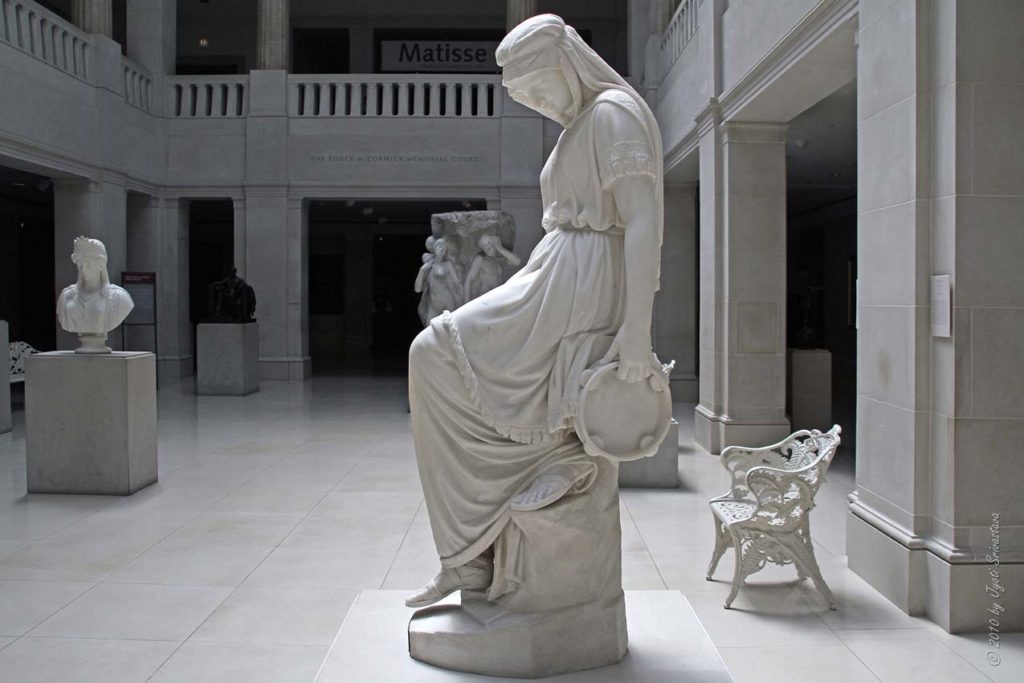
Picture: Jephthah’s Daughter at The Art Institute of Chicago.
Judges 11:29-40; Psalm 22; Hebrews 12:1-4; Luke 22:14–23:56 (Readings from A Woman’s Commentary for the Whole Church, Year A: Good Friday)
“For God so loved the world that God gave God’s only Son…” (John 3:16, Common English Bible [CEB]).
“God said, “Take your son, your only son whom you love…” (Gen. 22:2 CEB)
“Only she, an only child…” (Judges 11:35, A Woman’s Commentary for the Whole Church, Year A: Good Friday. Unless other noted, all Scripture quotations are from A Woman’s Commentary.)
Many of us know about the only sons: Isaac and Jesus. But how many of us know about the only daughter in Judges 11? I suspect not many. The Revised Common Lectionary skips her story. So does The Daily Lectionary in The Book of Common Prayer. Churches that use lectionaries have been trained to skip her story. After all, who wants to hear about a human sacrifice on Sunday morning, the Eucharistic Prayer notwithstanding?
But tonight we hear The Only Daughter’s story. Unfortunately, we cannot call her by name because the men who compiled the book of Judges didn’t think her name was important—just her father’s name is recorded.
The God of Jephthah
The story of The Only Daughter and her father is one straight out of a soap opera or telenovela. Jephthah, the father, is himself an abused son. His mother was a sex worker. His father took him from his mother, and his half-brothers and his stepmother heaped abuse on him. They ran him out of the country, and he became a mercenary. By now the area where he grew up—Gilead—is being attacked by another country, Ammon. Now the people of Gilead want Jephthah and his mercenary army to come and defend them. Jephthah only agrees to do this when the elders say they will make him the head of the region if he drives off the Ammonites. That’s where our reading begins.
For years Jephthah has been a wheeling and dealing manipulator. He knows what to say and what to do to get what he wants. So when the Spirit of the Holy One comes upon him, he does not take it at face value. This is a man who does not take anything at face value—even God. The Spirit of God isn’t enough. So the manipulator begins to wheel and deal because he wants to lead the people who drove him off. This is the deal: If God gives victory to Jephthah, he will offer “the one who comes out—whoever comes out—of the doors of my house to meet me, when I return” to God as a burnt offering.
Who Jephthah thought might be the first out of the door when he returned home after his victory is unclear. The Only Daughter, following the tradition of Miriam and Deborah, greets her father with drums, songs, and dance. And now Jephthah’s foolish and rash vow comes back on him. In his attempt to manipulate God because God’s Spirit was not good enough for him, he stands to lose his only begotten daughter.
Let’s be clear on one point from here on out: Jephthah could have repented of his foolish and rash vow. He could have admitted he was trying to manipulate God with his grandiose vow, humbled himself before God, and admitted his sin of unbelief in the power of God’s Spirit. But he didn’t. Even when the first person to greet him was his daughter-his only child. Instead of admitting his own sin, he blames her telling her, “You have become my trouble.”
The god Jephthah made his vow to will not let Jephthah out of his vow. This petty tyrant is not the Holy One who freely gave her Spirit to Jephthah, to begin with. The god of Jephthah is a rigid and unbending god who cannot forgive a foolish oath. The god Jephthah vowed his vow to makes him keep it—even if keeping it means human sacrifice, which is forbidden by the Torah. Jephthah does not question his own theology, and neither does he bargain with God as Abraham did for Lot’s life. Jephthah’s god does not forgive or relent. What is vowed must be done even if it violates the Torah that was given at Mount Sinai.
The Only Daughter’s response is as troubling as Jephthah’s vow and proclamation: “My father, you have opened your mouth to the Holy One, do to me according to what has gone out of your mouth.” The Only Daughter, not only accepts her fate, she binds Jephthah to his unfaithful words. Both father and daughter trap themselves in a vow that could have and should have been broken and repented of.
But the daughter does set a condition on her obedience: “Release me for two months, and I will go and go down among the hills, and weep for my virginity, I and my women-friends.” The Only Daughter might submit to her manipulative father’s foolish vow, but she will not spend the last months of her life with him: she chooses to spend that time with her women-friends. And those women remember her, and they teach their daughters about her. The daughters remember her, and The Only Daughter becomes “an observance in Israel. Year by year the daughters of Israel would go out to tell the story of the daughter of Jephthah the Gileadite for four days.” The Only Daughter weeps for her virginity, for she will not have children who remember her, but the faithful women in her life make sure she is not forgotten after her death.
In an interview with Christian Century, the author of A Woman’s Lectionary for the Whole Church, Dr. Wilda Gafney, said she intentionally chose each Psalm to be the woman’s or women’s response in the reading from the Hebrew Scriptures. So now we turn to Psalm 22, and hear the Only Daughter cry out: “My God, my God why have you forsaken me?/ Why are you so far from my deliverance, from the words of my groaning?/ My God, I cry by day, and you do not answer;/and by night, and there I find no rest.”
The God of Psalm 22
When we think of these words being cried out, we hear them cried out by Jesus on the Cross. In Dr. Phyllis Trible’s groundbreaking book, Texts of Terror, Dr. Trible applies these words to the daughter: “My God, my God why hast thou forsaken her,” but I have never thought about making these words the Only Daughter’s prayer as she wept and mourned with her friends. Just as God’s only Son felt abandoned on the cross, so Jephthah’s only daughter feels abandoned as well. Jesus prayed in Gethsemane the night before: “Abba, if you are willing, take this cup away from me; yet, not my will but yours be done.” The cup was not taken away for either Only Child.
As we read Psalm 22 the God of the Psalmist is entire universes away from the god of Jephthah: “Yet it was you who drew me from the womb;/keeping me safe on my mother’s breast./On you was I cast from birth,/and since my mother’s womb you have been my God.” The God of Psalm 22 is a nurse and midwife who brings life into the world and helps that life to flourish. This God is loving, caring, and trustworthy, and this is the God Jesus and the Only Daughter call out to in their time of despair.
Who Do We Say God Is?
Dr. Gafney comments that each of these texts requires us to ask who do we think God is. Are we talking about the vengeful tyrant of Judges 11 or the midwife and nurse of Psalm 22? This question matters—because this is the god we bring to tonight’s Passion Reading. Are we looking through Jephthah’s eyes seeing a petty and vengeful god who sends the only Son to be tortured and slaughtered for our sins, so that god’s wrath can be spent on Jesus, just so that same god can forgive us? Or do we bring the loving midwife and nurse of Psalm 22 to our reading of Luke’s Passion? Is God the Holy Midwife who is always bringing new life into this world, and that is the reason God sent the only Son into the world? Jesus died because those in power do not want to hear about the loving God who has no favorites. The powerful do not want the lowly to be raised. And God mourns and weeps with the women at the foot of the cross as Jesus dies just as the Only Daughter’s friends wept and mourned with her. As God weeps, God is preparing to answer this travesty. Yes, those in power—the occupying force of Rome–did the worse they could do to Jesus. But that isn’t the last word. God’s last word will come on Sunday morning.
On this holy night, we believe that Jesus was crucified, died, and was buried. He descended to the dead. Now I’m supposed to stop there, but I’m not. We believe that Jesus descended to the dead—to Sheol—the Hebrew underworld. In many Eastern icons, when Jesus is raised from the dead, he brings Adam, Eve, and all of God’s people from Sheol with him. He brings the Only Daughter with him, and Jesus KNOWS her name. The men who compiled the book of Judges may have forgotten this precious daughter’s name, but God did not.
But it is not Sunday yet. Tonight we mourn. We mourn with the other women in our readings. We mourn with the Only Daughter’s friends, and we mourn with Mary Magdalene, Mary the mother of James and Joseph, Salome, and the other female disciples at the cross. These women do not leave when Jesus is taken off of the cross. After Joseph lays Jesus in the tomb Luke tells us “The women followed, the ones who had come with him from Galilee, and they saw the tomb and how his body was placed.” Matthew tells us: “Mary Magdalene and the other Mary were there, sitting in front of the tomb” holding vigil. Both Jesus and the Only Daughter have cried out: “My God, my God, why have you forsaken me? Why are you so far from my deliverance, from the words of my groaning?” And now there is silence, and we hold vigil.
As we sit in this silence, in this holy and liminal space in the darkness of the tomb, we must remember Jesus Emmanuel: God is with us. God is with us in our lowest and bleakest times. God was with the Only Daughter as she submitted to a father that could not conceive of a God who could forgive a foolish oath. God was with Jesus as his male disciples fled, and the Roman government condemned him to death. Here the promise given at Jesus’ birth is the promise we must hold onto as Jesus lies in the tomb in the silence of Holy Saturday. God is with us. And just as God called the Only Daughter by her name, just as Jesus will call Mary Magdalene by her name, God calls each of us by name as we wait.
Wintering by Katherine Mays is a memoir written when Mays’ health forced her to take a sabbatical from her job. Her own personal winter (depression) happened during an actual winter. Mays brilliantly interweaves navigating her depression while navigating winter. As she explores winter as a time when we do pull away from the world to survive the cold weather, she compares it to navigating her own internal winter of depression, and the withdrawal and introspection that is called for in both circumstances. She also illustrates the paradox of winter’s withdrawal with the need to keep close to family and friends as well to survive both the cold months and depression as they rage on. I appreciate the fact that Mays has no easy answers, and it is a wonderful memoir of how navigating depression (any time of the year) is both a solitary and communal endeavor.
The Sentence by Louise Erdrich is a surreal, eerie novel that combines the concreteness of the pandemic and the social unrest of 2020 with a ghost story set in a bookstore in Minneapolis. Erdrich captures 2020 perfectly in her main character Tookie, who has to navigate both the pandemic and the protests and riots that followed George Floyd’s murder as a Native American woman while dealing with the ghost of a woman who constantly appropriated Native American culture while she lived.
I’ve had two ideas swirling around my head for a couple of years. The first Patricia McKillip gave me in her book Solstice Wood. The book features a group of women who use their arts and crafts to keep the land of Fairy at bay in their woods. This led me to think about a group of primarily women who use their arts and crafts to keep evil at bay in the world. Instead of fighting evil things like demons, mages gone bad, or their local alderperson (sorry, I live in Chicago) with swords, guns, or magical monsoons, they fight with their knitting needles, crochet hooks, wooden spoons and Dutch Ovens, paints, pottery wheels, and/or sewing machines.
This idea became extremely personal to me in March 2020 when COVID-19 shut down the world. When I started thinking about cracking a bottle of wine open and 10:00 am, I knew I was going to have to come up with a better way to deal with the stress. As I had been maniacally binge-watching The Great British Baking Show on Netflix, and I love to bake, that’s what I did. A couple of months earlier a friend had shared a sourdough starter with me, and I was already learning that, so I continued to learn and bake. My incredible husband found me 50 pounds of flour and a stock of yeast when everyone else jumped on the baking bandwagon, and off I went.
Of course, I thought that I’d bake for a couple of months then life would go back to normal. Two years later I’m still baking to keep my sanity and to make my friends happy. In December I baked and gave gift boxes to my friends, and saw firsthand how much an everyday craft can bring happiness and joy to our bleak world (and winter in Chicago is bleak my friends).
These two ideas keep feeding each other: that the everyday arts and crafts we do in our everyday lives, not only make our lives better but make our world a better place to live. This idea shouldn’t be so revolutionary to me. After all, I’m a Christian who believes that God is the Creator of everything. I also believe that this God made all human beings in her image. So of course we are all creators–we are made in the Creator God’s image.
But the connection that God’s creative action that changed The Void into something else in Genesis 1 could be connected to my baking (or knitting) changing the world into something else has only been an idea that clicked with me in the last couple of years. But I’m discovering that being made in the image of God means exactly that: our creative work, no matter how small or ordinary, changes the world we live in: it makes creation more of the place God intended it to be. (The crazy thing is I wrote an article about how writing does this in Writing the World Right years ago. I never thought to apply it to baking and knitting.)
This idea is what I’m going to be exploring on this blog for the next few months. I will be telling my stories and hopefully telling stories from friends and family as well. And I want to hear your stories. How are using your creative ability, your arts and crafts, to make yourself, your family, your home, your community, and your world a better, more beautiful, and divine place?
“In the year King Uzziah died,” Isaiah said, and those who were listening shuddered and looked at their feet instead of at him. It would be the equivalent of saying “In the year terrorists flew planes into the World Trade Center.” Or “In the year Covid-19 shut down the world.” The year King Uzziah died was not a good time for the country of Judah. The empire of Assyria was expanding its power through conquest. The end of Uzziah’s reign would be the last time Judah was an independent country in the middle of the empires of the Middle East and Egypt. The Syro-Ephraimitic War was just beginning. As a response to Assyria’s growing dominance, Syria and Israel had joined together to fight Assyria. When Judah refused to join them, they decided to attack Judah and make King Ahaz, Uzziah’s successor, join them one way or the other. So when Isaiah began his story of how he was called by God with “In the year King Uzziah died,” the people were not expecting a story with a happy ending.
Then Isaiah told where he was when he saw his vision of God: the Temple. And the people thought, “Oh that must be nice. To be one of the few people who can go into the Temple and be safe. How nice for him.”
Because here is what we modern-day Christians tend to forget: the Temple in Jerusalem was not like our churches. Not just anyone could get into the Temple itself: you had to be descended from Aaron. Only Aaron’s male descendants could be priests, and priests were the only ones allowed into the Temple itself. Women could go into the outer court, and men could go into the inner court, but only priests went into the temple. Isaiah was part of a very select group. The only reason he could pray in the Temple where God appeared to him was that he was born into the right family.
But God isn’t going to let Isaiah stay in the Temple. Although Isaiah had a vision of God’s robe filling the Temple, the seraphs who wait before the throne declare: “Holy, holy, holy is the LORD of hosts; the whole earth is full of his glory.” The WHOLE earth is full of God’s glory—not just the Temple or even the Temple Mount. The seraphs declare God is found in all of the world, and God wants someone to go into that world and tell the people God is with them wherever they are.
The Temple hierarchy is still firmly in place when Nicodemus visits Jesus one night in John 3. In fact, Jesus had just let the priests know what he thought of the way they controlled access to God in the previous chapter by throwing the merchants and money changers out of the Temple’s outer court. The only place women and Gentile proselytes could worship was also a noisy marketplace full of merchants selling animals to sacrifice and exchanging unclean pagan money for the Temple shekel. Jewish men could get away from the chaos in the inner court of the Temple, and of course, the priests could still go into the silent Temple, so the noise and hoopla from the outer court didn’t bother them in the least.
Jesus makes it clear to Nicodemus that God hasn’t changed her mind about being out and about in the world. The two have an interesting and befuddling theological conversation:
Jesus begins: “‘Very truly, I tell you, no one can see the kingdom of God without being born from above.’ Nicodemus said to him, ‘How can anyone be born after having grown old? Can one enter a second time into the mother’s womb and be born?’ Jesus answered, ‘Very truly, I tell you, no one can enter the kingdom of God without being born of water and Spirit. What is born of the flesh is flesh, and what is born of the Spirit is spirit. Do not be astonished that I said to you, “You must be born from above.” The wind blows where it chooses, and you hear the sound of it, but you do not know where it comes from or where it goes. So it is with everyone who is born of the Spirit.’ Nicodemus said to him, ‘How can these things be?’ Jesus answered him, ‘Are you a teacher of Israel, and yet you do not understand these things?’”
I don’t know if Nicodemus is actually confused by this conversation, or if he is being deliberately obtuse. Nicodemus is part of the Temple hierarchy: he benefits as a leader who has access to God and denies that same access to most of the Jewish people and all of the Gentile proselytes. But if Jesus is right–if there is another birth after the physical birth that gave Nicodemus the privileged access to God he has, and that birth of the Spirit grants equal access to God regardless of what tribe or family that one is born into–then who needs to the Temple? And who needs the Temple hierarchy to mediate between God and her people? If “the wind blows where it chooses, and you hear the sound of it, but you do not know where it comes from or where it goes. So it is with everyone who is born of the Spirit” is true, and this birth of the Spirit is as mysterious as the wind coming and going then how is the Temple hierarchy able to control access to the God of the heavens and the earth?
So when Nicodemus asks: “How can these things be?” he may not be asking about how being born from above by the Spirit is possible. He may be asking how can it be that everyone is able to have equal access to God.
So you may be wondering what all of this has to do with Trinity Sunday. Here’s the takeaway: it doesn’t matter which member of the Trinity we’re talking about: the Father or Mother, the Son, or the Holy Spirit: there is one thing the entire Godhead is agreed on: everyone on this planet has equal access to God the Father and Mother, God the Son, and God the Holy Spirit. The whole earth is full of God’s glory. The Spirit blows wherever she wants and makes whoever she wills a child of God, regardless of birth, family, race, nationality, religion, or creed. The family of the Trinity wants everyone to come into the fold, and the Godhead has always been actively working against all of the ways we humans come up with to limit access to God.
God appeared to Isaiah in the Temple because that was the only place Isaiah thought God would be and found out otherwise. Nicodemus comes to Jesus at night and discovers Jesus’ clearing out the Temple of salespeople was just the start of his radical idea that God was everywhere. And this is where my brain has been all week. Seeing the power structures in place in these Scripture Readings to keep most of the people away from God. Thanks to this last year I’ve been thinking A LOT about power structures anyway, as I’m sure most of us have. Both the pandemic and the Black Lives Matter movement have shown us the unequal access to health care, justice, and being able to walk down the street safely whole swaths of Americans have to live with. The last thing the church should be doing is upholding these power structures. Unfortunately, the opposite is true: the white church in the U. S. not only upholds these power structures, but we created them. Then we claimed they were God’s will just as Isaiah and Nicodemus thought it was God’s will to so severely limit access to God through the Temple hierarchy.
You’d think at some point God would just get tired of us stupid humans doing the same thing over and over and over again. Seriously, we’ve been creating power structures to limit access to God and to the resources God created for everyone to share in since the beginning. All the selfishness, greed, and power hoarding going on in this country isn’t new. Just ask the people of Judah after King Uzziah died. The human race has been acting this way for a very long time. And God just keeps coming to us and showing us there is another way to live. The WHOLE EARTH is still full of God’s glory. God the Creator is still creating and re-creating the world. God the Son is still teaching the world what it looks like to live the way God wants us to live. God the Holy Spirit is still blowing through the world making us children of God with unlimited access to the Holy and Undivided Trinity. The Trinity never gives up on us. So we can’t give up on ourselves either.
I’m proud of the work Grace has done to address our own prejudices and the way we are complicit in these power structures. I’m proud we want to repent of these sins, and we want to do things that will start taking down these structures. As we do this work of making the South Loop and Chicago a more equitable place for everyone, we need to remember that the Holy Trinity has already gone before us. The Godhead has been at work in this city for a very long time challenging these power structures, and leading churches across the city to address different aspects of the power structures that try to hoard as much as possible for the fewest people possible.
As we enter Ordinary Time—the time the church is called to take Christ out into the world–we need to remember Christ is already in the world working. The Holy Spirit is still blowing through the world. And the Creator is still fine-tuning her creation. We just need to pay attention. Pay attention to where the Trinity is already at work. Then join the Creator, the Son, and the Holy Spirit in the continuing work of redeeming the entire world for God because the whole earth is full of God’s glory.
The women of Holy Week frame the Passion of Jesus in the Gospel of Mark. Mark’s Passion Narrative began in chapter 14 with the female prophet who anointed Jesus as king and prepared him for his burial. Mark’s Passion ends with Mary Magdalene, Mary the mother of James and Joses, Salome, and “many other women who had come up with him to Jerusalem” bearing witness at the cross, and the two Marys holding vigil in front of the tomb. The stories of women embrace Jesus’ betrayal, arrest, denial, trial, and crucifixion. They followed “him and ministered to him when he was in Galilee,” and they followed him to Jerusalem (Mark 15:41).
Women were watching from a distance. Among them were Mary Magdalene, Mary the mother of James the younger and of Joses, and Salome. They had followed him and ministered to him when he was in Galilee. Many other women who had come up with him to Jerusalem were also there. That evening, because it was the Preparation Day (that is, the day before the Sabbath), Joseph of Arimathea came. He was a prominent council member who was also looking forward to the reign of Godde. He dared to go to Pilate and asked for Jesus’ body. Pilate was amazed that he might already be dead. He called the centurion and asked him whether Jesus had been dead long. When he confirmed it with the centurion, he gave the body to Joseph. He bought a linen cloth, took down the body, wrapped it in the linen cloth, and laid it in a tomb that had been cut from rock. He rolled a stone to the door of the tomb. Mary Magdalene and Joses’ mother Mary saw where he was laid (Mark 15:40-47, New Testament: Divine Feminine Version [DFV]).
At the Cross
In Mark those who follow Jesus are disciples. Minister comes from the Greek word group from diakonos, which means to serve. Diakonos is the word we get our word deacon from. Originally meaning “table service,” in the New Testament it became a specialized term for ministers of the Word and Eucharist. Mark uses minister when the angels ministered to Jesus after his temptation and when Peter’s mother-in-law ministered to Jesus after he healed her. Jesus used minister when he said “the Son of Woman came not to be served but to serve, and to give his life to liberate many” in Mark 10:45 (DFV).
The only time serve or minister is used for a man in The Gospel of Mark it describes Jesus. The other times the words are used they refer to angels or women. Elizabeth Struthers Malbon notes “Not only does Jesus take up women’s work, but women take up Jesus’ work. Women, from near the bottom of the hierarchy of power, have served and remained faithful followers to the end–although even they are ‘looking on from afar’….It is striking that Mark chooses to emphasize the presence of women followers in the absence of the male disciples at the crucial moment of Jesus’ death. Those with power can learn from those with less power” (“Gospel of Mark,” Women’s Bible Commentary, 491).
At the Tomb
Mary Magdalene, Mary, Salome, and the other women continued to faithfully minister to Jesus until the end. The women of Holy Week did not run away, they did not hide. Even if it was at a distance, they stayed with Jesus. They bore witness to his death, and they made sure he did not die alone. Mary Magdalene and Mary watched Joseph of Arimathea bury Jesus then remained at the tomb holding vigil. On Sunday morning they would be the first ones back at the tomb to finish anointing Jesus’ body for burial. We come full circle: at the beginning of the Passion Narrative the female prophet anointed Jesus to prepare him for the days ahead, and now Mary Magdalene and the other women who followed Jesus from Galilee now come to finish anointing Jesus’ body.
God rewarded them for their tenacity, perseverance, and faithfulness: they are the first to hear of the resurrection and see the risen Jesus. As they bore witness to the death and burial of Jesus, they now bear witness to the resurrection of Christ. The messenger at the tomb commissioned to tell the rest of the disciples that God has raised Jesus from the dead.
It is time for the church to stop overlooking the women of Holy Week, and to tell their stories in the context of Holy Week. These women show what Christ-like service looks like. Unlike the male disciples, they did not let their own ambitions blind them to Jesus’ teaching that he would die. They listened and understood. They ministered to him, and they bore witness. The women of Holy Week did not leave him alone during his darkest hours. The church needs to recognize and praise these women for their great faithfulness instead of pushing them into the shadows and forgetting them.
The women of Holy Week have always fascinated me. Apart from a passing glance at the foot of the cross, the church ignores them. It doesn’t help that The Revised Commentary Lectionary places some of their stories outside of Holy Week, and rips them out of their theological context.
When I did my own study of the women of Holy Week, I was surprised to find the first woman mentioned in Holy Week was the widow who gave her last two pennies as an offering in the Temple. I never connected her story with Holy Week, and for good reason: before her story is a list of controversies and debates Jesus was having with the religious leaders in the Temple. After her story, Jesus described the destruction of the Temple and what would happen before his second coming. Big stories with lots of drama are on either side of this humble, generous widow.
The Widow
Jesus sat down across from the treasury and watched the crowd throw money into the treasury. Many who were rich threw in large amounts. A widow who was poor came and threw in two small copper coins, which are worth a penny. He called his disciples and said, “Believe me when I say that this widow who was poor gave more than all those who are contributing to the treasury because they all gave out of their abundance, but she, poor as she is, gave everything she had – all she had to live on” (Mark 12:41-44, New Testament: Divine Feminine Version [DFV]).
This happened right after Jesus finished criticizing religious leaders who “devour widows’ houses and show off with long prayers” (v. 40). Normally stewardship campaigns praise this woman as a person who gave unselfishly to God. She trusted God would provide. But that interpretation does this woman a great disservice.
Elizabeth Struthers Malbon notes: “The poor widow is unlike the self-centered scribes and instead like Jesus–one who gives all. The last words of her story could well be translated ‘but she from her need cast in all of whatever she had, her whole life.’ Perhaps we are to assume that the poor widow has been victimized by the greedy scribes and by the authority of traditional religious teaching. But in this again she is like Jesus, who teaches with ‘authority, and not as the scribes’ (1:22), yet is victimized by those who hold authority in the temple and in the broader religious tradition” (Women in Scripture, 432).
Jesus’ praise of this woman–who lived her life the same way he called his disciples to live–is the last thing Jesus said before he left the Temple for the last time. Her offering of everything she had foreshadows Jesus’ own offering of his life on the cross. We praise this woman for pointing the way to Christ and for living the same kind of life, that Jesus himself lived: an all-encompassing sacrifice to God. The stewardship campaigns need to tell her full story instead of simply praising her for giving her last two cents.
The Prophet
After Jesus praised this woman and left the Temple, he described the future destruction of Jerusalem and the Temple. In chapter 14 we discover this end of times discourse nestled between two stories of women and their Christlike generosity. In Mark 14:1-11 we meet the woman who anointed Jesus as king and prepared him for his death and burial. This happened the day before he celebrated the Last Supper (for her story see my sermon, Anointing the King).
Once again Mark contrasts the thoughts and actions of corrupt religious men with the Christlike actions of a woman:
When he was in Bethany, reclining at the table in the house of Simon who had leprosy, a woman approached him with an alabaster jar of very expensive ointment made of pure nard. She broke the jar and poured it over his head. But some got angry. “Why has this ointment been wasted?” they said to one another. “This ointment could have been sold for more than three hundred denarii and given to those who are poor.” They scolded her.
But Jesus said, “Leave her alone! Why are you bugging her? She has done a good deed for me. You will always have people who are poor with you, and you can help them whenever you want to; but you won’t always have me. She did what she could. She poured this ointment on my body to prepare me for burial. Believe me when I say that wherever the good news is proclaimed in the whole world, what this woman has done will be talked about in memory of her” (Mark 14:3-9, DFV).
This is the first scene in Mark’s passion narrative. This woman who acted as a prophet (or priest) and anointed Jesus as king began Jesus’ journey to the cross. Like the widow, we see another selfless act of generosity. As the people in the Temple ignored the widow, Jesus’ fellow dinner guests criticized this woman’s offering as wasteful. Jesus rebuked the critics and praised the woman for preparing him for his burial. Jesus knew his road to kingship led to the cross, and he promised this prophet would be remembered wherever the Gospel is preached.
The First Two Women of Holy Week
In comparing these two women Malbon notes: “One woman gives what little she has, two copper coins; the other gives a great deal, ointment of pure nard worth more than three hundred denarii; but each gift is symbolically or metaphorically priceless. The irony that the poor widow’s gift occurs in the doomed temple is matched by the irony that the anointing of Jesus Christ, Jesus Messiah, Jesus the anointed one, takes place not in the temple but in a leper’s house (14:3), and not at the hands of the high priest but at the hands of an unnamed woman” (Women in Scripture, 433).
The widow and the prophet close Jesus’ public ministry in Mark and begin his journey to the cross. They foreshadow Jesus’ coming death. They also live the life of sacrificial faith that Jesus will live through his arrest, crucifixion, and death. These two women won’t be the last women we meet this Holy Week. In Mark, stories of women surround the entire Passion Narrative: The prophet who anointed Jesus opens the Passion Narrative and the women who stood vigil at the tomb close the narrative. The women who followed Jesus embraced him in this narrative as he lived through his betrayal, arrest, denial, and death on the cross. They obeyed him, and they did not forsake him.
How will we follow these women’s Christlike examples through Holy Week? What do the widow and the prophet have to teach us about living Christlike lives?
The second part of this series, The Women at the Cross and Tomb, will be posted on Wednesday.