Career Women of the Bible: Church Overseers, Ministers, and Patrons

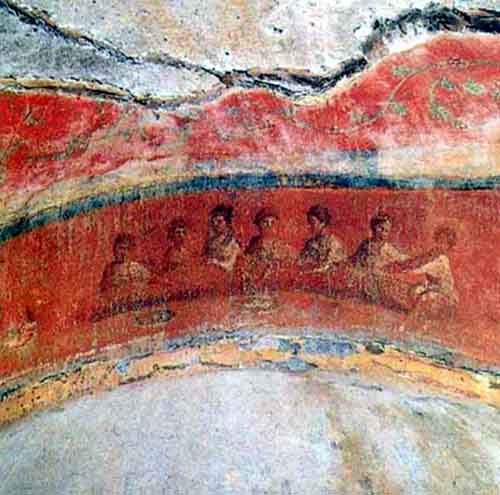
"The Breaking of Bread" in the Catacomb of St. Priscilla/Dorothy Irvin

In the last two articles we have been looking at women who ministered in leadership positions in the New Testament (Apostles and Prophets and Teachers, Elders, and Coworkers). We saw women minister as prophets, apostles, teachers, elders, and coworkers. Now we will look at the last three leadership roles: church overseer, minister, and patron.

Church Overseer

Church overseers were what we traditionally think of as a pastor, and they were normally the person or people who opened their homes for believers to meet for hearing God’s word and worship. Women who were overseers include Priscilla, Phoebe, Euodia, Syntyche, and possibly John Mark’s mother, Chloe, Lydia, and Nympha (Spencer, 108). The church overseer I would like to focus on is the “Elect Lady” of 2 John.

(more…)

What Is Worship?

Worship is not primarily about you and your bundle of felt needs, wishes, desires, good intentions, or a desire to escape dull or threatening realities of life through a swooning spiritual experience. “Worship is not about performance! The worship leaders are not there to keep us amused and entertained; they are not performers fishing for double encores. They are to guide us in offering a sacrifice of worship to God.” Worship is about God. We worship God because of who he is (Tracy, The Wesleyan-Holiness Way to Spiritual Formation, lesson 15). ” From “Spiritual Direction in the Wesleyan-Holiness Tradition” by Wesley D. Tracy in Spiritual Direction and the Care of Souls: A Guide to Christian Approaches and Practices.

I think this is why I lean toward liturgical worship. It is firmly centered around God in music, sermon, prayer and communion. It’s focus is this is how we come into God’s presence corporately. I also like how music cannot take over the worship service. So many times worship is reduced to music and singing, and that is only one part of worship. Public proclamation of the Word is also worship (one of the reasons I like the lectionary: reading all the passages for Sunday focuses us on the importance of God’s Word itself instead of just the interpretation of a passage during the service). The sermon is part of worship as is the prayers of the community, offertary, and communion.

The one thing I have loved about the emergent movement is its insistence on broadening what worship is and its communal nature. Corporate worship is “us and Jesus” not “me and Jesus with all these other people.” That’s one of the reasons responsive readings and readers’ theaters are some of my favorite forms of worship: it emphasizes that we are worshiping together as a community (as does singing, but I’m not great singer, and I love to proclaim Scripture). We are not sitting in a cocoon separated from everyone else (which is why I rarely close my eyes during singing–I like looking at the people I’m worshiping with).

What about you? What do you think worship is and what should it do? How do you like to worship with your community of faith?

Kurt Vonnegut

I would like to remember Kurt Vonnegut with his own words from A Man Without a Country:

For some reason, the most vocal Christians among us never mention the Beatitudes. But, often with tears in their eyes, they demand that the Ten Commandments be posted in public buildings. And of course that’s Moses, not Jesus. I haven’t heard one of them demand that the Sermon on the Mount, the Beatitudes be posted anywhere.

“Blessed are the merciful” in a courtroom? “Blessed are the peacemakers” in the Pentagon? Give me a break!

Blessed are the poor in spirit, for theirs is the kingdom of heaven.
Blessed are those who mourn, for they will be comforted.
Blessed are the meek, for they will inherit the earth.
Blessed are those who hunger and thirst for righteousness, for they will be filled.
Blessed are the merciful, for they will receive mercy.
Blessed are the pure in heart, for they will see God.
Blessed are the peacemakers, for they will be called children of God.
Blessed are those who are persecuted for righteousness’ sake, for theirs is the kingdom of heaven. Blessed are you when people revile you and persecute you and utter all kinds of evil against you falsely on my account. Rejoice and be glad, for your reward is great in heaven, for in the same way they persecuted the prophets who were before you.

What would our world look like if we took Jesus and his Beatitudes as seriously as we take The Ten Commandments?

(H/T to Street Prophets.)

RevGals Friday Five: Dental Edition

Cheesehead and I are both laid up this week with various tooth maladies. This one’s in honor of us:

1. Are you a regular patron of dentists’ offices? Or, do you go
a) faithfully, as long as you have insurance, or
b) every few years or so, whether you need it or not, or
c) dentist? what is this “dentist” thing you speak of?

I was a faithful attender of the dentist’s office until I moved to Chicago. It’s now been over a year, and I really need to find a new dentist and get going again.

2. Whatever became of your wisdom teeth?

They were removed. That’s when I found out the vicodin makes me sicker than a dog. Nothing like hurling with gaping holes in the back of your mouth.

3. Favorite thing to eat that’s BAAAAAD for your teeth.

Probably all the that lovely chocolate I love to eat.

4. Ever had oral surgery? Commiserate with me.

Yes, two of my wisdom teeth were embedded in my gums and had to be surgerically cut out, hence the gaping wholes in the back of my mouth.

5. “I’d rather have a root canal than _________________.”

Go through my teenage years again.

Bonus: Does your dentist recommend Trident?

Don’t know–I need to find one here.

Blogs that Make You Think

Sally was kind enough to list me as one of the bloggers who make her think, and I am now posting a blog in response:

1. If, and only if, you get tagged, write a post with links to 5 blogs that make you think
2. Link to this post so that people can easily find the exact origin of the meme
3. Optional: Proudly display the ‘Thinking Blogger Award’ with a link to the post that you wrote (here is an alternative silver version if gold doesn’t fit your blog).

Here are five blogs that make me think:

The Dude Abides by Kathleen Falsani. I’ve enjoyed Kathleen’s writing since I moved Chicago last year. Her book, The God Factor, had just come out, and I read it and loved it. I also always catch her column is the Chicago Sun-Times. I love how she weaves together religion and faith with pop culture. For you nature lovers out there, Kathleen is in Montana working on a book, and she’s posting some fabulous pictures.

Sally of Eternal Echoes–I have a soft spot in my heart for Sally. I have clinical depression and have struggled with it for years while going through seminary, ordination and then on into ministry (sound familiar Sally?). She’s really inspiring me to start writing up my own experiences with depression. I plan on doing that once I have the book proposal on spiritual direction done. It’s also very obvious the influence her posts have on me as I am regularly referring you to her blog.

the merge, or as I know him Eric. Eric and I went to seminary together and worked together as well. We’ve been buds a long time. Eric is a church planter and has excellent posts on being a leader and planting churches. He also passes on great articles and resources when he finds them. But my favorite posts are about his daughter: she wants to be President one day. 🙂

Junia’s Daughter is Mother Laura’s blog. She is insisting on following her call to be a priest in the Catholic Church, and I have a great deal of respect for her. Sometimes it’s hard enough being an ordained minister in a tradition that has been ordaining women for 103 years (like the Church of the Nazarene, although for a time we forgot about our history of incredible women pastors, evangelists, and teachers), but to be doing what she’s doing in the Catholic Church just leaves me in awe. She always has thought provoking posts, and she has written some incredible stuff on redeeming the sexual abuse she endured. I probably should be referring you to her as often as I do to Sally!

Hugo Schwyzer who always makes me think whether I want to or not. Hugo covers everything from sports to teaching to feminism to men who are feminist, and always seems to be able to be theological about all of it.

I’m not going to “tag” anyone, but I’d love to know what blogs influence you the most. If you’re comfortable sharing with us, then please share!

Good Friday

Christ himself bore our sins in his body on the tree.
That we might die to sin and live to righteousness.

Almighty God,
your Son Jesus Christ was lifted high upon the cross
so that he might draw the whole world to himself.
Grant that we, who glory in this death for our salvation,
may also glory in his call to take up our cross and follow him;
through Jesus Christ our Lord. Amen.

(From The United Methodist Book of Worship. Painting by Paul Heussenstamm.)

Career Women of the Bible: Apostles and Prophets

Andronicus, Athanasius of Christianopoulos and Saint Junia

Before Jesus ascended to the Father, he told his followers to wait in Jerusalem until the Holy Spirit came empowering them to continue building the kingdom of God on earth. They obeyed him. Acts 1:14 tells us the disciples and “certain women”Âť including Mary, the mother of Jesus, waited in the upper room and prayed. In Acts 2 the Holy Spirit fell on both men and women, and both genders were empowered to proclaim the word of God on the day of Pentecost. Peter confirmed this when he quoted Joel in his sermon that day: “In the last days it will be, God declares, that I will pour out my Spirit upon all flesh, and your sons and your daughters shall prophesy, and your young men shall see visions, and your old men shall dream dreams”Âť (Acts 2:17, NRSV). As we have seen throughout this series, Career Women of the Bible God has never discriminated between calling and empowering both men and women to lead God’s people and accomplish God’s plans on earth. This will not change with the coming of the new age. Now God’s Spirit would not be for the called few, but for everyone–all flesh, and both sons and daughters would prophesy, only now in greater numbers.

In Galatians 3:28 Paul proclaimed that “There is no longer Jew nor Greek, no longer bondservant nor free, no longer male and female, because you are all one in Christ Jesus.”Âť In Christ every human erected barrier comes down. Because Christ died for all, and all are saved through grace, there can no longer be superficial hierarchies of race, class, or gender. In Ephesians 4:8 Paul tells the church that Christ has given them gifts, and in verse 11 he tells us the gifts are “that some would be apostles, some prophets, some evangelists, some pastors and teachers” (NRSV). These gifts are given “to equip the saints for the work of ministry, for building up the body of Christ” (Ephesians 4:12, NRSV). Paul never says that some or all of these gifts are for men only. In fact, the New Testament goes on to describe women in these places of leadership within the Early Church.

Apostles

The literal meaning of apostolos is someone who has been sent with orders (Spencer, 100). The basic meaning is “messenger.”Âť In the New Testament an apostle could refer to one of the Twelve. It could also refer to all of those “who had accompanied the original twelve from the time that John baptized until Jesus ascended (Acts 1:21-22; ibid).” This would include Barnabas, James the brother of the Lord, and Silvanus who were not among the Twelve. It would also include the women we have seen in previous articles who followed Jesus: Mary Magdalene, Mary, mother of James; Mary, mother of Jesus; Joanna, and Salome.

There is a woman in the New Testament specifically named as an apostle: Junia. In Paul’s personal greetings to the believers in Rome he tells them to “7Greet Andronicus and Junia, my relatives who were prisoners with me. They’re outstanding among
the apostles, and they were in Christ before I was”Âť (Rom. 16:7). In the Roman world, Junia was a common name for women. Junia was assumed to be a woman by the early church fathers such as Origen and Jerome. In the fourth century John Chrysostorm said of her: “Oh! how great is the devotion of this woman, that she should be even counted worthy of the appellation of apostle!” Up until the thirteenth century when Aegidus of Rome referred to both Adronicus and Junia as “men”Âť (he translated Junia as “Julian”Âť), most commentators assumed Junia was a woman (the male form “Junias” is completely unknown in the Roman world). Since then there have been many textual variations trying to turn Junia’s name into a male form (Spencer 101-2, Grenz 94-5).

Another way that Junia’s role as an apostle has been marginalized is by watering down the translation of “outstanding [or “prominent,” NRSV] among the apostles.” Opponents of women in leadership positions have suggested Junia was only admired by the apostles, or she was well known to them. She was not one of their number. The word normally translated “prominent”Âť is episeimos. Its proper meaning is “a sign or mark upon,”Âť and is used to describe an inscription on money; “it implies selection from a group”Âť (Spencer, 102). Coupled with the preposition en, which means “within” or “among” in the plural, it is clear that Adronicus and Junia are prominent or notable “from among the apostles”Âť (ibid).

As apostles in Rome they were Paul’s counterparts. They apparently had witnessed part of Jesus’ ministry and his resurrection, and were sent by God and the church to proclaim this news in Rome. These two apostles “apparently laid the foundation for the churches’ in Rome, just as Paul had planted and laid the foundation for churches in Asia Minor and Eastern Europe (ibid). They would have done this through preaching the gospel and teaching the way of Christ. It is possible they were married and operated as a ministerial team like Priscilla and Aquila (Grenz, 96-7). This does not change the fact that Junia was named as an apostle. Since there is no mention of any of the apostle’s wives being named “apostle”Âť simply by being married to one, it is safe to assume that Junia was an apostle because she functioned as one in the early church.

Prophets

As we saw in previous chapters female prophets who spoke God’s word and led in worship were part of Israel’s history and theology. The tradition continued through Anna in Luke 2 and Philip’s four unmarried daughters in Acts 21:9. From Paul’s correspondence with the Corinthian church we find that women praying and prophesying during services was an accepted part of the worship service in the early church. Paul does not condemn the women for taking an active part in the service, which would have included authoritative prophetic utterance of God’s word. He only exhorts the women to do so in a manner that will not be scandalous to outsiders. If they are married, they are to keep their symbol of marriage on–their head was to be covered with a veil or worn up as was the custom for married women in that day. This way they would not be confused with the temple prostitutes that were numerous in Corinth due to the temple of Aphrodite-Melainis. The temple prostitutes were identified by wearing their hair loose or shaving it off. Christian women were not to bring shame onto their husbands by looking like prostitutes, but were to keep their “wedding ring”Âť on, and prophesy and pray in a socially acceptable manner. (For a great overview of the cultural and sociological context of these verses in 1 Corinthians, see my friend Mark Mattison’s “Because of the Angels: Head Coverings and Women in 1 Corinthians 11:2-16 and 14:34,35.)

Whether widowed as Anna, never married as Philip’s daughters or married as some of the Corinthian women were, Christian women continued the ancient tradition of speaking God’s word to his people.

Sources

Shawna Renee Bound, Your Daughters Shall Prophesy: A Biblical Theology of Single Women in Ministry, unpublished thesis, (© by Shawna Renee Bound 2002), “Women in the Early Church.”

Stanley J. Grenz with Denise Muir Kjesbo, Women in the Church: A Biblical Theology of Women in Ministry (Downers Grove, IL: InterVarsity Press, 1995).

Aída Besançon Spencer, Beyond the Curse: Women Called to Ministry (Peabody, MA: Hendrickson Publishers, 1985), 43-63.

All biblical translations are from the New Testament: Divine Feminine Version unless otherwise noted.

What Is Theology?

I found this fascinating description of theology in Kenneth Leech’s Soul Friend: The Practice of Christian Spirituality. He begins by saying that the entire spiritual tradition of Eastern Christianity rejects the idea of “detached” theology:

Theology is an encounter with the living God, not an uncommitted academic exercise. The encounter cannot survive if its only locus is the lecture theatre or the library. It needs the nourishment of sacramental worship, of solitude, of pastoral care and the cure of souls. Theology must arise out of and be constantly related to a living situation. Again in Eastern Orthodox thought all theology is mystical.

There is therefore no Christian mysticism . . . it is an existential attitude which involves the whole [person]: there is no theology apart from experience; it is necessary to change, to become a new [person]. To know God one must draw near to him. No one who does not follow the path of union with God can be a theologian.

So there should be no conflict between theology and spirituality, still less should theology be seen as a mere theorectical framework for spiritual life. Rather, all theology is contemplative, a concentrated looking upon God as revealed in Christ, and manifested in lives which are hidden with Christ in God.

It is with the mystery of renewal of human souls that all true theology and all spiritual direction is concerned.

What do you think theology is? What is your definition? Would anything look different in our Christian—both personally and in the community faith—if this is what we believed about theology and life in Christ?

Sermon: Lost and Restoration

This was a Lenten sermon I preached two or three years ago. St. Patrick is a big part of the sermon, so I thought it would be good to post it today.

Happy Saint Patrick’s Day!

“Loss and Restoration”
Ruth 1

A fleet of 50 longboats weaved its way toward the shore, where a young Roman Brit and his family walked. His name was Patrick, the 16-year-old son of a civil magistrate and tax collector. He had heard stories of Irish raiders who captured slaves and took them “to the ends of the world,” and as he studied the longboats, he no doubt began imagining the worst.

With no Roman army to protect them (Roman legions had long since deserted Britain to protect Rome from barbarian invasions), Patrick and his town were unprepared for attack. The Irish warriors, wearing helmets and armed with spears, descended on the pebbled beach. The braying war horns struck terror into Patrick’s heart, and he started to run toward town.

The warriors quickly demolished the village, and as Patrick darted among burning houses and screaming women, he was caught. The barbarians dragged him aboard a boat bound for the east coast of Ireland.

Patrick was sold to a cruel warrior chief, whose opponents’ heads sat atop sharp poles around his palisade in Northern Ireland. While Patrick minded his master’s pigs in the nearby hills, he lived like an animal himself, enduring long bouts of hunger and thirst. Worst of all, he was isolated from other human beings for months at a time. Far from home, he clung to the religion he had ignored as a teenager. Even though his grandfather had been a priest, and his father a town councilor, Patrick “knew not the true God.” But forced to tend his master’s sheep in Ireland, he spent his bondage mainly in prayer.

After six years of slavery Patrick escaped to the European continent. Many scholars believe Patrick then spent a period training for ministry on an island off the south of France. But his autobiographical Confession includes a huge gap after his escape from Ireland. When it picks up again “after a few years,” he is back in Britain with his family. It was there that Patrick received his call to evangelize Ireland—a vision like the apostle Paul’s at Troas, when a Macedonian man pleaded, “Help us!”

“I had a vision in my dreams of a man who seemed to come from Ireland,” Patrick wrote. “His name was Victoricius, and he carried countless letters, one of which he handed over to me. I read aloud where it began: ‘The Voice of the Irish.’ And as I began to read these words, I seemed to hear the voice of the same men who lived beside the forest of Foclut …and they cried out as with one voice, ‘We appeal to you, holy servant boy, to come and walk among us.’ I was deeply moved in heart and I could read no further, so I awoke.”

Despite his reputation, Patrick wasn’t really the first to bring Christianity to Ireland. Pope Celestine I sent a bishop named Palladius to the island in 431 (about the time Patrick was captured as a slave). Some scholars believe that Palladius and Patrick are one and the same individual, but most believe Palladius was unsuccessful (possibly martyred), and Patrick was sent in his place. In any event, paganism was still dominant when Patrick arrived on the other side of the Irish Sea. “I dwell among gentiles,” he wrote, “in the midst of pagan barbarians, worshipers of idols, and of unclean things.”

Patrick was in his mid-40s when he returned to Ireland. Palladius had not been very successful in his mission, and the returning former slave replaced him. Intimately familiar with the Irish clan system (his former master, Milchu, had been a chieftain), Patrick’s strategy was to convert chiefs or kings first, who would then convert their clans through their influence. Reportedly, Milchu was one of his earliest converts.

Predictably, Patrick faced the most opposition from the druids, who practiced magic, were skilled in secular learning (especially law and history) and advised Irish kings. Biographies of the saint are replete with stories of druids who “wished to kill holy Patrick.” “Daily I expect murder, fraud or captivity,” Patrick wrote, “but I fear none of these things because of the promises of heaven. I have cast myself into the hands of God almighty who rules everywhere.”

Indeed, Patrick almost delighted in taking risks for the gospel. “I must take this decision disregarding risks involved and make known the gifts of God and his everlasting consolation. Neither must we fear any such risk in faithfully preaching God’s name boldly in every place, so that even after my death, a spiritual legacy may be left for my brethren and my children.”

Patrick continued to concentrate the bulk of his missionary efforts on the country’s one hundred or so tribal kings. As kings converted, they gave their sons to Patrick in an old Irish custom for educating and “fostering” (Patrick, for his part, held up his end by distributing gifts to these kings). Eventually, the sons and daughters of the Irish were persuaded to become priests, monks, and nuns.

From kingdom to kingdom (Ireland did not yet have towns), Patrick worked much the same way. Once he converted a number of pagans, he built a church. One of his new disciples would be ordained as a deacon, priest, or bishop, and left in charge. If the chieftain had been gracious enough to grant a site for a monastery as well as a church, it was built too and functioned as a missionary station.

Though he was not solely responsible for converting the island, Patrick was quite successful. He made missionary journeys all over Ireland, and it soon became known as one of Europe’s Christian centers.

Patrick was not the first or the last to be taken to a place he did not want to go. Neither was he the first to go to a place he might not be well received. In our passage today we are going to meet two women—one women was taken to a foreign country by her husband during famine. The other woman chose to leave her country for one where she might not ever be accepted. Ruth and Naomi both knew what it was like to live in a foreign land. They also knew what is like to lose or leave behind everything one has known.

Ruth 1:1-21
This story starts in perilous times—“In the days when the judges ruled.” Like England and Ireland in Patrick’s day was dangerous, so was Israel of Ruth and Naomi’s day. In fact Judges has just ended with a cycle of stories that has graphically shown how far Israel had gone in their disobedience, rebellion, and adultery. Judges has just ended with a story of horrible abuse, murder, the tribes of Israel nearly wiping out the tribe of Benjamin, then the final acts of kidnapping and forced marriage. The narrator of Judges final evaluation of the entire book in 21:25 is “In those days there was no king in Israel; all the people did what was right in their own eyes.” “In those day when the judges ruled.” In those days this story takes place.

The story starts off with the information that there is a famine in Israel, so a man, Elimelech, his wife, Naomi, and their two sons went to Moab where the famine did not reach. Then Elimelech died. Naomi was a widow, but she still had her two sons; she was still a mother. Her sons married then there was hope for grandchildren. But after ten years of marriage there were no children, and then the sons died. For all intents and purposes Naomi lost everything that gave her identity in her world—she was no longer a wife or mother, and she had no grandchildren. Like Patrick she had been taken to a foreign land and lost everything she held dear: her family. Just as Patrick, being a slave in Ireland became essentially a non-person, so did Naomi. She had no one to provide for her, protect her, or care for her in old age.

In verse 6 we find that Naomi has discovered that the “LORD had considered his people and given them food.” She decides to return to her homeland, and her daughters-in-law go with her. Before they get far into the journey, Naomi tells them to return to their own mothers’ homes. There is no reason for them to go with her: she cannot give them the secure future they will need. She is old. Even if she were married and could have more children immediately, it would be years before they could marry Ruth and Orpah and provide homes for them. Naomi does not want her daughters in law to suffer the same fate she has.

Orpah obeys her mother-in-law and returns to her own mother’s house. But Ruth stays. Ruth makes the same decision that Patrick made when he decided to return to Ireland to preach the good news–she decides to leave everything she has known and follow Naomi back to her homeland. Ruth will not abandon Naomi: she will go with Naomi. Naomi’s people will become Ruth’s people and Naomi’s God will take the place of Ruth’s gods. Ruth will leave her home, her religion, and her land to insure that Naomi is taken care of and provided for. Later in Ruth her actions toward Naomi will be called “loyalty.” Loyalty translates the Hebrew word chesed—the word that is used to describe the covenant love and loyalty between God and God’s people. This Gentile woman, a Moabite, will be commended for showing covenant love toward Naomi, an Israelite.

Ruth and Naomi return to Bethlehem where Naomi describes what has happened to her life in verses 20-21. She left as a wife and mother—she left as a person who had security and stability. She now returns a widow and childless, which in her society means no identity as a person. Like many of us do when we suffer loss and hard times in life Naomi blames God. But through the rest of the book God is going to be working through Ruth, Boaz, and Naomi herself to restore what Naomi has lost and to create a home for Ruth who left hers.

Like Naomi, Ruth, and Patrick all of us go through times of loss and times when we must leave parts of our lives behind. Sometimes the losses are huge, like Naomi’s—husband, children, and home. Sometimes the losses are jobs, health, or friends. Sometimes our losses aren’t big, but they are significant to us. Then there are times like Ruth when we will leave behind parts of our lives. All of us know missionaries who have literally left everything they have known to follow God’s call on their lives. I have also known people who have left very well-paying jobs because they could not do their job and keep their Christian ethics. And just as there are little things we lose, there are also little things we leave. They may not look like much to anyone else, but to us they were a significant part of our lives.

We’re in the season of Lent. It’s the time the church traditionally dwells on the themes of loss and leaving behind the world. There are those who do give up something for Lent. But whether we do that or not, we are all called upon to look at our lives in the light of the grace that God has given us. Because we have received a salvation we could not earn and did not deserve, we look at how our lives reflect what God has done in our lives. Are we living in the joy of our salvation? Are we obeying God? Are we doing everything we can to make room in our lives for God? Are we sharing God’s love with others? And as we reflect on our lives in the light of this grace, we may be called on to lose something dear to us. We might be called to leave behind something we thought we could never live without.

But as we live in times of loss and leaving parts of our life behind, we need to remember that Ruth does not end with the return to Bethlehem and all that Naomi has lost, and all that Ruth has left behind. Ruth goes to the fields to gather grain for Naomi and herself. The town notices and talks about this Gentile woman’s loyalty to an Israelite widow and her hard work to provide food for her. When called upon to take care of his family, Boaz goes above and beyond the law and duty to marry Ruth and provide a home for both Ruth and Naomi. And Ruth ends with the joyous celebration over the birth of her and Boaz’s first son. Naomi’s loss is restored, and what Ruth has left behind has been replaced. God has provided.

As we go through Lent our losses and what we leave behind is not the end of the story. Because the ending of Lent is not Good Friday—it’s Sunday—the day of the resurrection. Good Friday reminds us that there is no resurrection apart from death, but Good Friday is not the end of our story. There is resurrection and restoration. Because of that hope when God calls us to leave we can go; when we have losses, we can look forward toward restoration. As Ruth, Naomi, and Patrick found out: God can bring incredible redemption out of loss and leaving. God used Patrick to bring the gospel to a whole land and save it. Ruth and Naomi would go on, to not only be great grandmothers of Israel’s greatest king–but Ruth would be a great grandmother to the very Messiah who came to restore all of us to God.
RevGals Friday Five: Whatcha Doin'?

Well friends, this is one of those weeks when I simply must work today, which is normally my day off. I know, I know. We may tut-tut all we want, but the fact is, some weeks are like that. So, this week’s F5 is simple.

Name five things you plan to do today.

1. Go grocery shopping.

2. Go to Target.

3. Feed neighbor’s cat.

4. Make pizza for supper.

5. Continue to read Jim Butcher’s Proven Guilty, which is one of the Dresden Files. He’s giving me some good ideas for my own novel. (To see everything I’m reading, click “What I’m Reading” on the right. )