Book Review: After You Believe by N. T. Wright
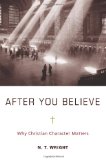
Have you ever thought: “I’m saved, now what?” Or “I know I’m a Christian, but there has to be more to Christian living than waiting around for heaven.” If so, After You Believe: Why Christian Character Matters* is the book for you. Bishop N. T. Wright (Anglican Bishop of Durham, England) has taken up the topic that most Protestants have been shying away from or vilifying for the last 500 years: good works. First Wright picks up with the topic of his last book, Surprised by Hope*, which corrected one of the biggest fables of Christianity: that heaven is the ultimate destination of the Christian. Our ultimate hope is not as disembodied spirits somewhere out there. The true Christian hope is bodily resurrection and inhabiting the new earth and new heavens. After You Believe tells us what difference our ultimate hope makes in living this life in this body (both individual and corporate) on this earth. Because we are called to be priests and one day will rule creation with Christ in the new earth, we need to learn the ways and language of that new world and that new way of life.

The way we learn to live this new life and prepare for our roles in God’s new creation, is through learning and living the Christian virtues of faith, hope, and love. This goes beyond a “keeping the rules” mentality or the “if you go with your heart you can’t go wrong” philosophy. Like learning a new language or learning how to play an instrument, this is not easy or natural at first. But the more we keep committing ourselves to choosing the ways of faith, hope, and love, the easier it becomes until it is second nature. Wright ties the Christian virtues to the fruit of the Spirit: “the fruit of the Spirit is love, joy, peace, greatheartedness, kindness, generosity, faithfulness, gentleness, self control” (p. 194). He notes that “‘the fruit of the Spirit’ does not grow automatically. The nine varieties of fruit do not suddenly appear just because someone has believed in Jesus, has prayed for God’s Spirit, and has then sat back and waited for ‘fruit’ to arrive” (p. 195, emphasis author’s). Just like gardening which takes pruning, watering, mulching, and looking out for blight and mildew to grow plants, we each have to cultivate a life in which the fruit of the Spirit can grow. For those who think that the Spirit’s fruit does come automatically Wright points them to the last characteristic on the list: self-control. No one comes by self-control automatically: it’s something everyone has to work on and develop throughout his or her life.

The final chapter of the book describes how virtue can be practiced, and how we learn to start living as the priests and co-rulers that we will be in the new creation. Wright calls it the virtuous circle, and the circle includes Scripture, stories, examples, community, and practices. It is by engaging with this circle as both individuals and communities, that our character will be transformed and loving God and loving others will become our second nature. These practices will prepare us for the new language and the new way of life that we will have in the new creation. There is an excellent “For Further Reading” appendix for those who want to delve more into virtue, Christian virtue, ethics, and character.

My few criticisms about the book have more to do with style than content. Wright does get repetitive, and you go over a lot of the same ground again. I was also annoyed when he would bring up a subject then say we would get to that later on in the book. It happens numerous times, and I thought: wait till we get to that part before bringing it up. There are also several occasions where he makes a comment, then says something to the effect of, but we can’t go into that here; it’s another book. If those asides are any indication, there are several more books on the way.

Overall I thought this was a good, informative book, and it starts to fill a gaping void in Protestant practice: where do good works and character fit into the Christian life without becoming something we have to do to earn salvation. I recommend it for anyone who wants to know more about how to live as a Christian in this body, in this world, at this time.

*Affliate Link

Disclosure of Material Connection: I received the product mentioned above for free by The Ooze Viral Bloggers in the hope that I would mention it on my blog. I am disclosing this in accordance with the Federal Trade Commission’s 16 CFR, Part 255: “Guides Concerning the Use of Endorsements and Testimonials in Advertising.” This article has been reposted at The Ooze Viral Bloggers.


Company Girl Coffee: Columbia College Story Week Edition

I know it’s been at least a month since I got in on Company Girl Coffee. I was determined to play today, which means I had to do a little copy and pasting. Havi has a Friday ritual too called The Friday Chicken where we all chime in on our weeks: what was hard and what was good. So here is my week in review, The Hard and The Good:

The Hard

I have not slept most of this week due to the evil, demonic entity known as insomnia. The rest of the hard stems from that. I’m way behind reading a book I’m reviewing, I’m way behind on the sermon I will be preaching Sunday, I’m way behind on writing projects and finding paying writing gigs. I’m way behind.

The Good

Hiring the personal trainer was a really good thing. I need the accountability to take care of myself through physical exercise. Plus I was feeling like crap yesterday when I went in (see evil, demonic insomnia above), and by the time we were done, I felt great. And I felt good the rest of the day. Getting up and moving does help me feel better. Now I need to find the same sort of accountability for my writing.

Columbia College’s Story Week Festival of Writers was just tremendous. I went around and heard authors read their work and talk about the craft, and it was marvelous. David Morrell (his books include First Blood, The Brotherhood of the Rose, and The Shimmer) totally rocks, and it you ever get a chance to hear him speak go. Change whatever you have to, reschedule whatever you have to, sell the dog if you have to, if you’re a writer and get the chance: GO! His love and dedication to writing is phenomenal. He is very blunt about how hard it is, but it’s also very obvious how much he loves what he does. And he has lots of good practical advice. I’ve just ordered his book The Successful Novelist. (Sorry for no links for the books, I don’t have the time right now. I’ll try to get them in later.)

I was sent a free book to do an advance review of by one of my favorite theologians! (N. T. Wright in case anyone was wondering.) And it is a very good book, and one that the Western Protestant Christian Church needs to hear. I’m not sure how much I can say before the reviews start going up, but I’ll let you know when I post the review.

I have set the number of pages I need to write a day on The Book Proposal. Like David Morrell said yesterday, I will write them everyday, no matter how long it takes. He made the point that writing is a perishable skill, and if you don’t use it everyday, you will lose it. That my friends, is one of my problems: I write a couple of times a week and am constantly reteaching myself the basics. To move on, I am going to have to write everyday. I had never thought about it before, but he’s absolutely right. Just like playing scales on an instrument, if I’m going to be a virtuoso at what I do, I am going to have to practice everyday.

Now I have to get ready to head to yoga then on to Trader Joes. I hope everyone has a great weekend! Wait! Before I go here is the literal, photogenic view from my window:

We are having a beautiful day in Chicago, and I am going to enjoy it. It’s supposed to snow this weekend. You gotta love Midwest weather.

Writing Is NOT for the Wimpy of Heart

Writing is brutal business. You think and you worry and you’re scared to death, but you still feel compelled to bare your soul to the world, wondering if you’re going to get back in one piece. Then you want to write but you’re frozen because you’re scared to death over what everyone is going to think . It really is a ridiculous process. You really have to be called to write. You have to know this is what you want to do. Otherwise it will tear you up and throw you to the side of the road. The Muses are not benevolent mistresses. It literally is gut wrenching work. Yet me and many others continue to do it. We continue to face the resistance or fear. Or we run away from it. There are days we let it distract us. We let it lull us into a protected web of TV watching and web surfing. I have done more TV watching and web surfing since I became a full time writer than any other point in my life (except when I had surgery). Of course it doesn’t help that I work at home.

Writing is not for wimps. It’s not for people who want to make an easy living or want to make money (fast or at all). It’s hard work. And most of the time no one notices. And yet millions of people in the past and present and millions in the future will bow to this brutal mistress and start putting words onto a page. Writing can be a relentless mistress who will make you grovel. But when you get it right… When the words flow… When you read back over a paragraph and wonder where the hell did that piece of art come from… It’s divine. When someone says that they read a piece of yours and liked it, loved it; it made them think; may be it will even change their lives, for awhile you forget the fear, self-doubt, and endless solitary hours. It must be like forgetting the pain of childbirth, once you hold the baby in your arms. Another divine moment.

So we writers keep plugging along. Sitting down everyday at the computer or the typewriter, or with a notebook and pen or pencil, and keep facing up to the doubt, the fears, the sheer resistance we feel at putting our very souls onto the page. When we finally get it right (after multiple drafts, breakdowns, and lots of chocolate), it can look so easy. But don’t fool yourself. It’s never easy. And it will never be easy.

Most of the time I have a love/hate relationship with my craft and its Muse. I’m not sure you can have any other relationship when you work in a creative field.

What about you? What creative work do you do? How do you feel about it? What kind of relationship do you have with your craft and your muse?

The Power of Story

In stories, the subconscious mind gives voice to some of its most deeply cherished longings. In myths and legends, men and women make desperate attempts to tell one another who they are, why they are here, where they are going, and what they are meant to do. –Jim Ware, God of the Fairy Tale: Finding Truth in the Land of Make-Believe*

I was frightened, and I tried to heal my fear with stories, stories which gave me courage, stories which affirmed that utlimately love is stronger than hate. If love is stronger than hate, then war is not all there is. I wrote, and I illustrated my stories. At bedtime, my mother told me more stories. And so story helped me to learn to live. Story was in no way an evasion of life, but a way of living life creatively instead of fearfully. –Madeline L’Engle, Walking on Water: Reflections on Faith and Art (Wheaton Literary Series)*

Stories have always been important to me, to who I am. I have read stories since I learned to read, and before that my mother told me stories. One of the first stories I remember writing was in the second grade. The only thing I remember is that it was set on Venus–we were studying the solar system in science.

I think the reason I prefer fiction to nonfiction is you can say things in a story that is harder to say in an article. You can challenge the status quo and confront issues from the side instead of head on. I think story carries more power and truth than an article based on fact. We have confused fact and truth: they are not the same thing, and they cannot always be equated. Facts and datum are just one part of truth–one facet. Not everything can be quantified and qualified by scientific method. I think that is the main reason that literalist Christians who have to prove the Bible as fact irritate me. Godde and her acts in this world cannot be reduced to mere facts and datum. And that does not make Godde or her actions any less true.

Story has the power to make you admit you are not the person you want to be. In story we can admit to what we really want and what we’re really looking for. It’s a safe haven, a sanctuary. There we can admit what our wildest longings and passions are, and it’s okay. I have learned more about God and life through story than I ever have through facts thrown at me about how God exists, and here’s the time line (or insert another chart) to prove it. I have learned more about who I am and who I want to be through story than through any other means. There is a reason why 60% of the Bible is narrative or story. We live in our stories. Life does not happen in one set of equations to another set of facts to another set of definitions. Life happens in living with each other, our stories overlapping, and growing into new and different stories.

I like to write nonfiction, but there is a reason why I write creative nonfiction: I need a story. But truth be told, I will always be  more at home in fiction than nonfiction, and fiction will always be my first choice when it comes to writing. (Hmmm may be I really do need to balance working on fiction and nonfiction more. May be I would write more of both if I wrote my first love along with the second. Is it possible to work on both a novel and nonfiction book at the same time?)

Here’s the last of my storytelling rambling: Nothing beats a good story…except for writing a good story.

(Originally posted on July 22, 2006. Sometimes you need to read back over old blog posts to remind yourself what you’re really supposed be to doing.)

*Affiliate links

Ash Wednesday Liturgies at Chicago Grace Episcopal Church

Chicago Grace Episcopal Church will be having two Ash Wednesday services including imposition of ashes on Wednesday, February 17. The first service is at 12:15–1:15 p.m. The second service is 6:00–7:00 p.m. with a soup and bread supper following the liturgy. All are welcome to come. I will be attending the service in the evening. Our church is on Printer’s Row, 637 S. Dearborn, right next door to Kasey’s Tavern, and our sanctuary is on the second floor.

Tonight we say good-bye to the alleluias. This hymn from The Saint Helena Breviary helps us to tuck them away until Easter.

Alleluia, song of gladness,

hymn of endless joy and praise.

Alleluia is the worship

that celestial voices raise

and, delighting in God’s glory,

sing in heaven’s courts always.

Alleluia, blessed Salem,

home of all our hopes on high.

Alleluia, sing the angels;

Alleluia, saints reply;

but we, for a time on this earth,

chant a simpler melody.

Alleluias we now forfeit

in this holy time of Lent.

Alleluias we relinquish

as we for our sins repent,

trusting always in God’s mercy

and in Love omnipotent.

Blessed Trinity of Glory,

hear your people as we pray.

Grant that we may know the Easter

of the Truth, the Life, the Way,

chanting endless alleluias

in the realms of endless day. Amen.

A huge thank you to Bosco at Liturgy for having it all typed out, so I wouldn’t have to do it. Bosco also posted a Shrove Tuesday mediation.

Procrastinating on Your Lenten Discipline?

Tomorrow is Ash Wednesday, the beginning of Lent. Am I the only one procrastinating on choosing a Lenten discipline? To be honest, I’ve been procrastinating on writing this article most of the day. I tweeted that I was going to write this blog post around 11:30 this morning, and I’m just now starting it at almost 6:00 p.m. I figured I wasn’t the only one dragging my feet on choosing something to do or give up for Lent, so here are a few of things I’ve thought of.

Lectio Divina

Lectio Divina means divine reading. It is a slow meditative reading of a passage of the Bible or a spiritual book. There are three movements of lectio divina: meditation (meditatio), prayer (oratio), and contemplation (contemplatio).

  • Meditation/meditatio: Read the passage three times out loud, slowly. The first time simply read through. The second time be aware of any words that pop out at you. The third time read until you reach the place that spoke to you on the second reading. Ask yourself: Why does this stand out? What is it saying to me? Why is the Spirit bringing this to my attention? Mull it over.
  • Prayer/oratio: Take whatever you find to Godde in prayer. Whether it’s gratitude, sorrow, joy, or repentance, pray about what the passage has said to you, and your response to it.
  • Contemplation/contemplatio: Choose a word from your reading or prayer that best expresses your experience during meditation and prayer. Close your eyes and take a few deep breaths. Spend a few minutes in silence, listening to Godde. If your mind wanders silently say the word you chose.
  • If you want, journal your lectio experience.

Online resource: Garden of Grace

The Daily Examen

The Daily Examen is a thoughtful look at the day to see how we saw and responded to Godde’s grace through what we did, our responses to the people we met though the day, and our emotions. IgnatianSpiritality.com says

The Daily Examen is a technique of prayerful reflection on the events of the day in order to detect God’s presence and discern [God’s] direction for us. The Examen is an ancient practice in the Church that can help us see God’s hand at work in our whole experience.

Here is one way of practicing the Daily Examen from Ignatian Sprituality:

  • Become aware of God’s presence.
  • Review the day with gratitude.
  • Pay attention to your emotions.
  • Choose one feature of the day and pray from it.
  • Look toward tomorrow.

IgnatianSpiritality.com has many different examens listed at their site.

The Daily Office

The Daily Office is praying through the day. Prayers are said in the Morning, at Noon, in the Evening, and at Night (before bed). In the longer offices of Morning and Evening Prayer two or three psalms are said or chanted, one or two passages of Scripture are read, then there  is time for prayers. In the shorter offices of Noon and Night (or Compline) a short psalm or a portion of a psalm is read or chanted and two or three verses of Scripture are read before prayers.

Two places you can pray the Daily Office online are at The Online Book of Common Prayer (click Daily Office on the menu) and Mission St. Clare. Mission St. Clare has the hymns in each office in karaoke so you can sing along. Fun!

If you’re like me and can’t pray on the computer, you can order the Book of Common Prayer* from Amazon, along with Phyllis Tickle’s The Divine Hours.* If you want a Daily Office that is gender inclusive, The St. Helena Breviary: Personal Edition* is wonderful.

Hospitality

Hospitality is one of the bedrocks of Christianity. Jesus liked to eat with people (especially people he wasn’t supposed to eat with) a lot. Jesus instituted Communion during the family meal and celebration of Passover. Early Christians gathered together to eat and share their resources with one another. Early in our history we started feeding people who couldn’t feed themselves. One of the most basic practices of Christians is feeding each other and feeding other people. I know, I know, a lot of people fast or give up a certain food group for Lent, but giving up food has never been a spiritual discipline for me.  Probably because I grew up with the skinnier-is-better and the “Diet! Diet! Diet!” culture, I just cannot consider giving up food to be a spiritual discipline (also my birthday always falls during Lent, and I’m eating my meat and cake!). If fasting is your thing, then go for it. However, I do make a suggestion: put aside the money you saved not buying sweets, pop, or meat, and at the end of Lent, give the money to a food pantry or homeless shelter. This is a personal preference: I much prefer to add something than just give up something for Lent.

Back to hospitality and food. If, like me, you like to feed people and feel it’s an important part of your spirituality here are two ways to practice hospitality during Lent:

  • Invite friends and family over for meals at your home. Decide how many times you want to provide hospitality during Lent. Then start meal planning and inviting.
  • Volunteer at a homeless shelter or food pantry to help feed the hungry people in your community. Provide hospitality to those who need it the most.

A last resource that has all of these disciplines plus more is Marjorie J. Thompson’s Soul Feast: An Invitation to the Christian Spiritual Life.* It’s a good resource that you will go back to again and again.

I hope this helps you in deciding a discipline to bring you closer to Godde during Lent. Do you have anything to add to the list? What are thinking of giving up or adding for Lent? I’m leaning toward Lectio Divina myself. It’s been a long time since I practiced it, and it has always been one of my favorites.

*Affliate links

RevGals Friday Five: Staving off the gloom edition

Sally writes:

Candlemass is past, and Christmas is well and truly over, here in the UK February looks set to be its usual grey and cold self. Signs of spring are yet to emerge; if like me you long for them perhaps you need ways to get through these long dark days. So lets share a few tips for a cold and rainy/ snowy day….

1. Exercise, what do you do if you can’t face getting out into the cold and damp?

This is why I joined a gym, so I would get some regular exercise. The gym is in the building behind ours, so I only have to walk across the alley, and I’m there. I love swimming. Swimming has always comforted me and made me happy, so I’m very glad to have year round access to a pool now. Restorative yoga also helps.

2. Food; time to comfort eat, or time to prepare your body for the coming spring/summer?

My comfort food is macaroni and cheese and polenta, especially grilled polenta. Along with home baked bread and dairy products.

3. Brainpower; do you like me need to stave off depression, if so how do you do it?

My lightbox has been a Godde send. It has really helped me get through these dark gloomy days. Praying the Daily Office also helps me a lot.

4. How about a story that lifts your spirits, is there a book or film that you return to to stave off the gloom?

For movies anything by Hayao Miyazaki and Disney/Pixar along with Under the Tuscan Sun. For books anything by Neil Gaiman, Robin McKinley, and Little Women.

5. Looking forward, do you have a favourite spring flower/ is there something that says spring is here more than anything else?

Tulips, daffodils, and lilac.

Bonus; post a poem/ piece of music that points to the coming spring……

Vivaldi’s The Four Seasons, The Spring.