Margaret Almon of Margaret Almon Mosaics

Today is Day 22 of the 31 Days to Building a Better Blog challenge over at The SITSGIRLS. Our challenge today is to make one of our readers feel like the most special person in the world. I am going to do my best by introducing you to Margaret Almon who owns Margaret Almon Mosaics. Margaret and I met through the challenge, and I was absolutely enchanted when I went to her site. Margaret is an artist, and she creates beautiful, breathtaking mosaics. Like this:

Tiffany Mandala Mosaic on Slate by Margaret Almon

Margaret lives in Philadelphia with her husband, Wayne Stratz, who is an abstract stain glass artist. Together they own Nutmeg Designs. They show their pieces all around Philly. Here is one of their exhibits at The Lansdale Farmers Market last month:

Nutmeg Designs at The Lansdale Farmer's Market, Philadelphia

Margaret has this to say about beauty: “I believe that beauty is a human need, and feel honored by the many people who have made my mosaics part of their homes and lives, or given them as gifts.”

If a plan to Philadelphia isn’t in your near future: no worries. Nutmeg Designs has its own Etsy shop where you can go browse all you want and may be buy a little something (Disclaimer: I take no responsibility if you go to Nutmeg Designs, look up, and two hours have passed. You’ve been warned.) Oh yeah: I have dibs on this:

You have no idea how wonderful this would look on my altar!

I believe that the best way to manifest The Divine  Feminine in the world is to create: poems, music, mosaics, painting, calligraphy, stories–anything. Margaret helps me to see Sophia in the world through her creative work. Thank you Margaret.

All photos were taken from Margaret Almon Mosiacs and Nutmeg Designs.

Sphere: Related Content

Soon afterwards [Jesus] went on through cities and villages, proclaiming and bringing the good news of the kingdom of God. The twelve were with him, as well as some women who had been cured of evil spirits and infirmities: Mary, called Magdalene, from whom seven demons had gone out, and Joanna, the wife of Herod’s steward Chuza, and Susanna, and many others, who provided for them out of their resources (Luke 8:1-3, NRSV).

One of the arguments that complementarians make for women staying at home is that it is God’s plan for men to work and financially support the family. As long as I’ve been on the other side of the argument, pointing out that women have always worked and supported their families monetarily, it was only last week when it hit me what these verses were saying. I’ve used these verses to show that women were disciples and followed Jesus in his travels just as the 12 did. But last week it hit me between the eyes: Mary Magdalene, Joanna, and Susanna plus other women “provided for them out of their resources.” The Greek word translated as resources can mean property, possessions, resources, or means. These women financially supported Jesus and his ministry from their own finances.

I’m sure some would say that what they gave Jesus was really the money their husbands made. This could be true for Joanna, but she is the only one with a husband in this passage. Mary Magdalene had no husband, and Susanna is not paired with a husband in these verses. This means their money was theirs. We don’t know how they had these resources. Maybe they were business women like Lydia and Priscilla. Maybe they were widows. But neither woman, nor her resources, is tied to a husband.

It’s a little thing. A little thing that can be easily overlooked. But I think that we should pay attention to this little thing. Women who weren’t tied to a husband, and a married woman who isn’t tied to her home, are following Jesus all over the countryside and supporting him. These little things start adding up to show that roles women played in the Bible are much broader than mother and wife. It also shows the freedom Jesus allowed women to have in his own ministry. He didn’t tell these women to go back home and take care of their husbands and children (and he didn’t tell them to go home, get married, and start having kids). He welcomed them and accepted their support.

These three verses in Luke give us a glimpse of the broader role of women in Jesus’ ministry beyond the home.

Originally posted at The Scroll, April 22, 2010.

Sphere: Related Content

I had just started working on my thesis in seminary. Tired of being asked if I was going to seminary to be a pastor’s wife, I decided to write a biblical theology of single women in ministry, showing that Godde’s calling for a woman was not dependent on her marital state. My thesis advisor, Dr. Joseph Coleson (professor of Old Testament Studies at Nazarene Theological Seminary), looked at my outline and thesis proposal and told me that I needed to add a chapter addressing the Creation Story in Genesis 1:1–2:25. He thought that I needed to deal with the second creation account found in Gen. 2:5-25, where woman is created to be an ezer cenegdo to the man. If the Hebrew phrase simply meant, “helper” then could a woman hold a leadership position in the church, let alone a single woman? But if that isn’t what ezer cenegdo meant, then that would open up the vistas I needed to write and successfully defend my thesis. Defend, not in front of the professors at seminary, but to defend against those who say woman was created to be a wife and mother, and only a helpmate for her husband. Dr. Coleson said the translators who translated our Bibles into English know that “helpmate” is a gross mistranslation of the Hebrew phrase, and he did not see how they could look themselves in the mirror day-to-day keeping that misintepretation in the Bible. It is the only time I saw him angry. So what does this little Hebrew phrase mean?

Continue reading »

Sphere: Related Content

St. Brigid icon by Katherin Burleson

Brigid is one of my favorite saints. I think a lot of it is because we can’t separate history from legend when it comes to her story. She’s part woman, part saint, and part goddess. Throw in a few miracles and her going back and forth through time to be Mary’s midwife and the fostermother of Christ, himself, and you just have one good story (and I love a good story).

What we do know about Brigid: she created the first monastic community that grew into the most renowned monastic city in Ireland, Kildare. Brigid was the abbess of the convent and church and the leader of the town that grew up around Kildare. She was known for her piety, her hard work, and her hospitality. She worked side by side with her nuns tending sheep, milking cows, along with weaving and cooking. Gifts given to the monastery by the rich were given to the poor and sold for food. No one was turned away from her convent, and she provided for all. One of the legends say that Brigid could speak to a cow and get her to give milk three times a day when she needed it for visitors. Here is a table grace attributed to Brigid:

I should like a great lake of finest ale
For the King of kings.
I should like a table of the choicest food
For the family of heaven.
Let the ale be made from the fruits of faith,
And the food be forgiving love.

I should welcome the poor to my feast,
For they are God’s children.
I should welcome the sick to my feast,
For they are God’s joy.
Let the poor sit with Jesus at the highest place,
And the sick dance with the angels.

God bless the poor,
God bless the sick,
And bless our human race.
God bless our food,
God bless our drink,
All homes, O God embrace.

Kildare grew so big that Brigid could no longer run it alone. A local bishop, Cloneth came to the monastery to help her and he brought monks with him. The monks were master silver and bronze smiths and made beautiful silver and metal ornaments to go with the nuns woven and embroidered tapestries throughout the monastery and church. One of her biographers, a monk who lived at Kildare while Brigid was there, said this about the monastery and town:

But who could convey in words the supreme beauty of her church and the countless wonders of her city, of which we speak? “City” is the right word for it: that so many people are living there justifies the title. It is a great metropolis, within whose outskirts–which Saint Brigid marked out with a clearly defined boundary–no earthly adversary feared, nor any incursion of enemies. For the city is the safest place of refuge among all towns of the whole land of the Irish, with all their fugitives. It is a place where the treasures of kings are looked after, and it is reckoned to be supreme in good order.

Cogitosus also hinted in his biography that Brigid functioned as a bishop preaching, hearing confession, and ordaining priests. The lines between laity and clergy, and the roles between men and women, were not as fixed in Ireland as they were in other places in Europe. It is possible that abbesses as powerful and influential as Brigid did function as bishops (this would quickly change once the Roman Catholic church gained a foothold in Ireland).

Now to the fun stuff. As I mentioned before, the Celtic tradition honors Brigid as Mary’s midwife, Jesus’ wet nurse, and his fostermother. “Time” was not a fixed, linear progression for the Celtic people. The material world and spiritual world intertwined in and out of each other, and there were thin places were one could cross from one to another with time running differently. This is why the legend of Brigid at the birth of Jesus was not a big deal for the Celts. The material and spiritual were not separate worlds in their thought. I also like this legend because, being the post-modern that I am, I like the idea of putting yourself into the story. Where am I in the grand story of God’s people? How is this story, my story? How is my story now becoming a part of the whole story? Brigid went on to become the spiritual mid-wife to Celtic women giving birth, and the midwife called Brigid into the house to assist in the birth.

Back before the stories of Brigid helping Mary and hanging her cloak on a sunbeam to dry out, Brigid was a goddess of the Celtic pantheon. She was the goddess of poets, blacksmiths, and healers. She was a triple goddess that manifests as maiden, mother, and crone. The fair maiden to poets, the mother creating to blacksmiths, and the old wise woman who knows how to heal. She has long been the symbol of spring coming to the land and the arrival of more light during this time of the year. February 1 is her day, and she was called on to protect the sheep who at this time would be carrying lambs. In the Christian tradition she is remembered for being able to coax cows into milking, and for being able to churn butter for everyone who needed it.

Milking cows and churning butter brings us back into the everyday realm. There is a strong domestic atmosphere in the stories of St. Brigid. Brigid’s life revolves around the home: giving away food to the poor, churning butter to feed all those who lived in the area, sweeping the floor, sewing, and herding both cattle and sheep. She kept her monastery in good order for visitors. Her love for domesticity naturally led to her generous hospitality. There was always food, clothing, and a bed in her house for those who needed it. Like so many women, Brigid wanted a well-run house where her family (her nuns) would have a nice home, and those who visited would find refuge. I am surprised at how domestic I’ve become in the last few years. But I’ve come to realize that I’ve become like Brigid. I want a clean, orderly house that can be a home and refuge for my husband and I. I also want to extend hospitality to our friends and give them a place to come eat, drink, and be merry. I also want them to find a refuge for awhile, rest and have fun while they are under our roof.

As the light comes back this spring, let us remember Brigid: a woman committed to her God, to helping the poor, and to taking care of all who came to her. She established a community that became a light to all who wanted to come pray, learn, work, or needed shelter and food. She worked hard and believed that everyone was part of the kingdom of God, and for that reason alone should be treated with respect and cared for. Everyone should have a home they can come to. There is room at the table for all. There is enough food to go around. And if not Brigid will be seen whispering in the ears of her milk cows.

A Collect for the Feast of St. Brigid:

Everliving God, we rejoice today in the witness of your servant Brigid of Kildare, who served as courageous leader and mentor, faithfully shepherding both men and women in her monastery and guiding them into holiness of life: Inspire us with life and light, and give us perseverance to serve you in our own day. This we ask in the name of the Holy and Undivided Trinity, one God, in glory everlasting. Amen. (From The Saint Helena Breviary, Personal Edition, 281).

Here are two other wonderful posts about Brigid:

A Habit of Wildest Bounty: Feast of St. Brigid at Jan Richardson’s The Painted Prayerbook.
Celtic Prayer: Brigid, Comrade-Woman by Elizabeth Cunningham at The Virtual Abbey.

Sphere: Related Content

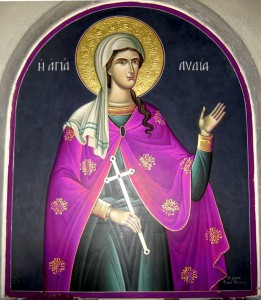
Jean Wise reminded me on her blog that today was the commemoration day of Dorcas, Lydia, and Phoebe. Who you  may ask? Let me tell you all about them:
Dorcas

Now in Joppa there was a disciple whose name was Tabitha, which in Greek is Dorcas. She was devoted to good works and acts of charity. At that time she became ill and died. When they had washed her, they laid her in a room upstairs. Since Lydda was near Joppa, the disciples, who heard that Peter was there, sent two men to him with the request, ‘Please come to us without delay.’ So Peter got up and went with them; and when he arrived, they took him to the room upstairs. All the widows stood beside him, weeping and showing tunics and other clothing that Dorcas had made while she was with them. Peter put all of them outside, and then he knelt down and prayed. He turned to the body and said, ‘Tabitha, get up.’ Then she opened her eyes, and seeing Peter, she sat up. He gave her his hand and helped her up. Then calling the saints and widows, he showed her to be alive. This became known throughout Joppa, and many believed in the Lord (Acts 9:37-42).

You almost miss Dorcas’ story. After all most of Acts 9 is taken up with Saul’s conversion (later to become the apostle Paul) to Christianity after leading the persecution against the early church. So after Godde literally threw Saul off his ass (sorry I just cannot resist that one), he went blind, was healed and started preaching, the focus of the story quietly changes to Dorcas. By the time we meet her, she has died. This is a great lost to her community because she took such good care of them. And she took very good care of those who were considered the least of these: widows. Woman without a husband had no social standing at this time. They were normally destitute women who were forced to beg or to become prostitutes to support themselves and their children. If a woman did not have family at this time, she was in a very precarious place. Dorcas made sure these women had clothes. Now when the story tells us that Dorcas made the clothes, it means a little bit more than she cut some material and sewed it. First she would have to spin the fiber into thread then weave it on her loom for the tunics and clothing she made. This was truly a labor of love on her part to make sure those in her community were at least dressed. She may have also weaved pieces for local merchants to sell in order to support herself (there is no mention of a husband). As long as a woman had a loom and access to wool or flax, she could make a living. Apparently not all the widows Dorcas knew had their own looms to make their own clothes or clothing to sell. Dorcas made sure they had the clothing they needed to survive.

Her illness and death was a big loss to the community, so they sent messengers to a nearby town because they heard Peter was there. Peter came, and the widows showed him the clothing Dorcas had made them. Peter responded to their grief. After sending everyone outside, he prayed and then said to her, “Tabitha get up.” She rose from the dead and was restored to her community. News spread. More people believed in Godde.

Lydia

We set sail from Troas and took a straight course to Samothrace, the following day to Neapolis, and from there to Philippi, which is a leading city of the district of Macedonia and a Roman colony. We remained in this city for some days. On the sabbath day we went outside the gate by the river, where we supposed there was a place of prayer; and we sat down and spoke to the women who had gathered there. A certain woman named Lydia, a worshipper of God, was listening to us; she was from the city of Thyatira and a dealer in purple cloth. The Lord opened her heart to listen eagerly to what was said by Paul. When she and her household were baptized, she urged us, saying, ‘If you have judged me to be faithful to the Lord, come and stay at my home.’ And she prevailed upon us (Acts 16:11-15).

Paul and his traveling companions arrived in Philippi. But there was no synagogue for them to worship at, so they decided to go to the river on the Sabbath where there was a place of prayer. Lydia was at the river. She was “a worshiper of God,” and listened to Paul’s teachings. In fact, we are told “the Lord opened her heart to listen eagerly to what was said by Paul.” In the next verse she and her household were baptized, and she urged Paul and his travelers to stay in her house. Lydia was the first convert to Christianity in Europe.

Lydia was a businesswoman, “a dealer of purple cloth” from Thyatira. Purple dye was a symbol of power and honor in the ancient world, and it was the most expensive and sought after dye in the Roman world. Thyatira was the capitol of the industry and renowned for its purple dyes. One had to have plenty of capital to deal in purple dye and the making of purple garments for sale. Lydia was a career woman, rich, the head of her household, and Acts 16:40 implies that by the end of Paul’s stay in Philippi a new church was meeting in Lydia’s home. All of this could mean that Lydia was the overseer or pastor of the first church plant in Europe.

Phoebe

I commend to you our sister Phoebe, a deacon of the church at Cenchreae, so that you may welcome her in the Lord as is fitting for the saints, and help her in whatever she may require from you, for she has been a benefactor of many and of myself as well (Romans 16:1-2).

Paul highly commended and respected Phoebe. He called her a “sister,” “deacon,” and “benefactor” to the church at Cenchreae as well as a sister and benefactor to Paul.

The odd thing about diakonos or “deacon” being used to describe Phoebe is that it is the masculine form of the word used to describe a woman. It is the same word Paul uses when he calls Timothy and Titus “servants” or “deacons” (or pastors) of their respective churches. Another thing that makes this phrase odd is that Phoebe is called the “deacon of the church of Cenchreae.” This is the only place in the New Testament where diakonos is followed by a specific congregation. This is the only place linking a specific person’s ministry with a specific church. This seems to indicate that Phoebe served as a deacon in the church at Cenchreae.

Paul uses another word to describe Phoebe: prostatis. This is the only occurrence of the word in the New Testament. This word is normally translated so that it’s main meaning is not obvious. The normal translation is “helper” or someone who has helped. The basic and most obvious translation of the word from classical Greek is “patron” or “benefactor,” and women in this role, are well attested in the Roman world. In the Greco-Roman world wealthy women sponsored the arts, philosophers, writers, and politicians. They paid them and gave them the social standing they needed to succeed. Phoebe was a wealthy woman who served the church out of her means as the women in Luke 8 served Jesus out of theirs. For Paul to say that Phoebe was a benefactor to him meant that she had probably helped to support his missionary travels financially. It’s also very likely she was known in Rome, and she has the appropriate social status and clout to introduce Paul to the churches in Rome. Churches Paul had not had any dealings with, nor had he helped plant them.

Phoebe was a woman who had her own means, and served the church in a leadership role. Paul comes very close to commanding churches he had no hand in planting, and Christians, most of whom he had never met, to welcome her and provide anything she needed. She was not only a deacon and a benefactor in the church, but Paul himself had also benefited from her generous leadership.

Sphere: Related Content

My dear neglected blog:

I know you don’t feel dear or loved or even somewhat liked. Because I’m so rarely here. I so rarely write and post. I procrastinate. I neglect you. I even ignore you. I’m so sorry. You see…I’m not just a flake–I am a huge, bigger than life FLAKE. I had to admit it after reading Sonia Simone’s post: The Complete Flake’s Guide to Getting Things Done. Here are the opening paragraphs:

Are you smart and motivated and passionate, and have lots of cool things you’d like to get done, but somehow when it comes to doing them, you just . . . don’t?

Are you great at ideas but lousy at execution? Talk a good game but don’t get any results? Spend a lot of time thinking about where you want to go, but not much time actually moving your ass down the road that would take you there?

You, my friend, are a flake. Congratulations. We are a worldwide force. If we could all get ourselves moving in the same direction, we would change the world. However, that will never happen.

I’m sure you’re recognizing several behaviors. I have grand plans for you, but I never quite get around to writing and posting. I am so passionate about how you could change how we think about the women and the Bible and tell the real story of women working outside the home, but then I hesitate; I doubt; I procrastinate; and then I find something else to do (yes, yes, I know Twitter is an addiction, and I don’t blame you for being jealous of all the time I spend there). Yes, I talk a good game but I don’t get any results, and you my dear friend remain neglected.

But don’t worry. Sonia has words of advice and help for flakes like me:

The Plan in 7 Reasonably Painless Steps

1. When you’ve got something to do, figure out what you really want to get out of it.

2. Do the pivotal technique. Think about what you want, then get clear about where you are right this minute. Notice the difference.

3. Figure out the next action.

4. Do what you feel like.

5. Rinse, lather, repeat.

6. Start a compost pile for ideas, notes, plans and insights.

7. Stick to three or four primary areas of focus.

So dear blog, I want you to know I am taking Sonia’s steps, and that you are one of my primary area of focus. I am going to find ways to be a flake and still get things done. I am going to find ways to be a flake, show my love for you, and write regular posts to show my love. Because I know you are tired of empty words and broken promises. But I’ve taken my first step. I’ve admitted that I have a problem: I’m a total and hopeless flake. And instead of changing that, I need to learn how to work with it. So dearest blog, I promise to stop turning away and use Sonia’s 7 Reasonable Painless Steps to show the attention and love that you deserve. You deserve to be updated regularly and marketed to shine as the gem I know you are.

Thank you for giving another chance (again).

Your humble flake,
Shawna R. B. Atteberry

Sphere: Related Content

Company Girl logoHappy Friday Company Girls! The coffee is on and hot!

Dreaming in the New Year

If it wasn’t for Home Sanctuary I don’t know how neglected this poor little blog would be. But the reason I haven’t written much is that I’m thinking and dreaming and planning for the upcoming year. I’m dreaming what I want my business to become and who My Right People are and how much I want to help the people who come to me. So in the busyness of the week of getting to head out to see my family in Oklahoma, I’ve been dreaming and planning and spinning possible futures in the back of my head. What are Right People? It’s a concept Havi at The Fluent Self (shes @havi on Twitter) came up with (and I will let her explain):

Thought 2: Your stuff doesn’t have to be helpful for everyone.

It doesn’t.

It just needs to be helpful for the people who need it in that form in that moment.

Those are your Right People. The ones who need your voice.

Anyone who doesn’t find it helpful? Probably not one of your Right People. Or not ready yet.

That person can go. Be there for the ones who do need what you have to say.

That’s what I really want to focus in on this year: My Right People instead of throwing stuff all over the wall and seeing what sticks. I want to envision My Right People and help them and make this a safe place for them. So that’s whay I’ve been doing business wise. You can find out more about Right people here and here.

We Loved Our Presents!

Let me preface this section by saying that The Hubby and I always travel at Christmas to see family. This year we’re heading to Oklahoma to see mine. Before we go we have our own Christmas and open our presents. So we always open our presents from each other early. They all came in this week and were wrapped, so we opened them Wednesday. Actually the really, really cool present I got My Hubby came in that day, and I couldn’t wait to see what he thought of it! I bought him this beautiful singing bowl from Fabeku Fatunmise at Sankofa Song whom I met on Twitter (he’s @fabeku). The Hubby loved it! And the bowl sings so beautifully! Tracy really got the hang of it last night and all of these gorgeous tones were washing over me. So glad I met Fabeku and learned about his sound healing ministry! He also included his CD, which I am going to have to wrestle out of The Hubby’s hands so I can listen it. He also loved his other gifts: Buckley Balls from Think Geek, and a space-age pen that writes underwater and in zero gravity. This pen has been going up with the astronauts since 1965. I love My Geek.

I will preface my gifts with I LOVE TO COOK. When you’re a person who LOVES TO COOK, pots and pans that are on their last leg and about to give up the ghost are very depressing. So I’d dropped a hint or two about new pots and pans. You should see them Company Girls. They are beautiful: triply, with one of the triplies being stainless steel. The triply insures they heat evenly and hold the heat. They are bright and shiny; they are begging to be cooked in. I finally have a 5 quart Dutch Oven! (My previous set claimed a Dutch Oven but….um…..no.)  Squeee! I am so in love. I also adore my other gift. After we first married, Tracy would leave little red bows hidden all over the place for me to find. Mainly around coffee stuff so he knew I would find it. :) But then the red bows start collecting up and you don’t know what to do with them. My Honey came up with a solution; my second gift: The Red Bow Tree. It’s a beauitful fall resin tree with a little snow on the branches. So now when red bows start appearing in expected and unexpected places I have a place to put them. I always thought I never had a sappy romantic bone in my body, then My Hubby came along. Aah, the sap that man has turned me into. But it’s okay because he buys me kitchen stuff. :)

Getting ready to leave

I’ve ran errands most of the week to get ready to leave: bank, Target, The UPS Store, library, etc. I need to go to the grocery store today to pick up a couple of items we’ll need over the weekend and clean house. I don’t want the cat sitter to be walking into a mess. We take off to OK next week, and I won’t have internet connection, but that’s okay because I will have a boatload of holiday baking to do. My Mom doesn’t like to bake that much, but I love to, and since we’re coming in early, I am going to do all the Christmas baking! Whoo-hoo! Then there’s all the eating, opening presents, eating, catching up with everybody, eating: you know how it goes.

I wish all of you a Merry Christmas and Happy New Year!

Sphere: Related Content