I had just started working on my thesis in seminary. Tired of being asked if I was going to seminary to be a pastor’s wife, I decided to write a biblical theology of single women in ministry, showing that Godde’s calling for a woman was not dependent on her marital state. My thesis advisor, Dr. Joseph Coleson (professor of Old Testament Studies at Nazarene Theological Seminary), looked at my outline and thesis proposal and told me that I needed to add a chapter addressing the Creation Story in Genesis 1:1–2:25. He thought that I needed to deal with the second creation account found in Gen. 2:5-25, where woman is created to be an ezer cenegdo to the man. If the Hebrew phrase simply meant, “helper” then could a woman hold a leadership position in the church, let alone a single woman? But if that isn’t what ezer cenegdo meant, then that would open up the vistas I needed to write and successfully defend my thesis. Defend, not in front of the professors at seminary, but to defend against those who say woman was created to be a wife and mother, and only a helpmate for her husband. Dr. Coleson said the translators who translated our Bibles into English know that “helpmate” is a gross mistranslation of the Hebrew phrase, and he did not see how they could look themselves in the mirror day-to-day keeping that misintepretation in the Bible. It is the only time I saw him angry. So what does this little Hebrew phrase mean?
Jean Wise reminded me on her blog that today was the commemoration day of Dorcas, Lydia, and Phoebe. Who you may ask? Let me tell you all about them:
Dorcas
Now in Joppa there was a disciple whose name was Tabitha, which in Greek is Dorcas. She was devoted to good works and acts of charity. At that time she became ill and died. When they had washed her, they laid her in a room upstairs. Since Lydda was near Joppa, the disciples, who heard that Peter was there, sent two men to him with the request, ‘Please come to us without delay.’ So Peter got up and went with them; and when he arrived, they took him to the room upstairs. All the widows stood beside him, weeping and showing tunics and other clothing that Dorcas had made while she was with them. Peter put all of them outside, and then he knelt down and prayed. He turned to the body and said, ‘Tabitha, get up.’ Then she opened her eyes, and seeing Peter, she sat up. He gave her his hand and helped her up. Then calling the saints and widows, he showed her to be alive. This became known throughout Joppa, and many believed in the Lord (Acts 9:37-42).
You almost miss Dorcas’ story. After all most of Acts 9 is taken up with Saul’s conversion (later to become the apostle Paul) to Christianity after leading the persecution against the early church. So after Godde literally threw Saul off his ass (sorry I just cannot resist that one), he went blind, was healed and started preaching, the focus of the story quietly changes to Dorcas. By the time we meet her, she has died. This is a great lost to her community because she took such good care of them. And she took very good care of those who were considered the least of these: widows. Woman without a husband had no social standing at this time. They were normally destitute women who were forced to beg or to become prostitutes to support themselves and their children. If a woman did not have family at this time, she was in a very precarious place. Dorcas made sure these women had clothes. Now when the story tells us that Dorcas made the clothes, it means a little bit more than she cut some material and sewed it. First she would have to spin the fiber into thread then weave it on her loom for the tunics and clothing she made. This was truly a labor of love on her part to make sure those in her community were at least dressed. She may have also weaved pieces for local merchants to sell in order to support herself (there is no mention of a husband). As long as a woman had a loom and access to wool or flax, she could make a living. Apparently not all the widows Dorcas knew had their own looms to make their own clothes or clothing to sell. Dorcas made sure they had the clothing they needed to survive.
Her illness and death was a big loss to the community, so they sent messengers to a nearby town because they heard Peter was there. Peter came, and the widows showed him the clothing Dorcas had made them. Peter responded to their grief. After sending everyone outside, he prayed and then said to her, “Tabitha get up.” She rose from the dead and was restored to her community. News spread. More people believed in Godde.
Lydia
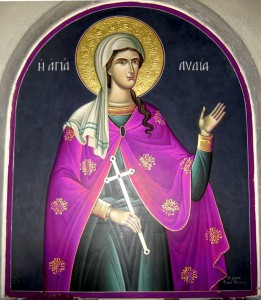
We set sail from Troas and took a straight course to Samothrace, the following day to Neapolis, and from there to Philippi, which is a leading city of the district of Macedonia and a Roman colony. We remained in this city for some days. On the sabbath day we went outside the gate by the river, where we supposed there was a place of prayer; and we sat down and spoke to the women who had gathered there. A certain woman named Lydia, a worshipper of God, was listening to us; she was from the city of Thyatira and a dealer in purple cloth. The Lord opened her heart to listen eagerly to what was said by Paul. When she and her household were baptized, she urged us, saying, ‘If you have judged me to be faithful to the Lord, come and stay at my home.’ And she prevailed upon us (Acts 16:11-15).
Paul and his traveling companions arrived in Philippi. But there was no synagogue for them to worship at, so they decided to go to the river on the Sabbath where there was a place of prayer. Lydia was at the river. She was “a worshiper of God,” and listened to Paul’s teachings. In fact, we are told “the Lord opened her heart to listen eagerly to what was said by Paul.” In the next verse she and her household were baptized, and she urged Paul and his travelers to stay in her house. Lydia was the first convert to Christianity in Europe.
Lydia was a businesswoman, “a dealer of purple cloth” from Thyatira. Purple dye was a symbol of power and honor in the ancient world, and it was the most expensive and sought after dye in the Roman world. Thyatira was the capitol of the industry and renowned for its purple dyes. One had to have plenty of capital to deal in purple dye and the making of purple garments for sale. Lydia was a career woman, rich, the head of her household, and Acts 16:40 implies that by the end of Paul’s stay in Philippi a new church was meeting in Lydia’s home. All of this could mean that Lydia was the overseer or pastor of the first church plant in Europe.
Phoebe
I commend to you our sister Phoebe, a deacon of the church at Cenchreae, so that you may welcome her in the Lord as is fitting for the saints, and help her in whatever she may require from you, for she has been a benefactor of many and of myself as well (Romans 16:1-2).
Paul highly commended and respected Phoebe. He called her a “sister,” “deacon,” and “benefactor” to the church at Cenchreae as well as a sister and benefactor to Paul.
The odd thing about diakonos or “deacon” being used to describe Phoebe is that it is the masculine form of the word used to describe a woman. It is the same word Paul uses when he calls Timothy and Titus “servants” or “deacons” (or pastors) of their respective churches. Another thing that makes this phrase odd is that Phoebe is called the “deacon of the church of Cenchreae.” This is the only place in the New Testament where diakonos is followed by a specific congregation. This is the only place linking a specific person’s ministry with a specific church. This seems to indicate that Phoebe served as a deacon in the church at Cenchreae.
Paul uses another word to describe Phoebe: prostatis. This is the only occurrence of the word in the New Testament. This word is normally translated so that it’s main meaning is not obvious. The normal translation is “helper” or someone who has helped. The basic and most obvious translation of the word from classical Greek is “patron” or “benefactor,” and women in this role, are well attested in the Roman world. In the Greco-Roman world wealthy women sponsored the arts, philosophers, writers, and politicians. They paid them and gave them the social standing they needed to succeed. Phoebe was a wealthy woman who served the church out of her means as the women in Luke 8 served Jesus out of theirs. For Paul to say that Phoebe was a benefactor to him meant that she had probably helped to support his missionary travels financially. It’s also very likely she was known in Rome, and she has the appropriate social status and clout to introduce Paul to the churches in Rome. Churches Paul had not had any dealings with, nor had he helped plant them.
Phoebe was a woman who had her own means, and served the church in a leadership role. Paul comes very close to commanding churches he had no hand in planting, and Christians, most of whom he had never met, to welcome her and provide anything she needed. She was not only a deacon and a benefactor in the church, but Paul himself had also benefited from her generous leadership.
Sphere: Related Content
(ED: I posted this article last year and ran it again as November 18 is St. Hilda’s Day. I added a collect for the day after the article.)
Hilda was one of the most powerful religious leaders in England during the 7th century. She was the abbess of a dual monastery of monks and nuns in Whitby. She held the same power of the bishops of the day, counseled kings, and five bishops came from her monestary.
Hilda was born in 614 CE to Hereric, the nephew of the king of Northumbria. She was baptized at the age of 13, and at the age of 33 she made the decision to become a nun. She was planning on joining her sister, Hereswith, who had established a convent on the fringe of Paris. She went to East Anglia where her nephew was king to prepare to sail to France, but Aidan, the apostle of Northumbria asked her to return to Northumbria. She obeyed, and he put her in charge of a small group of sisters on the north bank of the Wear river. After a year she was called to be the Abbess of Hartlepool. She stayed there for seven years until she built and organized a new monastery at Whitby on the dark cliffs overlooking the Northern Sea.
For thirty years Hilda was in charge of Whitby which was a monastery for both men and women. She ran a little city: there was a school, people to feed and clothe, travelers to provide lodging for, and discipline to be kept. She was not only in charge of monks and nuns, but also serfs who worked the land around the monastery. Kings, rulers, and bishops came to her for advice and counsel. In the midst of civil wars, Whitby spread the Christian faith. Whitby was a light shining for the gospel of love, forgiveness, and reconciliation in a time of wars and hatred. Venerable Bede tell us:
When she had for some years governed this monastery, wholly intent upon establishing a regular life, it happened that she also undertook either to build or to arrange a monastery in the place called Streaneshalch [Whitby], which work she industriously performed; for she put this monastery under the same regular discipline as she had done the former; and taught there the strict observance of justice, piety, chastity, and other virtues, and particularly of peace and charity; so that, after the example of the primitive church, no person was there rich, and none poor, all being in common to all, and none having any property. Her prudence was so great, that not only indifferent persons, but even kings and princes, as occasion offered, asked and received her advice; she obliged those who were under her direction to attend so much to reading of the Holy Scriptures, and to exercise themselves so much in works of justice, that many might be there found fit for ecclesiastical duties, and to serve at the altar (Ecclesiastical History, Book 4, Chapter XXIII).
While Hilda was the abbess of Whitby, it was one of the spiritual centers of England. She ruled a vast territory around Whitby, even providing soldiers in times of war. This was not unusual for the time. Abbesses managed their own realms and handled the finances to run them. Normally their domains were ruled by the pope bypassing the local bishop. Abbesses also “appointed local parish priests, heard confessions and cared for the material and spiritual needs of their people” (Grenz with Kjesbo, 41). There is also evidence that these women were ordained with the signs of the office of bishop: “the miter, ring, crosier, gloves, and cross”; however, later writings seem to replace “ordained” with “blessed,” obscuring the leadership role these women did play in the early church (ibid).
Hilda came to be known as “Mother” to her community. Many boys came to the monastery to be educated by her. Five of them became bishops: Bosa, Bishop of York; Hedda, Bishop of Dorchester and Winchester; Oftfor, Bishop of Worcester, and John of Gexham.
The story of Caedmon shows Hilda’s ability to bring out the best in others. Caedmon was always despondent because he could not sing after supper as was the custom of the day. One evening after leaving the festivities, he fell asleep and dreamed that Jesus came to him and told him to sing him a song about creation. The next day he told Hilda of the dream and sang the song he composed. Hilda recognized his talent and brought him into the monastery to devote himself to writing songs of Biblical stories in the Anglo-Saxon language. This is the first time since Latin became the official language of the western church that Scripture was translated into the vernacular. For the first time the Anglo-Saxons could learn and understand Scripture because it was in their own language. Caedmon’s poems are the earliest form of Anglo-Saxon poetry in existence (Baring-Gould 226).
In 664 CE HIlda hosted the first Synod of Whitby by order of the king of Northumbria, Oswy (who was her cousin). This synod was called by the king to peacefully solve the differences the Celtic tradition had with the Roman tradition, which included calculating the date of Easter. Historian Joanna McNamara notes, “Hild assumed a prestige usually reserved for bishops when she presided over the synod where the Irish and Roman churches competed for the allegiance of the Northumbrian king” (p. 127). The synod voted to align itself with the Roman branch of the Church. Although HIlda had been raised in the Celtic tradition, she obeyed and changed her monastery accordingly. This synod shaped the way Christianity would grow and develop in England, and “the fact that the synod, attended by all the leading churchmen of the isles, was held at a monastery ruled by a woman is a tribute to Hilda’s importance among her contemporaries” (Ranft, 118).
Hilda died in 680 CE after seven years of weak health. She was 66 when she died. These are Bede’s final words about her:
Thus this servant of Christ, Abbess Hilda, whom all that knew her called Mother, for her singular piety and grace, was not only an example of good life, to those that lived in her monastery, but afforded occasion of amendment and salvation to many who lived at a distance, to whom the fame was brought of her industry and virtue.
O God of peace, by whose grace the Abbess Hilda was endowed with gifts of justice, prudence, and strength to rule as a wise mother over the nuns and monks of her household, and to become a trusted and reconciling friend to leaders of the Church: Give us the grace to recognize and accept the varied gifts you bestow on men and women, that our common life may be enriched and your gracious will be done; through Jesus Christ our Savior, who lives and reigns with you and the Holy Spirit, one God, now and for ever. Amen. (From the The Saint Helena Breviary, Personal Edition)
Sources:
Sabine Baring-Gould Virgin Saints and Martyrs (Hutchinson and Company, London, England: 1900).
Shawna Renee Bound, Your Daughters Shall Prophesy: A Biblical Theology of Single Women in Ministry (unpublished thesis, 2002).
Edith Deen, Great Women of the Christian Faith (New York: Harper and Row Publishers, Inc., 1959; reprint Uhrichscile, OH: Barbour and Company, Inc.).
Stanley J. Grenz with Denise Muir Kjesbo, Women in the Church: A Biblical Theology of Women in Ministry (Downers Grove, IL: InterVarsity Press, 1995).
Kate Lindemann, “Hild of Streonshalh 614-680 CE” at Women-Philosphers.com (http://www.women-philosophers.com/Hild-of-Streonshalh.html accessed on November 20, 2008).
Joanna McNamara, Sisters in Arms–Catholic Nuns Through Two Millennia (Harvard University Press, Cambridge: 1996).
Patricia Ranft, Women and Spiritual Equality in Christain Tradition (Palgrave Macmillan, Houndmills, Basingstoke, Hampshire, England: 2000).
(No affliate links)
Sphere: Related ContentYesterday The Wahington Post reported this in their Religion Briefing:
The United Methodist Church, which boasts a history of ordaining women clergy, is seeking to shatter the so-called “stained-glass ceiling” blocking female pastors from its largest pulpits.
The nation’s second-largest Protestant denomination has launched a new initiative, the Lead Women Pastor Project, to examine barriers to women being appointed pastors to Methodist churches with more than 1,000 members. The Nashville-based United Methodist Church has 44,842 clergy, and about 10,000 are female — or 23 percent. Yet just 85 women lead those largest churches, compared with 1,082 men in those positions.
Church leaders say more women are needed to shepherd large churches, given that women make up more than half of those enrolled in master of divinity programs in United Methodist seminaries. Also, almost 58 percent of the 8 million-member denomination is female.
I’m glad the UMC is taking steps to make sure that their female pastors lead in churches of every size. It’s great that they are wanting women in leadership to reflect the percentage of their women in both seminaries and in their denomination.
Sphere: Related ContentHere is the full transcript of Rev. Dr. Sharon E. Watkins’ sermon from this morning’s National Prayer Service from The Christian Church/Disciples of Christ. You can watch a webcast of the service at the Washington National Cathedral’s site.
Isaiah 58:6-12, Mt 22:6-40
Rev. Dr. Sharon E. Watkins
National Prayer Service; January 21, 2009
Mr. President and Mrs. Obama, Mr. Vice President and Dr. Biden, and your families, what an inaugural celebration you have hosted! Train ride, opening concert, service to neighbor, dancing till dawn…
And yesterday… With your inauguration, Mr. President, the flame of America’s promise burns just a little brighter for every child of this land!
There is still a lot of work to do, and today the nation turns its full attention to that work. As we do, it is good that we pause to take a deep spiritual breath. It is good that we center for a moment.
What you are entering now, Mr. President and Mr. Vice President, will tend to draw you away from your ethical center. But we, the nation that you serve, need you to hold the ground of your deepest values, of our deepest values.
Beyond this moment of high hopes, we need you to stay focused on our shared hopes, so that we can continue to hope, too.
We will follow your lead.
There is a story attributed to Cherokee wisdom:
One evening a grandfather was teaching his young grandson about the internal battle that each person faces.
“There are two wolves struggling inside each of us,” the old man said.
“One wolf is vengefulness, anger, resentment, self-pity, fear…
“The other wolf is compassion, faithfulness, hope, truth, love…”
The grandson sat, thinking, then asked: “Which wolf wins, Grandfather?”
His grandfather replied, “The one you feed.”
There are crises banging on the door right now, pawing at us, trying to draw us off our ethical center – crises that tempt us to feed the wolf of vengefulness and fear.
We need you, Mr. President, to hold your ground. We need you, leaders of this nation, to stay centered on the values that have guided us in the past; values that empowered to move us through the perils of earlier times and can guide us now into a future of renewed promise.
We need you to feed the good wolf within you, to listen to the better angels of your nature, and by your example encourage us to do the same.
This is not a new word for a pastor to bring at such a moment. In the later chapters of Isaiah, in the 500′s BCE, the prophet speaks to the people. Back in the capital city after long years of exile, their joy should be great, but things aren’t working out just right. Their homecoming is more complicated than expected. Not everyone is watching their parade or dancing all night at their arrival.
They turn to God, “What’s going on here? We pray and we fast, but you do not bless us. We’re confused.”
Through the prophet, God answers, what fast? You fast only to quarrel and fight and strike with the fist…
Is not this the fast that I choose: to loose the bonds of injustice… to share your bread with the hungry, and bring the homeless poor into your house . .? Then your light shall break forth like the dawn, and your healing shall spring up quickly…
At our time of new beginning, focused on renewing America’s promise -yet at a time of great crisis – which fast do we choose? Which “wolf” do we feed? What of America’s promise do we honor?
Recently Muslim scholars from around the world released a document, known as “A Common Word Between Us.” It proposes a common basis for building a world at peace. That common basis? Love of God and love of neighbor! What we just read in the Gospel of Matthew!
So how do we go about loving God? Well, according to Isaiah, summed up by Jesus, affirmed by a worldwide community of Muslim scholars and many others, it is by facing hard times with a generous spirit: by reaching out toward each other rather than turning our backs on each other. As Mahatma Gandhi once said, “people can be so poor that the only way they see God is in a piece of bread.”
In the days immediately before us, there will be much to draw us away from the grand work of loving God and the hard work of loving neighbor. In crisis times, a basic instinct seeks to take us over – a fight/flight instinct that leans us toward the fearful wolf, orients us toward the self-interested fast…
In international hard times, our instinct is to fight – to pick up the sword, to seek out enemies, to build walls against the other – and why not? They just might be out to get us. We’ve got plenty of evidence to that effect. Someone has to keep watch and be ready to defend, and Mr. President – Tag! You’re it!
But on the way to those tough decisions, which American promises will frame those decisions? Will you continue to reason from your ethical center, from the bedrock values of our best shared hopes? Which wolf will you feed?
In financial hard times, our instinct is flight – to hunker down, to turn inward, to hoard what little we can get our hands on, to be fearful of others who may take the resources we need. In hard financial times, which fast do we choose? The fast that placates our hunkered-down soul – or the fast that reaches out to our sister and our brother?
In times, such as these, we the people need you, the leaders of this nation, to be guided by the counsel that Isaiah gave so long ago, to work for the common good, for the public happiness, the well-being of the nation and the world, knowing that our individual wellbeing depends upon a world in which liberty and justice prevail.
This is the biblical way. It is also the American way – to believe in something bigger than ourselves, to reach out to neighbor to build communities of possibility, of liberty and justice for all. This is the center we can find again whenever we are pulled at and pawed at by the vengeful wolf, when we are tempted by the self-interested fast.
America’s true character, the source of our national wisdom and strength, is rooted in a generous and hopeful spirit.
“Give me your tired, your poor,
Your huddled masses yearning to breathe free,…
Send these, the homeless, tempest-tost to me,1
Emma Lazarus’ poetry is spelled out further by Dr. Martin Luther King, Jr,: “As long as there is poverty in the world I can never be rich, even if I have a billion dollars. As long as diseases are rampant and millions of people in this world cannot expect to live more than twenty-eight or thirty years, I can never be totally healthy… I can never be what I ought to be until you are what you ought to be. This is the way our world is made.”2
You yourself, Mr. President, have already added to this call, “If there’s a child on the south side of Chicago who can’t read, that matters to me, even if it’s not my child… . It’s that fundamental belief – I am my brother’s keeper, I am my sister’s keeper – that makes this country work.”
It is right that college classes on political oratory already study your words . You, as our president, will set the tone for us. You will help us as a nation choose again and again which wolf to feed, which fast to choose, to love God by loving our neighbor.
We will follow your lead – and we will walk with you. And sometimes we will swirl in front of you, pulling you along.
At times like these – hard times -we find out what we’re made of. Is that blazing torch of liberty just for me? Or do we seek the “harmonies of liberty”, many voices joined together, many hands offering to care for neighbors far and near?
Though tempted to withdraw the offer, surely Lady Liberty can still raise that golden torch of generosity to the world. Even in these financial hard times, these times of international challenge, the words of Katherine Lee Bates describe a nation with more than enough to share: “Oh, beautiful for spacious skies, for amber waves of grain, for purple mountain majesties above the fruited plain…”
A land of abundance guided by a God of abundance, generosity, and hope – This is our heritage. This is America’s promise which we fulfill when we reach out to each other.
Even in these hard times, rich or poor, we can reach out to our neighbor, including our global neighbor, in generous hospitality, building together communities of possibility and of hope. Even in these tough times, we can feed the good wolf, listen to the better angels of our nature. We can choose the fast of God’s desiring.
Even now in these hard times let us
Lift every voice and sing Till earth and heaven ring,
… with the harmonies of Liberty;
Even now let us Sing a song full of hope…
Especially now, from the center of our deepest shared values, let us pray, still in the words of James Weldon Johnson:
Thou who has by Thy might
Led us into the light,
Keep us… in the path, we pray.
Lest our feet stray from the places, our God, where we met Thee,
Lest, our hearts drunk with the wine of the world, we forget Thee;
Shadowed beneath Thy hand,
May we forever stand.
True to our God,
True to our native land.3
1. Emma Lazarus
2. The Words of MLK, Jr., selected by Coretta Scott King, 21
3. James Weldon Johnson
Crossposted at Street Prophets.
Remember The National Prayer Service will begin at 9:00 a.m. on The Washington National Cathedral’s website. Rev. Sharon E. Watkins (General Minister and President of The Christian Church/Disciples of Christ) will be preaching, and Presiding Bishop Katharine Jefferts Schori of The Episcopal Church will be giving the benediction. If you watch it let me know what you think.
Sphere: Related ContentThis is from Episcopal Life Online:
Presiding Bishop Katharine Jefferts Schori will offer the closing prayer at a National Prayer Service set for January 21 at Washington National Cathedral. President Barack Obama and his family are scheduled to attend the invitation-only service.
The Very Rev. Samuel T. Lloyd III, Dean of the Washington National Cathedral, will welcome attendees to the event, followed by an invocation from Diocese of Washington Bishop John Chane.
The 2009 Presidential Inaugural Committee announced on January 16 the spiritual leaders who will participate in the service, which is a tradition dating back to the inauguration of George Washington and is considered the conclusion of the official inaugural events.
The prayer service, set to begin at 10 a.m. EST, will be broadcast live on the cathedral’s website. Online participants can light “virtual” candles and leave personal messages of hope, renewal, and reconciliation at the website. Online visitors can also access an historic presidential photo gallery, view video footage of the national prayer service, and explore the role of this “church for national purposes” throughout the years, according to a news release from the cathedral.
The service will include scripture readings, prayers (including those for civic leaders and the nation), hymns and blessings delivered by faith leaders from across the United States. The Rev. Sharon E. Watkins, general minister and president of the Christian Church (Disciples of Christ) will deliver the sermon, the first time a woman has preached at the service.
I am not only one happy Episcopalian, but I am one happy feminist theologian. Two women who are ordained and the leaders of their national religion/denominations are part of the National Prayer Service at the Washington National Cathedral on Inauguration Day. I will be watching the live broadcast that morning. I am so happy!
Sphere: Related Content
Recent Comments