The Future of Faith with Harvey Cox and E. J. Dionne

For anyone living in New York. Street Prophets will also be streaming this event live and taking question from the online audience!

Professor Harvey Cox and E. J. Dionne to Headline Discussion on Faith and the Progressive Movement

Event is second in series presented by the Progressive Book Club and the Center for American Progress

New York, NY: The Progressive Book Club (PBC) and the Center for American Progress (CAP) today announced that Harvard divinity professor Harvey Cox and syndicated columnist and author E. J. Dionne will headline the second installment of the monthly series Moving Forward: Foundations of a New Progressive Era. Launched last month, the Moving Forward series brings together leading progressive authors and policy experts in unique in-person and online forums designed to help Americans learn, connect, debate, and mobilize around ideas.

The evening’s discussion will explore the issues raised in Harvey Cox’s new book, The Future of Faith. Cox posits that Christianity is undergoing a third period of transformation marked by a disregard of dogma in favor of a more open “spirituality,” and a collapse of barriers between different religions.  One of the casualties of this transformation is an historically influential actor in American politics: religious fundamentalism.

Joining Professor Cox will be E.J. Dionne, whose most recent book – Souled Out: Reclaiming Faith and Politics After the Religious Right – announced the end of the Religious Right’s narrow social agenda, and the rise of more open-minded, social-justice oriented faith movements on both sides of the political aisle.  The two will engage in a lively discussion on the current and historical role of religion in American politics, and what this ongoing transformation means as current and future administrations struggle with a wide range of foreign and domestic policy challenges.

Author and Progressive Book Club Editorial Board member Todd Gitlin will moderate the discussion, which will be streamed live on the Progressive Book Club blog and feature a Q&A that engages both the live and online audience. There will be a reception following the discussion.

Beginning on November 9th, seats can be reserved by RSVPing online at http://progressivebookclub.com/cap.

WHAT: Discussion with Professor Harvey Cox and E. J. Dionne

WHERE: WNYC’s Greene Space

44 Charlton Street (at Varick Street)

New York, NY 10014

WHEN: November 18, 6:00 – 8:00 p.m.

FOR PRESS INQUIRIES:

PBC – Dina Owobu, 212.871.8219, dowobu@progressivebookclub.com

CAP – Anna Soellner, 202.492.296, asoellner@americanprogress.org

ABOUT THE PROGRAM PARTICIPANTS

E. J. Dionne Jr. is a syndicated columnist for the Washington Post, a regular political analyst on National Public Radio, a senior fellow at the Brookings Institution, and a professor at Georgetown University. His books include the best-selling Why Americans Hate Politics (Simon & Schuster), which won the Los Angeles Times book prize and was nominated for the National Book Award.  His latest book is Souled Out: Reclaiming Faith and Politics After the Religious Right.

Harvey Cox is Hollis Research Professor of Divinity at Harvard, where he began teaching in 1965, both at HDS and in the Faculty of Arts and Sciences. An American Baptist minister, he was the Protestant chaplain at Temple University and the director of religious activities at Oberlin College; an ecumenical fraternal worker in Berlin; and a professor at Andover Newton Theological School. His research and teaching interests focus on the interaction of religion, culture, and politics. His most recent book is The Future of Faith.

Todd Gitlin is a professor of journalism and sociology and chair of the Ph. D. program in Communications at Columbia University. He is the author of twelve books, including, most recently, The Bulldozer and the Big Tent: Blind Republicans, Lame Democrats, and the Recovery of American Ideals. He was the third president of Students for a Democratic Society, in 1963-64, and later helped organize the first national demonstration against the Vietnam War

ABOUT PROGRESSIVE BOOK CLUB

Progressive Book Club finds and promotes important authors, ideas, and new voices. Part e-bookseller and part online magazine, the club offers a unique opportunity to buy new books and support important causes with every purchase. PBC has created a 21st-century platform that enables people to learn, connect, and engage on the issues they care about most—while keeping progressive ideas at the center of the national debate.

ABOUT THE CENTER FOR AMERICAN PROGRESS

The Center for American Progress is a think tank dedicated to improving the lives of Americans through ideas and action. CAP combines bold policy ideas with a modern communications platform to help shape the national debate, expose the hollowness of conservative governing philosophy, and challenge the media to cover the issues that truly matter. Founded in 2003, CAP is headed by John D. Podesta, former chief of staff to President Bill Clinton and professor at the Georgetown University Law Center. CAP is designed to provide long-term leadership and support to the progressive movement. CAP’s ability to develop thoughtful policy proposals and engage in the war of ideas with conservatives is unique and effective. CAP policy experts cover a wide range of issue areas, and often work across disciplines to tackle complex, interrelated issues such as national security, energy, and climate change.

ABOUT THE PROGRESSIVE STUDIES PROGRAM

The Progressive Studies Program, co-directed by John Halpin and Ruy Teixeira, is a unique interdisciplinary project that explores the history, intellectual foundations, and public understanding of progressivism in America. The program seeks to increase public awareness of progressive ideas and values, and educate public officials and policymakers through lectures, seminars, articles, public events, book discussions, new media tools, and training seminars with activists and young people. It also seeks to develop thoughtful and honest debates about modern progressivism and its relationship to the earlier progressive era and other political and social movements throughout American history. The program’s public research component will complement these discussions by documenting and tracking American ideological attitudes and demographic trends across the country.
Veteran's Day 2009

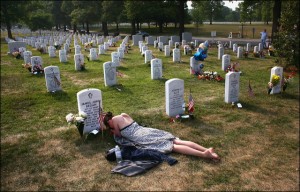
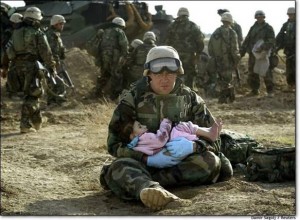
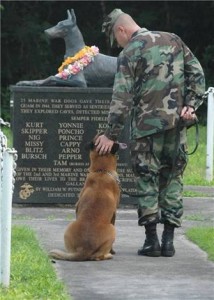
A recent email from a friend contained these pictures. I thought these beautiful and haunting images caught the heart of our military men and women and their families.

image0088

image0077

“Eternal Father, Strong to Save” by William Whiting

Eternal Father, strong to save,
whose arm hath bound the restless wave,
who bidd’st the mighty ocean deep
its own appointed limits keep:
O hear us when we cry to Thee
for those in peril on the sea.

O Christ, whose voice the waters heard
and hushed their raging at thy word,
who walkedst on the foaming deep,
and calm amid the storm didst sleep;
O hear us when we cry to thee
for those in peril on the sea.

Most Holy Spirit, who didst brood
upon the chaos dark and rude,
and bid its angry tumult cease,
and give, for wild confusion, peace:
O hear us when we cry to thee
for those in peril on the sea.

O Trinity of love and power,
our brethren shield in danger’s hour;
from rock and tempest, fire and foe,
protect them wheresoe’er they go;
thus evermore shall rise to thee
glad hymns of praise from land and sea.

John Moore, Getty Images

“Taps”

Day is done …
Gone the sun …
From the lakes …
From the hills …
From the sky …
All is well …
Safely rest …
God is nigh…

Fading light …
Dims the sight …
And a star …
Gems the sky…
Gleaming bright …
From afar…
Drawing nigh …
Falls the night ..

Thanks and praise …
For our days …
Neath the sun …
Neath the stars …
Neath the sky …
As we go …
This we know …
God is nigh …

On Street Prophets Irishwitch has a beautiful post up describing what it is like being a military wife and watching the Fort Hood Memorial.

To all of our military personnel, veterans, and their families: Thank you for all of the sacrifices you have made. May your reward soon be peace and reunion.

Let the NaNoWriMo Craziness Begin

November is National Novel Writers Month. The goal is to write 50,000 words in 30 days. It’s to get you to stop thinking about writing and write. I took part in 2005. I am taking part this year. The building I live in, Burnham Park Plaza, used to the main YMCA Hotel in Chicago and the second largest hotel in Chicago. It was built in 1915, opened in 1916 and closed in 1979. I am having a ball researching this. The original building was 19 stories with 1850 rooms. By 1926 they were turning people away, so they enlarged the building and added another story, increasing to 2600 rooms. I live in addition they added to the front of the building at that time. My kitchen wall is beautiful exposed brick that was the original outer wall. Originally the hotel was for men only. Dearborn, a couple of blocks away, was one the major railroad stations in Chicago and a massive amount of people poured into the South Loop from there, many of them looking to make their way in the world in Chicago. The Y was built at 826 S. Wabash Ave. to be a safe and moral place for young men to stay among the flophouses, brothels, and bars in the South Loop. In 1933 the YWCA at 830 S. Michigan Ave. closed its doors, and the top four floors were open for women to stay. These were normally single woman who were working in Chicago.

In January I found out a lady I go to church with, Jean, stayed here when it was the Y. She moved to Chicago in 1945 with a friend from college and they roomed together in a corner room that had three windows, bunk beds, a dresser, and a closet. When her friend married, she moved to a single room that was 6’x8′. Jean remembers standing in the middle of the room and spreading out her arms she could almost touch both walls. There was one window, a twin bed, a metal dresser, and a metal closet. She paid $30 a month for the room. The 20th floor was the lounge for the women. There was a piano, and Jean would play it. There was also the roof garden with a wonderful view of the city. Most of the men who stayed at the hotel at this time were soldiers going to or coming from the fronts in WW2.

There wasn’t a whole lot in this area. South of 9th St. were warehouses. Jean never went south of 8th St because further south were the bordellos and slums. Though some of that was still in the area. She remembers there being several bottle stores (liquor stores) in the area and flophouses. She also remembers walking past drunks and the homeless living on the street when she went to work. The retail section didn’t start until Jackson or Adams in the Loop, although there was a fresh vegetable market at Congress and Dearborn. There were a lot candy stores like Fannie Farmer and Emmetts. When the hoisery stores got in a shipment, women lined up for blocks around the stores to try to snag nylons. The first restaurant you came to was Berghoff’s at Adams. Most people went to the restaurants in hotels to eat: The Drake, The Blackstone, The Palmer House, Ambassador East and West, and The Stephens Hotel. For six months Jean worked at The Stephens Hotel (now The Hilton Towers) as a reservation girl in The Boulevard Club. It was one of the swankiest clubs in town, women came in their furs, and the top bands, singers, and comedians performed there. That was also back in the days when the Italian and Sicilian mobs controlled the restaurants. She saw the Mafia come in and out, and thought the maitre’d was probably part of the mob. She laughed as she recounted that the mob guys would dote on her; years later she realized it was probably because she was such a “greenhorn.”

During the 40s the South Loop was the shady transition area between the proper people and the red light district further south (though earlier in the century it had been the nototorious red light Levee district). It was still a shady place but the YMCA Hotel was the one reputable place in the area, and you could stay there without worrying. Jean said she felt safe there because it was the Y.

I’m going to break away from the setting now to describe my main character. She popped into my head not long after I decided I was going to set the novel in this building during its days as the Y. Miss Madie is a widowed Irish Catholic who moved to the Y after her husband died. My first and most consistient image of Miss Madie is sitting and praying the rosary. After she prays, her rosary beads are placed under her pillow. At that time there was a Catholic church right across the street at 901 S. Wabash, St. Mary’s Catholic Church (now a parking lot). It was a smaller church for the working class. Miss Madie loves just walking across the street to go to Mass. Miss Madie sees images out of the corner of her eyes and senses other presences. She thinks they are the saints, and she can feel them because she is close to death. But what Miss Madie doesn’t know is that there are more residents at the hotel than the mortal eye can see. The tentative title is Miss Madie’s Lost Lost Saints.

I am just loving learning about the South Loop and my building, and I can’t wait to find out more about Miss Madie. She’s being a little tight lipped with her past right now, but she’ll tell it. And I’ll be there when she does.

I have 1,712 words. Yes, I know I have some catching up to do. Here’s to writing 48,000 more words in the next 25 days!

I am ShawnaAtteberry at the NaNo site if you want buddy up.

Company Girl logo

Added on Friday: Company Girl Coffee

Go visit the other Company Girls of Home Sanctuary!