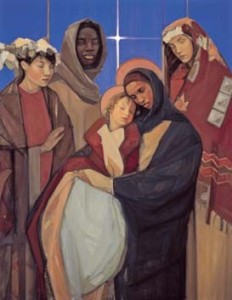
February 1 is the feast day of St. Brigid of Kildare. Brigid is one of my favorite saints. The primary reason she is one of my favorites is because we can’t separate history from legend when it comes to her story. She’s part woman, part saint, and part goddess. Throw in a few miracles and Brigid time traveling to be Mary’s midwife and the foster-mother of Christ, himself, and you just have one good story (and I love a good story).
Here is what we do know about Brigid: she created the first monastic community that grew into the most renowned monastic city in Ireland, Kildare. Brigid was the abbess of the convent and church and the leader of the town that grew up around Kildare. She was known for her piety, her hard work, and her hospitality. She worked side by side with her nuns tending sheep and milking cows, along with weaving and cooking. Gifts given to the monastery by the rich were given to the poor or sold for food. No one was turned away from her convent, and she provided for all. One of the legends say that Brigid could speak to a cow and get her to give milk three times a day when she needed it for visitors. Here is a table grace attributed to Brigid:
I should like a great lake of finest ale
For the King of kings.
I should like a table of the choicest food
For the family of heaven.
Let the ale be made from the fruits of faith,
And the food be forgiving love.
I should welcome the poor to my feast,
For they are God’s children.
I should welcome the sick to my feast,
For they are God’s joy.
Let the poor sit with Jesus at the highest place,
And the sick dance with the angels.
God bless the poor,
God bless the sick,
And bless our human race.
God bless our food,
God bless our drink,
All homes, O God embrace.
Kildare grew so big that Brigid could no longer run it alone. A local bishop, Cloneth came to the monastery to help her and he brought monks with him. The monks were master silver and bronze smiths who created beautiful silver and metal ornaments to go with the nuns’ woven and embroidered tapestries throughout the monastery and church. One of her biographers, a monk who lived at Kildare during Brigid’s life, said this about the monastery and town:
But who could convey in words the supreme beauty of her church and the countless wonders of her city, of which we speak? “City” is the right word for it: that so many people are living there justifies the title. It is a great metropolis, within whose outskirts–which Saint Brigid marked out with a clearly defined boundary–no earthly adversary feared, nor any incursion of enemies. For the city is the safest place of refuge among all towns of the whole land of the Irish, with all their fugitives. It is a place where the treasures of kings are looked after, and it is reckoned to be supreme in good order.
Cogitosus also hinted in his biography that Brigid functioned as a bishop preaching, hearing confession, and ordaining priests. The lines between laity and clergy, and the roles between men and women, were not as fixed in Ireland as they were in other places in Europe. It is possible that abbesses as powerful and influential as Brigid did function as bishops (this would quickly change once the Roman Catholic church gained a foothold in Ireland).
Roses Kildare Ireland by hugh.carlow/Flickr
Now it’s time for the fun stuff. As I mentioned before, the Celtic tradition honors Brigid as Mary’s midwife, Jesus’ wet nurse, and his foster-mother. “Time” was not a fixed, linear progression for the Celtic people. The material world and spiritual world intertwined in and out of each other. There were thin places were one could cross from one world to another with time running differently. This is why the legend of Brigid at the birth of Jesus was entirely believable for the Celts. The material and spiritual were not separate worlds in their thought. I also like this legend because, being the post-modern that I am, I like the idea of putting yourself into the story. Where am I in the grand story of God’s people? How is this story, my story? How is my story now becoming a part of the whole story? Brigid went on to become the spiritual mid-wife to Celtic women giving birth, and the midwife called Brigid into the house to assist in the birth.
Back before the stories of Brigid helping Mary and hanging her cloak on a sunbeam to dry out, Brigid was a goddess in the Celtic pantheon. She was the goddess of poets, blacksmiths, and healers. She was a triple goddess revealing herself as maiden, mother, and crone. The fair maiden to poets, the mother creating new life to blacksmiths, and the old wise woman who knows how to heal. She has long been the symbol of spring coming to the land and the arrival of more light during this time of the year. February 1 is her day, and she was called on to protect the sheep who at this time would be carrying lambs. In the Christian tradition she is remembered for being able to coax cows into milking, and for being able to churn butter for everyone who needed it.
Milking cows and churning butter brings us back into the everyday realm. There is a strong domestic atmosphere in the stories of St. Brigid. Brigid’s life revolves around the home: giving away food to the poor, churning butter to feed all those who lived in the area, sweeping the floor, sewing, and herding both cattle and sheep. She kept her monastery in good order for visitors. Her love for domesticity naturally led to her generous hospitality. There was always food, clothing, and a bed in her house for those who needed it. Like so many women, Brigid wanted a well-run house where her family (her nuns) would have a nice home, and those who visited would find refuge. I am surprised at how domestic I’ve become in the last few years. I’ve realized I’m becoming more like Brigid. I want a clean, orderly house that can be a home and refuge for my husband and I. I also want to extend hospitality to our friends and give them a place to come eat, drink, and be merry. I want them to find a refuge for awhile, rest and have fun while they are under our roof.
As the light comes back this spring, let us remember Brigid: a woman committed to her God, to helping the poor, and to taking care of all who came to her. She established a community that became a light to all who wanted to come pray, learn, work, or needed shelter and food. She believed that everyone was part of the realm of God, and for that reason alone should be treated with respect and cared for. Everyone should have a home they can come to. There is room at the table for all. There is enough food to go around. And if not, Brigid will be seen whispering in the ears of her milk cows.
A Collect for the Feast of St. Brigid:
Everliving God, we rejoice today in the witness of your servant Brigid of Kildare, who served as courageous leader and mentor, faithfully shepherding both men and women in her monastery and guiding them into holiness of life: Inspire us with life and light, and give us perseverance to serve you in our own day. This we ask in the name of the Holy and Undivided Trinity, one God, in glory everlasting. Amen. (From The Saint Helena Breviary, Personal Edition, 281).
Here are two other wonderful posts about Brigid:
A Habit of Wildest Bounty: Feast of St. Brigid at Jan Richardson’s The Painted Prayerbook.
Celtic Prayer: Brigid, Comrade-Woman by Elizabeth Cunningham at The Virtual Abbey.
Originally posted February 1, 2010.