Learning to tell stories that empower instead of hurt

Fre-smile by Frerieke

The last couple of days have not been good. I’ve basically gone catatonic when I’ve tried to work Monday and Tuesday. Monday I went back to bed and slept all day. Yesterday I zoned out in front of the TV. Last night I grabbed my journal and began being an investigator, trying to find out what was going on with me. Then I heard “What stories are you telling yourself?” I had to stop and think for a while. These are the stories that I have been telling myself:

I can’t do this. I never finish anything. It’s too big. Who do I think I am? I will be ridiculed. This book comes out and everyone will know I am a fraud.

I decided this story needed a little reality check editing. In The Life Organizer Jen Louden says, “Delineating between facts and stories is one of the most powerful life practices you can develop.” We need to find those facts and tell a new story. Here’s my new story:

I am writing Career Women of the Bible, and I’m almost finished with the book proposal. I have finished one book proposal: Spiritual Direction 101. I have finished a book, Your Daughters Shall Prophesy: A Biblical Theology of Single Women in Ministry. So what if I’m ridiculed. Heaven knows I’ve ridiculed enough books and authors. It’s all kharma. If some of it comes back to me, I will be kind, and extend love and grace. I am not a fraud. I know what I’m writing about. I have both the education and experience. I’ve lived intimately with the women of Bible for the last few years. I know them, and they want me to tell their stories. My women need their lives written into being, so people can see who they really are instead of the empty caricatures we get at church.

I’m going to write this and hang it up where I work. Are you having trouble with stories? Are there some stories you want to share with us? May be we can help each other change the stories that no longer serving us.

One of my favorite hymns says:

“Let us bring the gifts that differ
And, in splendid, varied ways,
Sing a new church into being,
One of faith and love and praise
“Sing a New Church” by Dolores Dufner, OSB

Can we write a new story into being in splendid varied ways? Write a new community into being full of love, support, and the occasional kick in the pants?

Photo by Frerieke.

Freedom for Christian Woman Coalition Demands an Apology

Suzanne McCarthy at Suzanne’s Bookshelf has posted a letter from The Freedom for Christian Women Coalition demanding an apology from the CBMW for their dangerous and non-biblical views of men, women, and the supposed roles of each in life. She has asked that we link to the letter, and I am more than happy to do so.

July 24, 2010

Dr. Randy Stinson, President
Council on Biblical Manhood and Biblical Womanhood
2825 Lexington Road, Box 926
Louisville, KY 40280

And

Dr. J Ligon Duncan III
Chairman of the Board of the CBMBW
First Presbyterian Church
1390 North State Street
Jackson, MS 39202

The Freedom for Christian Women Coalition met on July 24, 2010, in Orlando, Florida, and agreed and affirmed this Demand for an Apology from the Council on Biblical Manhood and Biblical Womanhood because of the concerns as listed in the following pages.

For the sake of all Christians, men and women, we demand that the Council on Biblical Manhood and Biblical Womanhood, make a public apology for the misuse of Holy Scripture as it relates to women, and cease to publish or promote The Danvers Statement on Biblical Manhood and Biblical Womanhood.

Sincerely,
Shirley Taylor
Waneta Dawn

Cynthia Kunsman

Janice Levinson
Jocelyn Andersen

Freedom for Christian Women Coalition

DEMAND FOR AN APOLOGY FROM THE COUNCIL ON BIBLICAL MANHOOD AND BIBLICAL WOMANHOOD

At a time in our church history that the main focus should be on winning lost souls and spreading the gospel to a hurting world, we fear for the future because the Council on Biblical Manhood and Biblical Womanhood has placed a greater priority on women’s submissive role rather than on the gospel of Jesus Christ.

It is with that thought in mind that we make these statements.

1. We are concerned that men are being taught that they are god-like in their relationship to women within the church and home. As the mothers, wives, and daughters of these men, it is our concern that this doctrine is setting them up for failure as Christian fathers, husbands and sons;

2. we are concerned about the sin that evangelical church leaders commit when they deny the love of Christ fully to women simply because they were born female;

3. we are concerned about the damage this causes to families when husbands and fathers are told that they have Headship over their wives and daughters;

4. we are concerned about wife abuse, girlfriend abuse, and abuse to female children that takes place in many homes where evangelical men are taught that they have earthly and spiritual authority over women;

5. we are concerned that the children who attend churches that subscribe to the principles of The Danvers Statement on Biblical Manhood and Biblical Womanhood will grow up not knowing the full redemptive power of the blood of Jesus for both men and women;

6. we are concerned for the mental and emotional development of girls and boys who attend churches that teach males have superiority over females;

7. we are concerned that men who are taught that they have Male Headship over a home and church do not feel that they are not accountable for abusive attitudes and actions towards women;

8. we are concerned about the mistranslation of the scriptures by complementarian translation committees and by the false teachings propagated by the Council on Biblical Manhood and Biblical Womanhood;

9. we are concerned that pastors who teach and preach male domination/female subordination cannot relate in a loving, Christ-like manner to female members of their congregations because they have already judged them and found them lacking;

10. we are concerned that the issue of wifely submission, promoted so heavily by the Council on Biblical Manhood and Womanhood, is more about power and control than about love or obeying the Word of God.

It is because of these concerns that:

1. We demand that the Council on Biblical Manhood and Womanhood acknowledge the harm that has been done to the church body by The Danvers Statement on Biblical Manhood and Biblical Womanhood, confess it as sin, and denounce it;

2. we demand that denominational leaders and all churches and seminaries which have adopted The Danvers Statement on Biblical Manhood and Biblical Womanhood do the same;

3. we demand a public apology from the Council on Biblical Manhood and Biblical Womanhood, and from all heads of seminaries and Bible colleges that have adopted The Danvers Statement on Biblical Manhood and Biblical Womanhood, for the inestimable damage this statement has done to all Christians whose lives have been influenced by it;

4. we demand that the Council on Biblical Manhood and Biblical Womanhood begin to promote the Biblical design of functional equality for all Christians, both men and women;

5. we demand that the Council on Biblical Manhood and Biblical Womanhood begin to speak out against pastors who continue to demean women and oppress Christians by the use of The Danvers Statement on Biblical Manhood and Biblical Womanhood;

6. we demand that the Council on Biblical Manhood and Biblical Womanhood chastise pastors who claim that abuse of women is acceptable and justified because the wife is not submitting to the husband;

7. we demand that the Council on Biblical Manhood and Biblical Womanhood make known to every boy and every girl who attend an evangelical church, that God is their head, and that authority over another human being can come only from God;

8. we demand that the Council on Biblical Manhood and Biblical Womanhood teach men that they share equally in the burden of society’s ills, and that all that is wrong with society today cannot be blamed on women;

9. we demand that the Council on Biblical Manhood and Biblical Womanhood do everything in their power to teach seminarians to show the love of Christ to both men and women;

10. we demand that the Council on Biblical Manhood and Biblical Womanhood teach pastors to be loving towards those Christian men and women who disagree with The Danvers Statement on Biblical Manhood and Biblical Womanhood;

11. and, finally, for the sake of all Christians, men and women, we demand that the Council on Biblical Manhood and Biblical Womanhood, make a public apology for the misuse of Holy Scripture as it relates to women, and cease to publish or promote The Danvers Statement on Biblical Manhood and Biblical Womanhood.

Shirley Taylor, bWe Baptist Women for Equality , Presented at the
Seneca Falls 2 Evangelical Women’s Rights Convention July 24, 2010 in Orlando, Florida

AFFIRMED BY THE FREEDOM FOR CHRISTIAN WOMEN COALITION AT THE SENECA FALLS 2 EVANGELICAL WOMENS RIGHTS CONVENTION JULY 24, 2010 IN ORLANDO, FLORIDA

Empowering Women: My 10 Favorite Books, Part 2

Yesterday The day before yesterday (this will post at 12:16 a.m. argggg) I posted the first five books in my 10 favorite books that empowered me to be the woman Godde created me to be, and that I think will help other women become all Godde has called them to be. Here are the final five books.

Theology

The books in this list are scholarly and use a lot theological jargon, but I think they are worth the time it takes to read.

She Who Is: The Mystery of God in Feminist Theological Discourse by Elizabeth Johnson

This is the book that showed me I could explore the Divine Feminine and remain a Christian and true to my biblical roots. Johnson is the one who introduced Sophia into my religious life: Spirit-Sophia, Jesus-Sophia, and Mother-Sophia. This book showed me that women’s experience of the divine was just as valid as men’s (i. e. normative) experience. After reading this book I started seeing how women’s experience of Godde was marginalized and neglected.

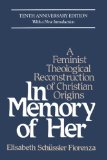
In Memory of Her: A Feminist Theological Reconstruction of Christian Origins by Elisabeth Schüssler Fiorenza

For me Schüssler Fiorenza picked up where Johnson left off. Schüssler Fiorenza dives into how women’s roles and experiences were marginalized, suppressed, and lost to history. Her reconstruction of early Christianity focusing on female disciples and apostles, and the roles that the Bible and sacred history hint at, flesh out a “theological reconstruction of Christian origins.” This book continued to show me how much of Christian history is that: his. It made me realize how desperately we need to balance out our religious experiences, traditions, worship, and Godde-talk with women’s words, women’s experience, and re-discovering the Divine Feminine.

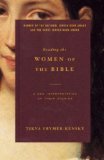
Reading the Women of the Bible: A New Interpretation of Their Stories by Tikva Frymer-Kensky

If you only have one scholarly, wordy book about the women of the Bible on your shelves, this is the one. Technically the Bible we’re talking about here is the Hebrew Scriptures. Frymer-Kensky was a Jewish scholar and Middle East Historian par excellence. As far as I’m concerned no one could pick apart of piece of Scripture in the Hebrew, put it back into English, then add the historical, sociological and cultural background and make me wonder what I can learn from this woman and how can I apply this to my life. In fact, the last chapter is “Mirror and Voices: Reading These Stories Today” helps us start thinking about how these women’s stories can possibly change our own lives and culture.

Unfortunately Dr. Frymer-Kensky passed away in 2006 after a four year battle with breast cancer. Her first book In the Wake of the Goddesses: Women, Culture and the Biblical Transformation of Pagan Myth would be #11 on this list. After reading her two books, I was devastated to find out that would be all I would read. I would love for her passion for Scripture, helping us see the hard truths we don’t want to acknowledge, and the hope of change her work still gives people to live on in a few more books. If you light candles to honor those who have passed on, please light a candle for Tikva.

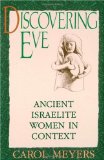
Discovering Eve: Ancient Israelite Women in Context by Carol Meyers

As In Memory of Her reconstructed early Christian origins, Meyers book seeks to reconstruct the ancient Israelite culture the creation stories in Genesis spring from. Discovering Eve, published in 1998 seeks to show what women’s lives in ancient Israel were like as a result of recent archeological finds at the time. Rural villages had been unearthed, and with them, glimpses of women’s lives. Meyers sees Eve as an archetype: Everywoman in the Bible. She shows us what the typical woman’s life would have been like when the Genesis creation stories were being told orally from one family to the next, one tribe to the next. Starting with the typical life and working backwards to show how Adam and Eve as the ideal Everyman and Everywoman came to be and why the Israelites were living in a dry, arid land where eeking out enough crops to live on was so hard instead of living in the water rich Eden.

Meyers also gives an incredible translation of Genesis 3:16 that would revolutionize how we think about women and their roles in the home and society if anyone was interested in an accurate translation of the verse:

I will greatly increase your toil [work/labor] and your pregnancies;
(Along) with travail [physical work] shall you beget children
For to your man is your desire,
And he shall predominate over you.

Meyer’s theory is that not only will the women’s pregnancies increase, but the physical work she does will also increase. Meyers also makes the observation, that in context, the husband only predominates over the women, so that she will have children. Large families were needed to farm the dry, arid land, but with the large infant mortality rate (half of all children born did not live to their second birthday), and mother mortality, the woman would be hesitant to have sex. The husband could rule over her in this for the work that needed to be done to survive. Meyers points out that we no longer need large families to survive, and with modern birth control, the husband predominating over the woman is now a moot point. I think it’s a moot point since Jesus: Jesus came to reverse the curse, including this one. But Meyer’s additional reading of this verse, strictly in the verse’s context is absolutely brilliant.

Worship

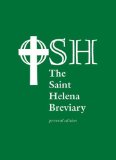
The Saint Helena Breviary: Personal Edition

The Saint Helena BreviaryI will always be grateful to the Episcopalian nuns in the Order of St. Helena for this gender inclusive prayer book. The nuns chant the Daily Office: four services of prayer through the day that include Psalms, readings from the Hebrew Scriptures and New Testament, and prayers. The nuns grew tired of the masculine-only language for Godde. Over a number of years they wrote liturgy and chanted; this breviary is the result. It’s imaginative language and poetic meter help me to see Godde in new ways.

Hopefully in the future there will be more resources for fairly orthodox Christian women using Divine Feminine language for Godde. A good friend of mine is creating a Sophia Daily Office (which I hope a publisher will have the guts to pick up), and I am working on The Christian Godde Project. We are translating the New Testament using Diving Feminine names and pronouns for Godde to begin to balance out the male language only versions (Heaven help us).

If you know of prayer, worship resources, or liturgies using Divine Feminine language, please leave them in the comments.

All book links are affiliate links.

Empowering Women: My 10 Favorite Books, Part 1

This is for the Day 2 Challenge, Write a List Post, for 31 Days to Build a Better Blog Challenge at The SITS Girls on BlogFrog.

For my list post(s) I have decided to give the 10 books that empowered me to be the woman and leader that Godde called me to be. This is the first post of two. I will post the second part including theology and worship books tomorrow.

Practical Books

All We’re Meant to Be: Biblical Feminism for Today by Letha Scanzoni and Nancy Hardesty

This book was instrumental in helping me claim my life as my own as a leader in the church and as a single woman who didn’t know if she wanted to get married and have kids. I did get married, but I chose not to have children for the simple reason I am not called to be a mother (and The Hubby is just fine with being Uncle Tracy, thank Godde). This book gave me that option as a Christian woman. Scanzoni and Hardesty systematically take the reader through the Bible pointing out where mistranslations, mis-interpretations, and neglect have been used to caricature the women of the Bible as wives and mothers and nothing else. They lay solid biblical and theological groundwork for why women were created to be more than wives and mothers (without diminishing those roles: they are important!), and they illustrate how women were merchants, business women, spiritual and political leaders in The Hebrew Scriptures and The New Testament.

Ten Lies The Church Tells Women by J. Lee Grady

10 Lies the Church Tells WomenGrady, the former editor and now contributing editor for Charisma Magazine, systematically goes through the lies that most women grew up with in church:

        • God created women as inferior beings destined to serve their husbands.
        • A woman should view her husband as the “priest of the home.”
        • Women who exhibit strong leadership qualities pose a serious danger to the church.
        • Women can’t be fulfilled or spiritually effective without a husband and children.
        • Women shouldn’t work outside the home.

Grady goes through each lie telling how he has seen it effect women in many churches through the years, and giving women solid, conservative, biblical positions to stand on if and when Godde calls them to be leaders in their church or calls them to a secular vocation outside of the home. If you’re on the conservative side this is the book I recommend you start with. Grady has a high regard for the inerrancy of the Bible, and conservative women won’t feel like he is manipulating Scripture or putting traditions and world cultures ahead of the Bible.

Harlot by the Side of the Road by Jonathan Kirsch

This is one of my all-time favorite books, period. This book began when Kirsch, a Jew, decided to start reading The Hebrew Scriptures to his son at bedtime. He was amazed at the stories they hit not too far into Genesis: a drunk and naked Noah. He went on to discover adultery, gang rape, incest, and war. He didn’t remember any of this from when he learned the stories as a child, so he began investigating the forbidden tales of the Bible and out came this wonderful book. These are the stories that all of us who claim The First Testament as our holy scriptures want to leave out. Here are a few of the chapter titles to give you an idea of the forbidden tales he uncovers:

  • Life Against Death: The Sacred Incest of Lot’s Daughters
  • The Woman Who Willed Herself into History: Tamar as the Harlot by the Side of the Road
  • The Bridegroom of Blood: Zipporah as the Goddess-Rescuer of Moses
  • God and Gyno-sadism: Heroines and Martyrs in the Book of Judges

This well researched book is very accessible to readers who are not scholars and theologians. Kirsch helps us see some of the women in the Bible who have been considered as sexually loose or whores in a new light. He also helps us to see how we, as people of The Book, can start navigate the abuse and violence of our world in a biblical context.

History

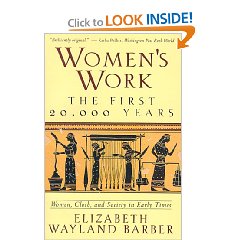
Women’s Work: The First 20,000 Years Women, Cloth, and Society in Early Times by Elizabeth Wayland Barber

Here’s what people don’t realize about women working and financially supporting their families: women’s work drove the ancient economy. Women’s work, weaving and textiles, fueled the ancient economy of trading. The money women made from their looms was their own to manage how they saw fit. Women have always worked to support their families. It’s just in the first 20,000 years almost everyone worked from home (with the exceptions of soldiers and traders). Men used to work from home to support families too up until Industrial Age divided work and home into two separate spheres. Wayland Barber shows how women’s work made trade and ancient economy go round. I found the history and her research fascinating. It is also a very accessible book: you don’t have to have a specialized vocabulary or a degree in history to read this book. Here are two of my favorite excerpts.

We also have many letters that the traders’ wives wrote to them from far away in Ashur, the capital of Assyria [Syria]–letters not just about how the family was getting along, but also about business matters. For at least some of the wives, daughters, and sisters were in business for themselves, acting as textile suppliers to their menfolk six hundred miles away in Anatolia [Turkey] and taking considerable profit therefrom to use for their own purposes (p. 169).

In the early layers of the Late Bronze Age sites in Israel…we suddenly begin to find locally made clay imitations of Egyptian fiber-wetting bowls, developed for just this purpose [splicing and twining linen]. The appearance of these humble textile tools, used only by women, alerts us that this is a time when women had just arrived in Palestine from Egypt in considerable numbers and settled there–and there is no other such time that we have found. Thus out of the several points in Egyptian history that scholars gave suggested for the date of the Exodus, the women’s artifacts tell us that this one (around 1500 to 1450 B. C.) is the archaelologically (sic) most probable layer to equate with their Exodus from Egypt (p. 254).

A Woman’s Place: House Churches In Earliest Christianity by Carolyn Osiek, Margaret Y. MacDonald with Janet H. Tulloch

This is a more scholarly book but well worth the time it takes to read. Osiek, et. al. unearth the structures of ancient households and the churches meeting within them during the first 300 years of Chrisitianity before the Christian religion was legalized and churches began to be built. One of the reasons given that women should not be pastors and bishops is that a woman’s sphere of influence should be the home. But the early churches met in homes where the matriarch of the family ruled. The authors show how much responsibility women had within in their homes and how much power they wielded within their homes, which translates into women having power within the churches that met in their homes.

All book links are affliate links.

Thank you to Elizabeth Ferree at The Life of a Home Mom for giving me the idea for this list post! (She’s @homemom3 on Twitter.) Actually I took two of her ideas for a list post and crunched them together, and it got me excited to write this post. This is a first time in a long time I’ve been excited about writing a post. Thank you Elizabeth! And thank you to The SITS Girls for putting together the blog challenge, so we can encourage and inspire each other!

31 Days to Build a Better Blog with the SITS Girls: Day 1

I always mean to blog more and start posting regularly. It still hasn’t happened. I’m really really bad about procrastinating. From my adventure a couple of weeks ago with the Reading Deprivation Week of The Artist’s Way, I found out I am a Pathetic Procrastinator who needs accountability. To that end I’ve joined The SITS Girls on BlogFrog in the 31 Days to Build a Better Blog Challenge. I’ve owned 31DBBB for six months, and the furthest I’ve gotten is Day 5 on my own. My goal is at the end of the 31 days to complete the book and be posting regularly.

The Day 1 challenge is to write an elevator pitch for your blog. This is one or two sentences that describe what your blog is all about. I’ve had my pitch in the About Me box on the side column for awhile, but I’ve decided to tweak it. Here’s the new one:

I empower women to be the leaders Godde calls them to be at home, work and church by exploring the Divine Feminine and stories of the women in the Bible. I also use my experience and spiritual direction to help them discover new facets of Godde and their own leadership abilities.

I’ve been wanting to talk about the Divine Feminine more, but I hadn’t taken the time to work out how it would fit into the purpose I already had for this blog. It fits in so naturally, I wonder now why I procrastinated for so long. This also gives me a chance to explain the terms I use for Godde on this blog. First up: why Godde and not God? Godde is combination of God and Goddess to show that God transcends gender: Godde is neither male nor female and both male and female since Godde created both men and women in the image of Godde. I believe that  Godde is Mother as well as Father, and instead of using the standard Lord that’s used to translate Yahweh in the Hebrew Scriptures, I use Sophia-Yahweh. I will lean more towards feminine references to Godde on my blog as masculine references are just about all you hear in church and society to refer to Godde. I use exclusively feminine pronouns for Godde for this reason as well. You’ll be seeing Sophia and Mother a lot on this blog, and I hope it doesn’t offend you. I hope it will help you to see Godde in new ways and start to walk on new paths with this Godde who cries out like a woman in labor to bring forth her people and nurses them at her own breast (Deut. 32:18, Psalm 22:10; 131:2; Isaiah 42:14; 49:15; 66:13).

Reading Deprivation Is Over

I survived four days of no reading and no computer. I learned that I am The Queen of Procrastination. If I don’t read, I watch TV. If I turn off the TV, I listen to NPR. If I turn off the radio, I take naps. It wasn’t pretty. This makes me very glad that I signed up for Cairene MacDonald’s Project Front Burner class that is designed to get procrastinators like me off my ass and doing something. I think the accountability will be good for me. Have you been putting of something? Have you been working on a project for a long time (like three years), like me? You might want to sign up for Cairene’s class.

I’ve come to the conclusion that I’m going to have to look into that whole accountability thing, if for no other reasons to make me set goals and deadlines for those goals. I’m really, really bad about thinking, “Hey, it’ll happen. Inspiration will strike some time today.” Yes, you’re right. I do know better.