The Woman Who Didn't Take No for an Answer–Not even from Jesus

I noticed that the Gospel Reading in the lectionary for this week is the story of the Syro-Phoenician woman in Matthew 15. A lot pastors have problems preaching this passage, so here is some help from What You Didn’t Learn in Sunday School: Women Who Didn’t Shut Up & Sit Down.

The Syro-Phoenician Woman didn’t shut up and sit down, even when Jesus told her too! I think you learn the most from this passage by comparing and contrasting it to the parallel passage in Mark.

The Syro-Phoenician Woman:
One Story, Two Gospels, Two Interpretations

Mark’s Story

From there he set out and went away to the region of Tyre. He entered a house and did not want anyone to know he was there. Yet he could not escape notice, but a woman whose little daughter had an unclean spirit immediately heard about him, and she came and bowed down at his feet. Now the woman was a Gentile, of Syrophoenician origin. She begged him to cast the demon out of her daughter. He said to her, “Let the children be fed first, for it is not fair to take the children’s food and throw it to the dogs.” But she answered him, “Sir, even the dogs under the table eat the children’s crumbs.” Then he said to her, “For saying that, you may go—the demon has left your daughter.” So she went home, found the child lying on the bed, and the demon gone (Mark 7:24-30, NRSV).

We don’t hear much about women giving Jesus lip in our churches. In the biblical witness we find two women who talked back to Jesus: Martha, the sister of Mary and Lazarus, and the Syro-Phoenician Woman in this passage. That these two women stood up to Jesus and talked back is usually explained away. In one scene, Martha was tired from cooking; in the other, her brother had just died: of course she’s snippy and Jesus is patient. In this scene, the Gentile woman knows that Jesus is just teasing her, and she plays along.

Martha and this woman’s backbones are covered up, their nerve shoved into a corner. Neither of these women thought silence and submission was the way to go.

“No Violence” by Ray Allen

Jesus had been healing and teaching. He fed the multitude of 5,000. He had been debating (fighting) with the religious leaders. He came to a totally pagan, Gentile area to get away from everything. He was here for a break. He was here to not teach, to not heal, to not fight. No one knew him here. He could sneak in, get some rest, and sneak out again. Or so he thought. Since Jesus was trying to stay incognito, we don’t how the woman knew he was in the neighborhood. My guess is the local grapevine. She found out a great healer was in town, and she decided to act. If she had a husband, he’s not mentioned. This mother acted on her own. She went to the house where Jesus was keeping a low profile, and there she fell at his feet begging him to heal her daughter, who was demon-possessed.

We expect Jesus to immediately act. We expect him to get up and go with this woman to her daughter, like he did with Jairus in the previous chapter. We also know from chapter 5 Jesus has no qualms about healing Gentiles: he healed the Gentile demoniac in the country of the Gerasenes. His first healing in Mark was healing a man with leprosy by touching him. But what we expect does not happen in this story.

Instead he told the woman, “it’s not right to throw the children’s bread to the dogs.” At this point (if we are honest with ourselves) our jaws drop, and we wonder “What happened to Jesus?”

A dog. Jesus called her a dog, a term of derision for Gentiles. They were unclean just as dogs were unclean. But pigs were unclean too, as well as graveyards, and Jesus did not call the Gerasenes demoniac a dog or swine. Why this abrupt change in Jesus? Does exhaustion alone account for it?

But the woman is quick-witted. She let the insult slide over her with this incisive retort: “Yes, but even the dogs get to lick up the crumbs on the floor.” Fine. If he called her a dog then a dog she would be. She accepted what dogs accept: table scraps, crumbs, whatever those at the table deem worthy enough or inconsequential enough to give.

Because this woman did not shut up (or submit to the Son of Godde), because she stood her ground, Jesus changed his mind. He had not come here to heal. He didn’t want to heal this woman’s daughter. But in the end he did heal the daughter. He did because of the woman’s retort. This woman’s daughter was healed because she talked back to Jesus, and didn’t assume her place was one of quiet submission.

Matthew’s Story

Jesus left that place and went away to the district of Tyre and Sidon. Just then a Canaanite woman from that region came out and started shouting, “Have mercy on me, Lord, Son of David; my daughter is tormented by a demon.” But he did not answer her at all. And his disciples came and urged him, saying, “Send her away, for she keeps shouting after us.” He answered, “I was sent only to the lost sheep of the house of Israel.” But she came and knelt before him, saying, “Lord, help me.” He answered, “It is not fair to take the children’s food and throw it to the dogs.” She said, “Yes, Lord, yet even the dogs eat the crumbs that fall from their masters’ table.” Then Jesus answered her, “Woman, great is your faith! Let it be done for you as you wish.” And her daughter was healed instantly (Matthew 15:21-28, NRSV).
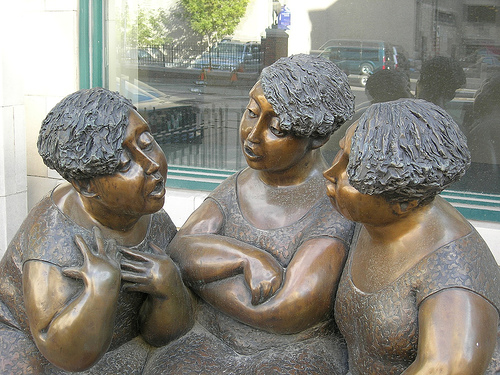
Gossip, a sculpture by Rose-Aimee Belanger. Photo by Dan McKay.

We can interpret Matthew’s version of the story a little differently than Mark’s version. This is the main reason it’s hard to say this is what Godde meant one time and forever more. The writers of the Bible gave different versions of stories with their own interpretations and for application for their own communities. In Mark’s version the disciples are invisible; in fact, they’re not even mentioned. But not in Matthew: here they are front and center. I always figured it’s because Matthew was uncomfortable with the Jesus in Mark being abrupt and rude (Matthew and Luke “fix” Mark quite a bit). But an Anglican priest I met in 2009 gave me another way to interpret this story.

Reverend Nadim Nassar grew up in Syria and went to school in Lebanon. He now lives in London. There is a very cultural thing he grew up with that explains perfectly what is going on in Matthew if we know Middle Eastern culture. In the Middle East when the eldest son marries, he still lives at home with his parents, and his wife comes to live with the family. This is because as the main heir, the eldest son is expected to take care of his parents in their old age.

When the mother-in-law doesn’t like something the daughter-in-law is doing, or doesn’t think the daughter-in-law is treating her with enough respect, the mother-in-law does not tell the daughter-in-law. She complains about it to a neighbor in the daughter’s-in-law hearing.

“Miriam, do you know how my daughter-in-law treats me? I tell her every night, dry the dishes with a towel, don’t air dry them! But does she listen to me?”

“Abraham, have I told you how my daughter-in-law doesn’t respect me? I told her to water the garden this morning. Bah! Just look at my poor tomatoes withering away in this harsh sunlight!”

You get the idea. Now take this idea and apply it to the story. Jesus is the mother-in-law. The disciples are the daughters-in-law. The Canaanite woman is the neighbor. So what does that mean Jesus is doing in this story? In Mark’s story Jesus is the one who’s being exclusive, showing the members of Mark’s community that even Jesus was corrected when he thought the gospel was just for the Jews. In Matthew, the disciples want Jesus to send the woman away, and he takes a minute to teach the disciples (Matthew’s community) the gospel was not just for the Jews.

Jesus: “Look at my daughters-in-law thinking Godde is just for them. You called me ‘Son of Bathsheba and David.’ You know I can’t take the kids’ food and feed it to the dogs who come wandering in.”

Woman: “Oh you poor thing. Such disrespect. But you know even the dogs get the crumbs the children leave behind.”

Jesus (chuckling): “Woman you have great faith. Go. Your daughter is healed.”

Woman looking at disciples’ shocked faces: “Good luck with those daughters-in-law.”

I said in Mark’s story we could not read any humor or twinkling of eyes into that account. The only reason we can do that in this account is because of the disciples and what we know about Middle Eastern culture. This interpretation will not work in Mark because the disciples are not mentioned in the story. If they are in the room they are silent. The scene is strictly between Jesus and the woman. And yes, Mark’s account makes Jesus look bad, which is why Matthew added the disciples. They can look bad while Jesus appears to be an exasperated mother-in-law, which every woman who heard this story would understand. After all, they were all mothers-in-law or daughters-in-law: they lived this situation out every day.

  • What do you think of the differences in the accounts between Mark and Matthew?
  • Do you want to harmonize the two accounts and read Matthew into Mark, so Jesus doesn’t look so surly?
  • Can you take each account on its own terms and live with the tension?

–Excerpted from What You Didn’t Learn in Sunday School: Women Who Didn’t Shut Up & Sit Down, pp. 16-24.

Share you answers in the comments!

Are you preaching this passage this Sunday? How are going to approach it and preach it for your congregation?


Book Review: Touching God

Touching God: Experiencing Metaphors for the Divine
Ellyn Sanna
© 2002
Paperback, $12.95

Touching God is like sitting down with a really good friend who makes you look over the last few days or weeks of your life and see them in a different way. The two of you are talking about your mundane lives then she says something that makes you see a daily occurrence in a whole new light. Sanna makes you look at the things that make up your daily, routine life such has food, light, housekeeping, children, and friends and helps you see Godde. Taking everyday objects and activities and making them metaphors to describe Godde is nothing new–Jesus did the same thing in parables. Throughout the Bible daily activities are turned into metaphors to describe this invisible Godde we are in a relationship with. Things and activities we are familiar with give Godde the human skin we need to touch her and know she is with us. Metaphors like:

  • Godde is light.
  • Godde is a rock.
  • Godde is bread.
  • Godde is a housekeeper.
  • Godde is a spouse.
  • Godde is a friend.

Keeping each metaphor firmly rooted in her daily life and relationships, Sanna unpacks how we experience Godde through these symbols in the 21st century. She is good at taking the things of everyday life and giving Godde the flesh we all crave.

Being the descendent of Italian Americans who love to cook and eat, my favorite chapter was the one on food. The chapter begins with one of the most creative and imaginative retellings of the Feeding of the 5,000 I have read. Beyond the obvious connection with the sacrament of communion, Sanna reminds us that at the heart of seeing Godde as food is remembering the connection between food and our physical well-being. Food has become everything from an addiction to a reward in American society, and our obsession with food revolves around what we can’t have and shouldn’t have. We have forgotten that we need to food to live, just as we need Godde to live. Yes, human beings shall not live by bread alone, but we will not live at all without bread. Sanna believes we need to remember and think of our meals as blessings of abundance and generosity instead of calorie counting to help us remember the same abundance and generosity we receive from Godde.

After recently posting about the importance of homemakers in the Early Church, I was very pleased to see a chapter comparing Godde to a housewife in Touching God. Sanna begins with the parable in Luke 15 that normally gets looked over when we talk about Godde looking for lost things and lost people:

Or what woman having ten silver coins, if she loses one of them, does not light a lamp, sweep the house, and search carefully until she finds it? When she has found it, she calls together her friends and neighbours, saying, “Rejoice with me, for I have found the coin that I had lost.” Just so, I tell you, there is joy in the presence of the angels of God over one sinner who repents (Luke 15:8-10, NRSV).

Remembering lessons from Sunday School Sanna says:

I don’t remember a time I didn’t know that God was the Good Shepherd searching for the lost sheep, and my Sunday school teachers made quite clear that just as the father ran out to greet his prodigal son, God welcomes us when we come back to him. God is a shepherd, God is a father; I was familiar with these metaphors. But no Sunday school teacher ever spelled out the parallel metaphor that is clearly there in Christ’s story: God is a housewife.

I don’t remember hearing anything about Godde being a housewife in my years of Sunday school and church either. Though I have heard many sermons and Sunday School lessons about Godde the Shepherd, and Godde the Loving Father. Those three verses between these two parables are conveniently skipped over, so we don’t have to demean Godde by showing Godde doing something as menial as “woman’s work.” Although, as Sanna points out, in the biblical time being a homemaker/housekeeper was not considered demeaning labor. Women were responsible for the processing of and allotment of all the food the family needed. Women’s work also fueled the ancient economy with their continuous spinning and weaving of cloth for clothing, shelter, and housewares. And as I pointed out in my post about Martha, Sanna also explains that rich homemakers ran small businesses.

One of the things that I adore about this book and Sanna is her penchant for picking up the dictonary and looking up what words really mean. This is how I found out that menial did not always mean inferior or demeaning. Menial “comes from the Latin roots meaning ‘to remain, to dwell.’ This sense of stability and permanence surely means that our household chores reflect aspects of the divine nature, ‘with whom is no variableness, neither shadow of turning’ (Jas 1:17, KJV).”

The next time I am cleaning the bathroom or mopping the kitchen floor my mantra is going to be: “Godde is a housekeeper too. Godde is a housekeeper too.”

The most challenging chapter, and the one I resisted the most will probably be the one other readers will have trouble with as well: Seeing Godde in the poor. Sanna herself notes:

We are attracted to most symbols for God. Metaphors from nature may be intimidating at times, but they are still beautiful; in most human metaphors for God we catch a glimpse of something loveable and sympathetic, some human quality we recognize and appreciate. But the poor make us uneasy. People who lack food, proper hygiene, and education are seldom pretty; how can we see God’s image in such ugliness and despair?

Even though Jesus was born in poverty and was a poor man all his earthly life, we have problems with seeing Godde as poor, seeing Godde in poverty.

When we catch a glimpse of God in those who are poor, we are not meant to sit back and simply admire it. Other divine metaphors may speak to us through their essential beauty; we can meditate on these symbols’ attributes and learn more about the nature of God–but there is nothing divine at all about human suffering and need. The poor are not blessed because they possess some wonderful spiritual quality; instead, they are blessed because God hears their cry….They are a challenge to our smug self-sufficiency, a voice that demands our response.

The question is will see Godde in the poor and act? Or will we turn away to the more pleasant symbols for Godde and ignore that this was the life our own Savior chose while walking the earth?

I recommend this book to anyone who wants to recognize Godde’s presence in their ordinary, mundane lives. Godde is there, but we so often don’t take the time to look, search, and meditate on the many different ways Godde shows up in our day. Touching God will help you to slow down and start looking for the many metaphors and symbols in your own life that will help you see Godde all around you everyday.

I have also reviewed Ellyn Sanna’s new translation of Julian of Norwich’s Showings: All Shall Be Well: Divine Revelations of Love by Julian of Norwich.

Disclaimer: I received a free copy of this book from Anamchara Press agreeing to post a review of it on my blog.

RevGal Friday Five: What to Do, What to Do Edition

Kathryn writes about vacations and staycations:

I’m wrapping up a two week vacation that has taken me from beach to basement.

WHAT?

It’s true, I took a week off of work to clean out the basement. Sadly, to look at a before/after photo would not make it look like my time had been used wisely. Just about everything is still down there, it’s just in a different pile. BUT… our church rummage sale this year is going to be very, very blessed.

I’m wondering if anyone else out there takes a week off of work to do a different kind of work:

1) Have you ever ‘staycationed’ in order to work on a project? If no, would you?

Yes. In fact, a couple of years ago I took the week between Christmas and New Year in order to clean out the office and other odd jobs that needed to be done but never got done.

2) What project did you or would you tackle first?

The office needs to be shoveled out and organized again. It’s the place where we throw everything that doesn’t have a home.

3) Any other projects?

I would also like to clean out the cupboards in the kitchen and get some things arranged in a more natural order of how I use it. Oh and filing–the mountains of filing that need to be done. Oomph.

4) What are the pitfalls of a staycation for you?

I don’t work on the projects, I use it as an excuse to watch TV and movies.

5) Never mind this staying at home business, where do you want to go and what do you want to do there?

I want to go to Ireland, rent a place and stay for three or four months. Living, writing, and exploring. In fact that is my long term game plan: to pick a region and go there live there for a few months then come back home. Ireland is just a the top of the list.

You can see what projects other RevGals are up to here.


Company Girl Coffee: Kicking Back with the In-laws

We’re on vacation this week in Nebraska visiting my in-laws. We’re having a great time. Yesterday was my father and mother’s in law 44 wedding anniversay. We went out to eat and people they have known for years joined us. I got to meet friends My Hubby has had since high school. It was so much fun. Earlier in the day my MIL treated me to a pedicure, and they had massage chairs! I was in heaven. Here are my pretty toesies:

Blue sparkly toes with flowers! Squee!

We went to the zoo with my sister-in-law and her family Wednesday. It was a lot of fun. As you can see there are three kiddos, whom I’m calling Thing #1, Thing #2, and Thing #3 because I love Dr. Seuss.

Thing #1 riding a horse.

Thing #2 riding a horse.


Things #2 & #3 feeding the goats

PENGUINS!

Thing #1 in the butterfly tent. Thing #2 is to the left, also in the butterfly tent.


The whole family

I love flamingos. Don't know why, but I do.

Grandma finally got Thing #3 to look at the camera. She looked away from the camera all day.


I’ve also gotten some work done. I posted a review of an excellent book yesterday: Touching God: Experiencing Metaphors for the Divine. I really enjoyed reading this book, and it challenged me to be more mindful of where I see Godde, and how I experience her in my every day  life. I highly recommend it.

Today’s plans are up in the air depending on the weather. If it stops raining, we’re going to the county fair. I’m excited. I haven’t been to a fair in years. If the rain keeps up, then we’ll go see a movie. We head back home Sunday. It’s been a really good week, and we’ve had a lot of fun.

Not only is there coffee by the FIL provided donuts as well! Have a cup of coffee, grab a donut, and tell me about your week. Then go sit and have a chat with another Company Girl.

5 Years Ago on ShawnaAtteberry.com: The 12th Centry B.C.E. Career Woman

I started this blog five years ago (where has the time went?). This was the post that kicked off what become Career Women of the Bible. It was originally posted in August 2006.

Deborah: Words, Women and War', Nathan Moscowitz. )For information about the detailed use of symbols in this intricate painting, go to http://www.nahumhalevi.com/Deborah.html.)

The 12th Century B.C.E. Career Woman

In my imagination I see her under her palm tree, sitting and listening to the people who came to her for justice and peace. Her head nodding as she listens. In my mind’s eye I see her standing, veil blowing in the wind, eyes flashing, as she commands Barak to gather his men and fight Sisera at Yahweh’s command. I also see her resolutely lead Israel’s armies into battle, her chin set, her eyes never wavering from their forward stare. After the battle I see her dancing around the fire, tambourine in hand, singing of the victory in what would become one of the oldest songs recorded in the Hebrew Scriptures. But I also see her in her home, feeding her family, singing stories to her children, going to bed with her husband. Deborah: the first career woman mentioned in the Bible. She is judge, prophet, military leader, and worship leader. But she is also wife, mother, sister, and daughter. It’s no wonder that those who advocate that the “bibilical” place for women is in the home and not the workforce, skip right over Deborah and her story.

During the time of the Judges, Deborah arose as a judge and prophet to lead the people of Israel against an enemy that had cruelly oppressed them for 20 years: King Jabin of Canaan and his general Sisera. Judges 5 is one of the oldest texts of the Bible believed to have been composed as early as the late twelfth century B.C.E. It predates Judges 4 by several centuries. It is Deborah’s song of victory over the forces of Jabin and Sisera, which climaxed in Sisera’s death.

In “Awake! Awake! Utter a Song!” Susan Ackerman shows how Hebrew parallelism is used to show that Deborah and Yahweh work together to win this victory. Verses 1-2 set the tone, ”the people are waiting for Yahweh, they are ready to obey what he says. Deborah calls to the kings and princes to listen to her song for Yahweh has spoken to her. In verses 3-4 Deborah sings of Yahweh’s coming. Yahweh comes from Seir and Edom; from the place where God met Israel at Sinai and made a covenant with them. God is shown as marching north to fight for and defend the people. It is a cosmic event: the earth trembles, the heavens and clouds pour water, the mountains quake when Yahweh comes.

Verses 6-7 then show us what is happening on earth: people cannot travel safely and caravans stopped until Deborah arose as “a mother in Israel,” then the people, even peasants, prospered on the plunder that was taken. This poetic feature shows that this is a holy war–God is coming to fight for his people, and it doesn’t take place on the cosmic level alone–it takes place on the earth to deliver his people. The song also shows that Deborah is Yahweh’s counterpart on earth; she is the one God is speaking through and working through to accomplish God’s purposes on earth.

A Mother in Israel

In verse 7 Deborah is referred to as “a mother in Israel.” Judges 5 does not mention Deborah being married, so it is unlikely we are to take this phrase to literally mean that Deborah had children. The only other place “mother in Israel” is used is 2 Samuel 20:19 to describe the city of Abel of Beth-maacah where Sheba hides after he has instigated a rebellion against King David. When Joab besieges the city a wise woman appears at the wall wanting to know why he is attacking a city that is “a mother in Israel.” Abel is a city that is known for its wisdom in settling matters between conflicting parties. In the past it had been said, “Let them inquire at Abel” (2 Sam. 20:18). Abel was renown for its ability to resolve conflicts. It is a peaceful city, faithful in Israel, which could be a reference to its support of David. The wise woman also calls Abel “the heritage of the Lord” (v. 22). Earlier in 1 Samuel when the mother of Tekoa pleads her case to David she calls her son “the heritage of the Lord” (14:16). The heritage of Yahweh is something that Yahweh has given to his people whether it be children or land, and it is viewed as worth fighting for. “A mother in Israel” is a city that is renown for its wisdom and negotiating skills. It is able to bring about resolutions that protect the heritage of Yahweh.

By extension the wise woman herself is “a mother in Israel.” She shows all of the characteristics of her city: wisdom, negotiating skills, and she is a leader. She wants to protect her city, which is the heritage of Yahweh, and she will have a man killed in order to secure the well-being of her city. This is seen in the fact that Joab speaks to her and doesn’t demand to see someone else. This woman is the elder, and in all likelihood, the military commander of Abel, and that is why Joab negotiates with her: she is his equal.

For Judges 5 to call Deborah “a mother in Israel” is to show that she was known for her wisdom and ability to negotiate peace. It also shows her passionate commitment to bring peace to Israel and well-being to the heritage of Yahweh. She will insure that her people have peace and can prosper, and so she is willing to go to war with Jabin and Sisera at the command of Yahweh to accomplish this goal. She is “the perfect human counterpart of Yahweh, who as ‘the God of Israel’ likewise displays a passionate commitment to the Israelite community” (Ackerman, 43). In the past Yahweh has fought for his people and delivered them out of slavery and oppression, and Deborah boldly announces that he is about to act to free Israel again, and Deborah will obey all he commands of her to see his will done.

Military Leader

The next place we see the cosmic/earth and divine/human intersection is in verse 12: “Awake, awake, Deborah! Awake, awake, utter a song!” Normally the cry to “awake” is cried out by the people to God. They are calling for him to awake and come to their aid. This pattern is seen in both the Psalms and the Prophets. Here we see that it is Deborah who is called to “awake.” This call can come to Deborah because she is Yahweh’s human representative on earth.

In Judges 5 Deborah’s marital status is never mentioned. She is also clearly the military leader with Barak as her second-in-command. This is seen in the following ways: first her name is mentioned more often. Second Barak’s name never appears independent of Deborah’s, and her name is always first. The text also says that the oppression happening in Israel did not stop until Deborah arose in Israel; Barak is not mentioned. The verb arose also implies that it was Deborah who arose to lead Israel’s troops against Sisera and his army.

This changes in Judges 4. Chapter 4 is part of the Deuteronomistic history, which was written and complied during Josiah’s reign in the seventh century B.C.E. Deborah is now identified as a prophet and judge. She is the only female judge in the Hebrew Scriptures, and one of the few named female prophets (Miriam, Huldah, and Noadiah are the other three). She is also married: she is the wife of Lappidoth.

Her role as military leader has been considerably minimized. Yahweh’s role in the battle and the defeat is also curtailed. In chapter 5 Yahweh marched north to Israel causing cosmic upheavel in order to free his people. The only mention of Yahweh’s participation in chapter 4 is in verse 15 where Yahweh throws Sisera’s troops into a panic so that Barak and his men can come and win. Barak now leads the troops although he would not go into battle unless Deborah accompanied him. His reticence to believe that Yahweh was speaking through Deborah would cost him the glory of killing Sisera himself: that honor would go to a woman.

During the premonarchic period before the monarchy and the cult were institutionalized in Jerusalem, a woman could be portrayed as a military leader leading troops into battle to execute Yahweh’s holy war on earth. Due to the mythic nature of the poem, Israel could look beyond gendered roles for women to accept a female military leader. This has changed in the seventh century. Both the monarchy and the temple cult are set in place and acceptable gender roles are established. A female military leader is unacceptable. Therefore Deborah fades into the background and Barak takes the lead. Barak also takes the glory in the rest of the canon (1 Samuel 12:11; Hebrews 11:32). In the lists of judges who are commended, Barak is always mentioned; Deborah is forgotten.

There have also been efforts to insure that Deborah is portrayed as a ‘good, little wife.” This is seen in the tag that she is the wife of Lappidoth. This is also seen in commentators who have tried to marry her off to Barak to explain why they go into battle together. The text does not support a marriage between the two. And Lappidoth does not seem to play a part in Deborah’s calling as a leader. According to the text he didn’t even have anything to say about his wife going off to war. He could have been one of the warriors who went into battle, but apparently he supported his wife’s ministry, and had no trouble with Deborah being a judge over Israel and a prophet.

Deborah, wife of Lappidoth, mother not only to her own children, but to Isreal; prophet, judge, and leader, shows us that women juggling their callings as wife, mother, and leader have existed from the beginning. She is also shows us that family and career can be juggled successfully.

Sources

Susan Ackerman, Warrior, Dancer, Seductress, Queen: Women in Judges and Biblical Israel (New York: Doubleday, 1998), “Awake! Awake! Utter a Song!” 27-88.

Shawna Renee Bound, Your Daughters Shall Prophesy: A Biblical Theology of Single Women in Ministry, unpublished thesis, (© by Shawna Renee Bound 2002), “Judge and Prophets,” 23-34.

E. John Hamlin, Judges: At Risk in the Promised Land (Grand Rapids, MI: William B. Eerdmans Publishing Co., 1990).

The IVP Women’s Bible Commentary (Downer’s Grove, IL: InterVarsity Press, 2002), “Judges,” 133-5.

All biblical quotations are taken from the Revised Standard Version unless otherwise noted.

The New Testament Church: Built by homemakers like Martha

Christ in the House of Mary and Martha by Vincenzo Campi

July 29 is the feast day of the sisters Martha and Mary. I’ve written on both sisters before here, here, here, and here. But the one thing I’ve never written on concerning the sisters is that Martha’s skills in the home were instrumental in the establishment of the church and giving the church a foothold in wider Greco-Roman society. Martha usually takes a lot of slack for her homemaking skills due to Luke 10:38-42:

Now as they went on their way, he entered a certain village, where a woman named Martha welcomed him into her home. She had a sister named Mary, who sat at the Lord’s feet and listened to what he was saying. But Martha was distracted by her many tasks; so she came to him and asked, “Lord, do you not care that my sister has left me to do all the work by myself? Tell her then to help me.” But the Lord answered her, “Martha, Martha, you are worried and distracted by many things; there is need of only one thing. Mary has chosen the better part, which will not be taken away from her” (NRSV).

This is an important passage for women being disciples along with men, and Jesus treating his male and female disciples equally. But I’ve done lots of writing on that subject. It’s time to look at the busy homemakers of the The New Testament, the Marthas. The New Testament lists several women who hosted churches in their home:

  • Mary, the mother of John Mark (Acts 12:12-17)
  • Lydia (Acts 16:11-15)
  • Priscilla (Romans 16:3, 1 Corinthians 16:19, 2 Timothy 4:19)
  • Chloe (1 Corinthians 1:11)
  • Nympha (Colossians 4:15)
  • The Elect Lady of 2 John

In order for there to be enough room for the church to meet, the homes they met in were probably the homes of the richer members of the church. We see this with Lydia: she was a merchant, and had her own household with slaves. She was a rich businesswoman. In Luke 10 Martha is preparing a meal for Jesus and his 12 disciples. In order to accomodate this many people Martha, Mary, and Lazarus had to be rich. Martha was used to running a large house.

Guardian, Military Commander, Queen

In the Greek philosopher, Socrates’ book Oeconomicus (Economics), we see the kind of power the matrona, matron of the house had. Socrates said these were the matron’s responsibilities:

Supervision of all comings and goings in the house, protection and distribution of supplies, supervision of weaving and food production, care of sick slaves, instruction slaves in household skills, rewarding and punishing slaves, in short independent management of an entire household (7.36-43). She is to be the guardian of its laws, like a military commander, a city councilor, or a queen… (A Woman’s Place*, 146).

The matron was not only responsible for everything that went on in her home and estate, she was also to set an example by working with her servants and slaves. Matrons spun wool and flax, wove, and prepared food. In Greek and Roman literature writers and poets pictured the ideal Roman matron as one who wove cloth and clothed her family with her own hands.

According to the literature of the time (reading between the male centric lines) the matron of the household operated independently of her husband, and the husband liked it that way. The matron was the queen of her domain.

“It is surprising how much responsibility is expected of wives: total management of household resources, personnel, and production–quite a different picture from the passive image of the wife in the New Testament household codes. This literature gives us insight into how wives and hence widows were perfectly used to being independent household managers and how men expected them be just that” (p. 152).


The household was a woman’s place. So what does that mean for the early church that met in these women’s spaces where women were expected to be the leaders and managers?

This is my body…

It means the members of the churches that met during the time of the New Testament would not have thought twice about women being leaders in their services. It would also not be unusual for a woman to preside over the love feast and communion during this time:

The host of the meal would have been the ordinary leader of any toasts that took place and, in Christian groups, of the special blessing and sharing of bread and cup with ritual words toward the end of the eating portion of the meal (p. 159).

As meals fell under the domain of the woman in the house, it would not be unusual for the matron of the house to preside over the meal. There are also women like Mary, Nympha, Lydia, and Chloe who are not linked with husbands, which meant they hosted the love feasts in their homes and presided over communion. A typical Roman meal also included discussions on philosophy, along with teaching. Most of the teaching and preaching that happened in the early church probably happened around the table while everyone was eating, and the matron of the household presided over it all making sure everything ran smoothly.

“Women were expected to independently manage their households, with or without a husband. Therefore, to step into a Christian house church was to step into women’s world” (p. 163).


What does all of this have to do with Martha?

Martha started it. Martha hosted the first church in her home. She provided shelter and food for Jesus and his disciples. Jesus taught in her home. Jesus ate in her home. Martha was the first hostess of the church. The early church depended on homemakers, like Martha, to provide an organized, well-run home for them to meet in. It was the woman who made sure the meal was ready and presided over the meal and all that happened during the meal. Jesus may have discounted Martha’s worries over the meal. May be Martha did allow herself to be distracted by too many things. But the early church gives a different testimony about Martha, her duties, and her worries. Without women like Martha efficiently running large, rich households there would be no church.

*”Women Leaders of Households and Christian Assemblies” in A Woman’s Place: House Churches in Earliest Christianity by Carolyn Osiek and Margaret Y. MacDonald with Janet H. Tulloch (Minneapolis: Fortress Press, 2006), 144-163.


One Year Ago on ShawnaAtteberry.com: A book every woman needs on her shelves

Women at the Time of the Bible by Miriam Feinberg Vamosh

Women at the Time of the Bible
Miriam Feinberg Vamosh
Paperback
$19.99

Women at the Time of the Bible is an indispensable guide of the ordinary lives that ordinary women lived in the Bible. Author Miriam Feinberg Vamosh has lived in Israel for 40 years, and she is a tour educator who specializes in pilgrimages in the Holy Land. In addition to writing, she also lectures. This is a well researched book that is perfect for the regular person who wants to know more about the daily lives of their spiritual foremothers.

Feinberg Vamosh literally puts us in the shoes of Biblical women as she shows us their lives in beautiful prose and amazing full-color pictures. The chapters include:

  • The Household: Home, Hearth and Beyond
  • It’s Never Done: Women’s Work
  • Under Caring Wings: Motherhood
  • Ladies who Lament: Professional Mourners
  • A Teacher for Life: Women and Learning
  • Standing out, Speaking Out: Women’s Leadership

She also covers betrothal and marriage, how women worshiped, and the final chapter is on women who lived at the margins of society: prostitutes, mediums, seductresses, and loners. Each chapter ends with a portrait of a woman who personifies the chapter. The portraits are well written narratives of women like Martha, Sarah, Rahab, and Abigail showing us new insights into their lives.

The full color pictures on each page of the book help the reader to see how these women lived, and pictures of present day nomads show, that in some places, life has not changed much from biblical times. Feinberg Vamosh has firmly anchored this book in archeological finds, history, sociological studies, and the biblical accounts to help us step into the ancient world of our foremothers.

My only quibble with the book was the price. I ordered if off Amazon.com, and I was expecting a bigger book for the price of $19.99, but the quibbling was soon silenced as I began reading the book and marveling at the pictures. Take it from me: the book is worth the price.

What are some of your favorite books about the women of the Bible? Any book open your eyes to see these women more clearly and show you something new on their part in sacred history?

Poetry: Daughter of Mary Magdalene

Today is the feast day for Mary Magdalene, the Apostle to the Apostles. This poem was inspired by Mary.

“Daughter of Mary Magdalene”

I want to be a bearer of the gospel.
It doesn’t matter if I bear children.
I want to fulfill my vows to God,
And not have my calling dependent on a man.
As Mary (who had no man) I want to proclaim
I want to shout and shine with love–
The love of a risen Savior
Who has called me as a person in my own right.
I hear the voice of my risen Savior:
“Come follow Me.
Follow Me away from the expectations
Follow Me away from those who limit you
Follow Me into glorious possibilities
Beyond your imagination.
I called you because I wanted you
Not a package deal.
Come, follow Me, and I will be your desire.”
As Mary I come to You
My risen Lord
My risen Lover.
I cast off the images of what I should be
And revel in the truth of who I am:
A bearer of Your good news.

© 2003 by Shawna Renee Bound

Company Girl Coffee: Wow Where Did the Summer Go Edition?

It’s been awhile since I actually did a post specifically for Company Girl Coffee. I’ve combined it with the RevGal Friday Five a couple of times, but it’s been a long time since I just did coffee. So I’m doing coffee today.

I’m trying to figure out where the summer went. I spent most of the summer dealing with migraines and sinus problems. Needless to say I haven’t gotten a lot done in any one particular area of my life: finding an agent, finishing the novel, updating this blog, and my poor house. (Really need to get back to the Small Things.) Between a new prescription for my glasses and finding the right sinus medicine to aspirin ratio, I’m doing better and have the headaches under control.

Once they were under control, I was all prepared to throw myself full tilt into all of my projects, and this whole week I spent…procrastinating. Yesterday I went back to my old faithfuls of getting my  rump out of the procrastination rut: Jen Lounden’s The Satisfaction Finder and Havi Brooks’ Dissolve Procrastination. I find that if I use them together, I get things done. Havi’s Dissolve Procrastination helps me deal with the soft stuff: why I procrastinate, negotiating with the fears and monsters that want to keep me safe but are doing it all wrong. Jen’s Satisfaction Finder helps me put goals down on the paper that are measuarable and do-able on a normal day–not the perfect day–but a normal day. Combining these two things wonderful programs usually gets me out of the procrastination rut.

But it all hasn’t been procrastination. Last week I decided to attend DePaul University’s Summer Writing Conference, which was incredible. It was three days of wonderful classes on all kinds of writing. I loaded up on the non-fiction and fiction classes, particularly the fiction classes. I’ve discovered after a two year hiatus from fiction writing, that my fiction skills are just a wee bit rusty. I feel like I received help and advice that will help me get the novel done. I also met some wonderful people. I’m glad I did it, it was worth every penny I paid to attend.

Company Girls, I have coffee and lots of fresh fruit (strawberries, peaches, plums), so have a seat, pour yourself a cup, and tell me about your week.