New article published in Gather Magazine

My article “Family Redefined” has been published in the June edition of Gather, a monthly magazine for ELCA women. In it I talk about my decision not to have children, the trepidation I had about coming out of the childfree closet, and why I think the church’s definition of family is far too narrow and small. The article is only in the print magazine. I hope you don’t have trepidation about buying the magazine. It is a well done and thought out magazine (with excellent Bible studies), and they are very generous with writers, so support your Evangelical Lutheran sisters with a subscription.

IMG_2527

Women's History Month: Florence Nightingale

Florence Nightingale

Today is the feast day of Florence Nightingale. This was originally posted in March 2012 for Women’s History Month.

I often say that Brigid of Kildare was my first patron saint, and she is because I chose her as my patron saint after I knew what they were as an adult. But as a child I chose another woman. I would have never called her a patron saint: the religious environment I grew up in didn’t have those. But looking back now I realize that Florence Nightingale was my first patron saint. I found a biography of her in the school library when I was in grade school. I’m not sure how old I was. I think third or fourth grade. I fell in love with her. She immediately became a twin spirit. I read everything my public school library had then went to the public library. I was dismayed that most of the biographies there were for adults, and I tried to read them, but they were over my head.

Florence was a fighter. She didn’t settle for the life everyone else wanted her to have. She heard God’s voice, and she knew God had a calling on her life, but she had to wait many years to realize that calling (so did I). I admired the way she made her own decisions and her bravery in going to be a nurse during the Crimean War. I drug out our huge Atlas to find out where Crimea was then I had to find a history book to know why there was a war there. I read in awe of how she invented modern nursing and treated the soldiers as men and human beings and not “the hopeless brutes. You cannot expect anything from them” that one of the officers told her (James Kiefer). Realizing the men spent their pay on alcohol because there was nothing else for them to buy, she set up a writing room for them where they could write their families and send money home. The authorities at the hospital wouldn’t let her do it, so she appealed to Queen Victoria and got her writing room. British soldiers “sent home 71,000 pounds sterling in less than six months” (Kiefer).

Conditions in hospitals at the time were appalling, with sheets not being changed nor bandages being washed and used again. Florence earned the doctor’s trust and instituted new sanitation guidelines with regular changing of sheets, using new bandages, and making sure blanket’s were not rotting away in a storehouse when they were needed in the hospital. She also started sanitizing the equipment needed for operations and procedures.

When I was eight or nine years old, I wanted to be Florence Nightingale. I started checking out books on being a nurse. Not long into that reading spree my mother gently told me, “Shawna, you can’t stand the sight of blood, and nurses see a lot of blood everyday. I’m not sure nursing is right for you.” (She was right: to this day when I have a blood draw, I have to look away. No way I would’ve made it through nursing school). I was devastated. But like the typical eight or nine year old, I quickly found something else I wanted to be.

I hadn’t thought about Florence for years then I picked up Edith Deen’s Great Women of the Christian Faith, and there in its pages, I once again found my childhood heroine. And I found out my path had actually run pretty close to Florence’s. At the time I was in college preparing to be a pastor: a doctor of souls. A lot of the reasons Florence felt called to be a nurse, I felt called to be a pastor. I found out we were both 17 when we were called into Godde’s service, and that neither one of us was sure what that meant. I assumed I’d be a missionary because in the Southern Baptist Church that was the only ministry that was open to me as a woman.

Edith Deen writes:

Like Joan of Arc, she heard a voice outside herself when she was seventeen. She was sure that God had called her to His service, and she was filled with confidence and faith, relates Cecil Woodham-Smith, in her biography entitled Florence Nightingale. Florence felt that God spoke to her directly four times after this, and she gave the exact dates later in her life. By the time she was twenty-four, she knew that her destiny was to serve the sick and dying (p. 214).

Godde also spoke to me after the initial calling and my calling blossomed into pastoring, preaching, writing, and speaking. Florence’s call was to care for and heal bodies. My call is to take care and heal souls. Both our calls grew and changed over the years. Florence started out in hospitals in the poorer districts of London then she went on to Kaiserwerth Germany to study with the Institute of Protestant Deaconesses, who ran a hospital. After that she volunteered to nurse in the Crimean War.

In Crimea Florence’s work did not end with her shift. Her stamina was incredible, and she was known to be on her feet twenty hours a day.

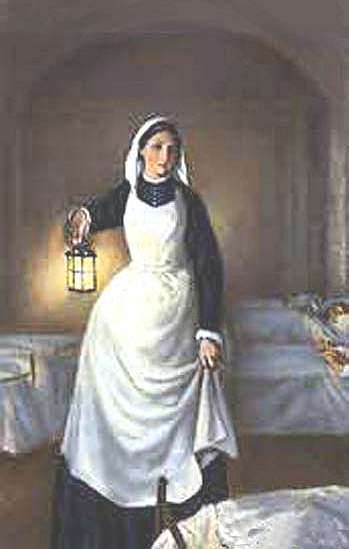
The London Times reported: “When all the medical officers have retired for the night and silence and darkness have settled down upon those miles of of prostrate sick, she may be observed alone, with a little lamp in her hand, making her solitary rounds” (Deen, 217).

The Lady with the Lamp was her affectionate nickname from the soldiers who watched for her light and some would even kiss her shadow as she passed.

She was forced to return to England after she came down with hospital fever. She served in Crimea for two years. After her return to England she revolutionized the nursing profession with her Notes on Nursing, which became a classic guide. She was given 250,000 pounds, which she used to “found the Nightingale Home for Nurses at St. Thomas’s Hospital” (Deen, 217).

I’ve watched my own call grow and develop over the years taking me places I never thought I’d go either. I will never have the influence of Florence or make any groundbreaking work and revolutionize a vocation the way she did. But my sister still holds her light and beckons me on. And I still follow.

May 18 is Florence Nightingale’s feast day in The Episcopal Church and Anglican Communion. Here is the prayer for that day.

Life-giving God, who alone have power over life and death, over health and sickness: Give power, wisdom, and gentleness to those who follow the example of your servant Florence Nightingale, that they, bearing with them your Presence, may not only heal but pain and fear; through Jesus Christ, the healer of body and of soul, who lives and reigns with you and the Holy Spirit, one God, for ever and ever. Amen.

Sources:

Great Women of the Christian Faith by Edith Deen, (Uhrichsville, OH: Barbour and Company, Inc. 1959).

“Florence Nightingale: Nurse, Renewer of Society” by James Kiefer.

A Good Friday Reflection from Cynthia Bourgeault

All four gospels insist that when all the other disciples are fleeing, Mary Magdalene stands firm. She does not run; she does not betray or lie about her commitment; she witnesses. Hers is clearly a demonstration of either the deepest human love or the highest spiritual understanding of what Jesus was teaching, perhaps both. But why, one wonders, do the Holy Week liturgies tell and re-tell the story of Peter’s threefold denial of Jesus, while the steady, unwavering witness of Magdalene is not even noticed? How would our understanding of the Paschal Mystery change if even that one sentence that I finally heard at Vézelay [“Mary Magdalene and the other Mary were there, sitting opposite the tomb” (Matthew 27:61, DFV).] was routinely included in the Good Friday and Palm Sunday Passion narratives? What if, instead of emphasizing that Jesus died alone and rejected, we reinforced that one stood by him and did not leave?—for surely this other story is as deeply and truly there in the scripture as is the first. How would this change the emotional timbre of the day? How would it affect our feelings about ourselves? About the place of women in the church? About the nature of redemptive love?

From The Meaning of Mary Magdalene: Discovering the Woman at the Heart of Christianity, Kindle edition, location 367.

Sermon: The God of the Dead

The God of the Dead
The Fifth Sunday in Lent, Year A
Ezekiel 37:1-14; John 11:1-42

The rocking chair was old, but it had been well made, and it’s structure was solid. It had been handmade, and made well. Unfortunately subsequent owners didn’t know what to do with wood. The layers upon layers of paint testified to that. Why did people paint over perfectly good wood? Hadn’t they any sense? It was her summer project. She set it out on her screened in back porch. It was going to take a lot of paint remover to get the layers upon layers of paint off, and she’d need plenty of ventilation. She was also going to need plenty of Q-tips to get the paint out of the grooves, the ridges, and the hand chiseled design on the back. But that was okay. She was a patient woman, and she had the perfect place in her living room for the rocking chair. Day after day she smoothed the paint remover on and wiped it off, humming quietly to herself. She patiently removed the paint in the grooves, ridges and carvings with Q-tips. The wood–the real wood–was beginning to show through. It was a beautiful mahogany, it’s red undertones still vibrant. Who in their right mind would paint over this? she continually thought. Finally, it was done. All the paint was off. The wood was dull and looked lifeless, but not for long. She carefully sanded it. She had to go to three different hardware stores, but she finally found varnish that matched the tone of the wood perfectly. She put on two coats of varnish, letting it dry in between. Then she waxed it to a shine. It looked new. It was no longer the old beat-up, glumly painted rocker that she had nearly stolen for $15 at a garage sale. It looked liked the handcrafted antique that it was. No telling, what she could get for it if she wanted to sell it. But that she wouldn’t do. She was now going to enjoy the fruits of her labor. She picked up the rocking chair, eased it through the back door and placed it in the living room next to her big picture window. It would be a wonderful place to read, to crochet, or just to watch TV in the evening. Everyone who came over oohed and ahhed over it. Including the woman she bought it from. The woman she bought it from never believed that the red mahogany rocker was the same battered up rocker she had just wanted to get rid of.

Some people have the ability to see something beyond what it is to what it could be. There are also people who have the ability to see beyond what a person is to what he or she could be. Jesus was one of these people. He saw beyond tax collectors, sinners, and prostitutes to people God loved and God could transform. He saw beyond reputations–good in Nicodemus’ case, not-so-good in the Samaritan woman’s case–to the heart and offered to them what they really needed. Like God, Jesus never gave up on anyone: even the dead.

But let’s begin with God who didn’t give up on Israel, even after their idolatry and trampling on each other put them into slavery. In fact, the people thought they were dead and in their graves. But God doesn’t give up on them. At the beginning of Ezekiel’s ministry God called him to call the people to repentance, so that they would not go into exile. But the people did not listen and Jerusalem and the temple were destroyed. In the second half of his ministry, God called Ezekiel to reassure the people that God was still their God and still with them. Our passage today is one of the strongest statements God makes to the Jews in exile, and one of the most mind blowing promises in Scripture.

In a vision Ezekiel sees a field of dried, strewn out bones. It looks as if they died in battle, no one buried them. This was an ancient way of making sure people didn’t move onto the next world after death. This is how the Jews saw themselves. They were in captivity, and their land was gone. They had no hope. But God gives Ezekiel a vision, an incredible vision. These bones that have been lying in this valley for so long they are now dried up are commanded to life. And God doesn’t just do it. God tells Ezekiel to prophesy and tell these bones to come together, for flesh to form and muscles to develop. God worked through the prophet God had called instead of just doing it. When God renews life, restores life, resurrects life, God wants to work with us.

After the bones have bodies, they are still not living. So God commands Ezekiel to command the wind–God’s Spirit–to come and breathe life into the bodies. This would remind Ezekiel’s audience of the creation story in Genesis when God made the human out of clay and breathed life into the body. Now through a prophet’s word God’s Spirit comes and breathes life into the bodies that have raised from “dem dry bones.” Then Ezekiel is to tell the exiles just as God raised a living army from these dry bones, so God will restore the people to their land. They will once again be a nation, in their land. They are not without hope. They are not dead in their graves. God still loves them and restores them to their original covenant with God.

Whereas God restored and resurrected a nation that had been destroyed, in our New Testament reading, Jesus will resurrect a friend and restore him to his family. John tells us that Jesus loves Martha, Mary, and Lazarus. They have a close friendship. So it is surprising when Jesus does not go when Martha and Mary send news that Lazarus is sick. Jesus waits two days and then travels to Bethany. When he gets there, Lazarus has been dead and buried for four days. Martha meets Jesus before he gets to the house and tells him that she knows her brother would not have died if Jesus had been there. She goes on to tell Jesus that even now she knows God will grant whatever Jesus asks. Martha and Jesus go on to have this conversation:

Jesus said to her, “Your brother will rise again.” Martha said to him, “I know that he will rise again in the resurrection on the last day.”

Jesus said to her, “I am the resurrection and the life. Those who believe in me, even though they die, will live and everyone who lives and believes in me will never die. Do you believe this?”

She said to him, “Yes, Lord, I believe that you are the Messiah, the Son of God, the one coming into the world.”

Whereas Peter has the ultimate confession of Jesus being the Messiah in the other three Gospels, in John, it is Martha who gives the ultimate confession of faith. She is the one who proclaims Jesus to be the Messiah, the Son that God has sent into the world. She also makes this confession before Jesus raises Lazarus. In John this is the faith that is true, the faith that Jesus is looking for. Faith that believes that Jesus is the Son of God apart from the miracles and signs.

After this Martha goes to Mary and tells her that Jesus wants to see her. Mary goes to Jesus and tells him the same thing Martha said: Lazarus would not be dead if Jesus had been there to heal him. Then they go to the tomb. At the tomb Jesus is greatly troubled and angry. He is angry because God hates the things that destroy us. Jesus came to make sure that sin and death no longer had the last word. In fact, this is the last event in his public ministry. After this Jesus prepares for his “hour,” his death, and tries to prepare the disciples as well. Jesus decides that death will not have the last word with Lazarus and his sisters. Jesus orders the stone to be removed from the front of the tomb. The always practical Martha reminds Jesus that Lazarus has been in the grave for four days–there will be a stench. Jesus reminds her of what he told her when she met him on the road to her house. If she believes she will see the glory of God.

The stone is removed, and Jesus calls out “Lazarus, come forth!” Do you ever wonder how many people in the crowd fainted when Lazarus actually stumbled out of the tomb? Once again God’s people are told to help: they unbind Lazarus from the burial clothes he is wrapped in.

In both stories something or someone is given new life: Israel in Ezekiel and Lazarus in John. In both stories we see that God does not like the things that destroy God’s people: sin, death, and destruction. We also see that God chooses to work through God’s people: through Ezekiel, through those who rolled back the stone, and through those that removed Lazarus’ bindings. God also uses us to restore and bring new life into our worlds. These stories remind us that God has never stopped creating and re-creating. God still restores and gives new life. These stories tell us that God alone is life, and that God hates death and destruction. And God uses God’s people, God uses us, to continue to re-create, restore, and give new life to the world God created. Earlier in John Jesus said that God never stops working. God never stops working in the world, and God never stops working in us and through us to make us the people God wants us to be and to continue building God’s kingdom in this world.
We have a winner!

Congratulations to Susan Curry for winning the $25 Amazon.com gift card! Thank you to all of you who bought my book this last month. I really appreciate it. I’d love to know what you think about it, and if you feel so inclined please leave a review on Amazon. I would also like to put a plug in for Susan. Susan is an interior designer, and we hired her a couple of years ago to re-do our living room. She did a fabulous job, and we found my favorite chair in the world with her. This is the chair I sit in in the morning with my coffee watching the Lake. If you’re in the Chicagoland area and looking for an interior designer, please give Susan a call at (312)  470-7893.

Spend Lent with the Women of the Bible

W&S Cover 2Today is my birthday! Today is the last day to enter to win a $25 Amazon.com gift card! You have until 5:00 p.m. CDT today to buy my book and email me (shawna@shawnaatteberry.com) your order number to get your name in the drawing. Good luck!

Is one of your Lenten goals to spend more time studying the Bible? Have no idea where you’re going to start? Why not spend Lent with some incredible biblical women? What You Didn’t Learn in Sunday School: Women Who Didn’t Shut Up & Sit Down is a 9 week Bible study that will introduce you to women like:

  • The five daughters of Zelophehad who stood up to Moses when they thought the Law was unfair, and God said they were right.
  • The Wise Woman of Abel who saved her town from a besieging army.
  • The woman who would not take no for an answer, even when the no came from Jesus.

Get reacquainted with women, whose whole stories you may not of heard:

  • Deborah the judge and military leader, who led Israel’s armies into battle.
  • Career-woman Priscilla who was a tent-maker missionary and teacher with her husband.
  • Phoebe, a pastor and patron in the New Testament church, whom Paul entrusted to deliver his letter to the churches in Rome.

Women both now and in the Bible wore multiple hats and had many different roles to balance. Having complicated lives is nothing new! This Lent listen to these women’s stories of how they found and obeyed God in the midst of very complicated circumstances in very complex lives. What You Didn’t Learn in Sunday School can be used for individual and group Bible studies as well for your devotions. This book will guide you through a self-directed Bible study of each woman, and at the end you will find suggestions and resources for continuing to study the women of the Bible. It is available in paperback and Kindle versions.

If you order What You Didn’t Learn in Sunday School between now and my birthday, March 26, your name will be entered in a drawing for a $25 Amazon.com gift card. Email me (shawna@shawnaatteberry.com) your order number from Wipf & Stock Publishers or Amazon.com, and I will put your name in the hat. I will announce the winner on my birthday.

If you live in the Chicagoland area and would like me to speak at your church, Bible Study, or schedule a book signing, please Email me.

Lydia: Buisness Woman and Home Church Pastor

Every Lent I take part in Lent Madness. Instead of picking basketball teams to win a championship, we pit saints against each other to see who will win The Golden Halo. Today’s match-up includes one of my favorite women in the Bible: Lydia.

We set sail from Troas and took a straight course to Samothrace, the following day to Neapolis, and from there to Philippi, which is a leading city of the district of Macedonia and a Roman colony. We remained in this city for some days. On the sabbath day we went outside the gate by the river, where we supposed there was a place of prayer; and we sat down and spoke to the women who had gathered there. A certain woman named Lydia, a worshipper of God, was listening to us; she was from the city of Thyatira and a dealer in purple cloth. [God] opened her heart to listen eagerly to what was said by Paul. When she and her household were baptized, she urged us, saying, ‘If you have judged me to be faithful to [God], come and stay at my home.’ And she prevailed upon us (Acts 16:11-15, NRSV).

Lydia is a biblical woman you probably didn’t learn about in Sunday School. Lydia does not fit the “traditional Biblical woman” model that some claim a woman should be: married, at home with children, and submissive. Lydia was not married. She didn’t have kids. She was a business woman who had her own household which she managed and ran. She was the perfect person for God to lead Paul to for the start of the Christian mission in Europe.

When Paul and his traveling companions arrived in Philippi, there was no synagogue for them to attend for worship. They decided to go to the river on the Sabbath where there was a place of prayer. Lydia was at the river. She was “a worshiper of God,” and listened to Paul’s teachings. In fact, we are told God “opened her heart to listen eagerly to what was said by Paul.” In the next verse she and her household were baptized, and she urged Paul and his travelers to stay in her home. Lydia was the first convert to Christianity in Europe.

Lydia was a businesswoman, “a dealer of purple cloth” from Thyatira. Purple dye was a symbol of power and honor in the ancient world, and it was the most expensive and sought after dye in the Roman world. Thyatira was the capitol of the industry and renowned for its purple dyes. One had to have plenty of capital to deal in purple dye and the making of purple garments for sale. Lydia was a career woman, rich, and the head of her household. She was also quick to show hospitality to Paul and his companions by inviting them into her home. By the end of Acts 16 a new church was meeting in Lydia’s home. In most New Testament home churches, the head of the household was the leader of the people who gathered under their roof for worship. This could mean that Lydia was the overseer or pastor of the first church plant in Europe. With her connections from her business in purple cloth, she probably carried a great deal of influence with those in the upper echelons of society, and could champion the Christian cause to them. She probably traveled quite a bit, which meant she could be a missionary in her travels as Paul was. God knew what she was doing when she led Paul to this hospitable, influential woman to further the cause of Christ in Europe and throughout the Roman Empire.

This month for my birthday I am going to give away a $25 Amazon.com gift card to a lucky person who buys my book, What You Didn’t Learn in Sunday School by March 26 (my birthday!). Lydia isn’t the only woman who doesn’t fit the cookie cutter image of a “biblical woman” you probably didn’t learn about in Sunday School. There were the five sisters who stood up to Moses, the wise woman who saved her city from a besieging army, and the woman who didn’t take no for an answer–even from Jesus! Spend Lent (or Women’s History Month) getting to know your incredible foremothers of the faith. You can order What You Didn’t Learn in Sunday School: Women Who Didn’t Shut Up & Sit Down from Wipf and Stock publishers or Amazon.com. After you’ve ordered email me (shawna@shawnaatteberry.com) your order number, and I’ll put your name in the hat for the gift card. The lucky winner will be announced on March 26.

And join in the Lent Madness! It’s not too late to start learning about both our mothers and fathers in the faith, vote them to The Golden Halo and get to know some incredible people along the way. Read the comments! There is always a great discussion going on about the voting for that day.

My interview with the NotMom Blog

My profile at the TheNotMom.com Blog has been posted. You can read about my thoughts on being a NotMom, my chosen family, and why women without children weren’t that big of a deal for Jesus or the early church here. Please leave comments and show the other NotMoms some love.

I’m very thankful for my many chosen families, and all of the love and new roles they’ve brought into my life. In today’s world where we often don’t live near our birth families, and move so much more than we used to, I think it’s very important to have a chosen family close to you. I also think it’s important for theological reasons: Jesus said that anyone who obeyed God was his mother, brother, and sister (Matthew 12:50; Mark 3:35), so for me, my church is my family.

Jesus broadened the definition of family to include those who obeyed God. In fact, he ignored his biological family for his chosen family, which is why the American church’s idolatrous view of the biological family makes me angry. For Jesus, the chosen family that obeyed God was the most important family, not the one you are born into.

Huldah: Authenticating the Word of God

How did she feel as she held the scroll in her hand?

What did she think of the high priest and these other men from the temple who wanted to know if these words were true?

Did Huldah have any idea what she started when she proclaimed that the scroll she held was the word of God? Did she know one day centuries later her proclamation would end in a canon of Scripture?

Did you know that it was a woman who first declared that a piece of writing was the word of God? Did you know it was a woman who started us on our way to having written Scripture?

Huldah is one of the incredible women in the Bible you will get to know in What You Didn’t Learn in Sunday School: Women Who Didn’t Shut Up & Sit Down. You will learn she was a prophet living in Jerusalem. She was respected enough that the king of Judah sent the high priest of the Temple to get advice from her. Did you learn about this incredible woman in Sunday School? Or Bible study? Have you ever heard a sermon about her?

It’s time to bring Huldah out from the shadows along with equally incredible women who populate the pages of our Bible. What You Didn’t Learn in Sunday School is a nine week Bible study that will introduce you to women who didn’t take no for an answer, even from Jesus. From now until March 26 (my birthday!) when you buy What You Didn’t Learn in Sunday School, your name will be entered into a drawing to win a $25 Amazon.com gift card. After purchasing your book at Wifp & Stock Publishers or on Amazon.com, email me (shawna@shawnaatteberry.com) your order number, and I will throw your name into the hat. The winner will be drawn on March 26. Travel with some extraordinary women through Lent, and find out the powerful and amazing ways God can change the world through a woman just like Huldah, a woman just like you.

Proudly Childfree referenced on PsychologyToday.com

In her article Childfree Adults: Selfish or Selfless, Dr. Ellen Walker references my post Proudly Childfree and Not Apologizing For It in her response to Ross Douthat’s op-ed on the selfishness of childfree people. In response to Douthat’s opinion that childfee people don’t want to commit, she point’s out that parents do not always make commitments themselves:

Douthat implies that childfree adults are unable to commit, or that parents are somehow unique in their ability to do so. As a psychologist, I meet parents on a daily basis who have as many as five or six children, and who – sadly – feel no obligation to provide financially or emotionally for their offspring. This is surprisingly true of both dads and moms and blows the theory that parents will instinctively prioritize protecting and caring for their offspring.

Read the rest of her article for a much more nuanced look at the choice to have children or not from a psychological framework. Dr. Walker has written the book, Complete Without Kids: An Insider’s Guide to Childfree Living By Choice Or By Chance.

Thank you for the shout out Dr. Walker!